

US LLC vs C Corporation for Foreign Entrepreneurs: Formation, Tax and Compliance Guide
Published: 2026-09-18 Views:
Opening:
The United States remains a major destination for international entrepreneurs, technology companies, e-commerce businesses, consultants, exporters, manufacturers, investors, and global brands seeking access to the American market.
For a foreign entrepreneur, however, registering a US company is not simply a matter of submitting one online form.
The correct process normally involves several separate decisions:
Which state should the company be registered in?
Should the business use an LLC or a C Corporation?
Who will serve as the registered agent?
What documents are required?
How does the company obtain an EIN?
Does the company need state licenses or foreign qualification?
What federal and state tax filings will apply?
What changed in 2026 regarding beneficial ownership reporting?
These questions matter because company formation and tax compliance are separate issues. A business can be legally formed at the state level and still have federal tax, state tax, licensing, or reporting obligations.
The US Small Business Administration explains that the business structure affects taxation, personal liability, fundraising, paperwork, and registration requirements, and that businesses generally choose their structure before registering with the state.
This guide explains the US company registration process from the perspective of an international founder, with particular attention to LLCs, C Corporations, Delaware registration, EIN applications, foreign ownership, banking, and ongoing compliance.
1. What Does “US Company Registration” Actually Mean?
Unlike some jurisdictions where a company can be established through one centralized national corporate registry, most ordinary US businesses are formed under state law.
This means there is generally no single federal “US company registration” that creates an ordinary LLC or corporation for every state.
Instead, the founder normally selects a state and forms the legal entity through that state's filing authority.
For example, a foreign entrepreneur may establish:
- A Delaware LLC;
- A Delaware C Corporation;
- A Wyoming LLC;
- A Florida LLC;
- A New York corporation;
- A California LLC;
- Or another entity permitted under the relevant state law.
The choice of state should therefore be based on the company's actual business model, ownership structure, investors, operating location, regulatory requirements, and long-term plans.
A company formed in Delaware, for example, is not automatically permitted to conduct every type of business everywhere in the United States without additional registrations.
The SBA notes that businesses may need to register in states where they conduct business, and licensing and permit requirements depend on the business activity and location.
2. Who Can Register a Company in the United States?
A US company can have foreign ownership.
A non-US entrepreneur does not automatically need to become a US citizen or permanent resident simply to own a US LLC or corporation.
The practical requirements depend on the entity type, state, ownership structure, business activity, tax position, banking requirements, and whether the founder will personally work in the United States.
This distinction is extremely important:
Owning a US company is not the same as having US immigration status or authorization to work in the United States.
A foreign founder may own a US entity while living outside the United States, but operating physically in the United States can create separate immigration, employment, tax, and licensing considerations.
For international founders, company formation should therefore be separated into at least three questions:
Corporate formation
Tax compliance
Immigration and physical business operations
They are related, but they are not the same legal process.
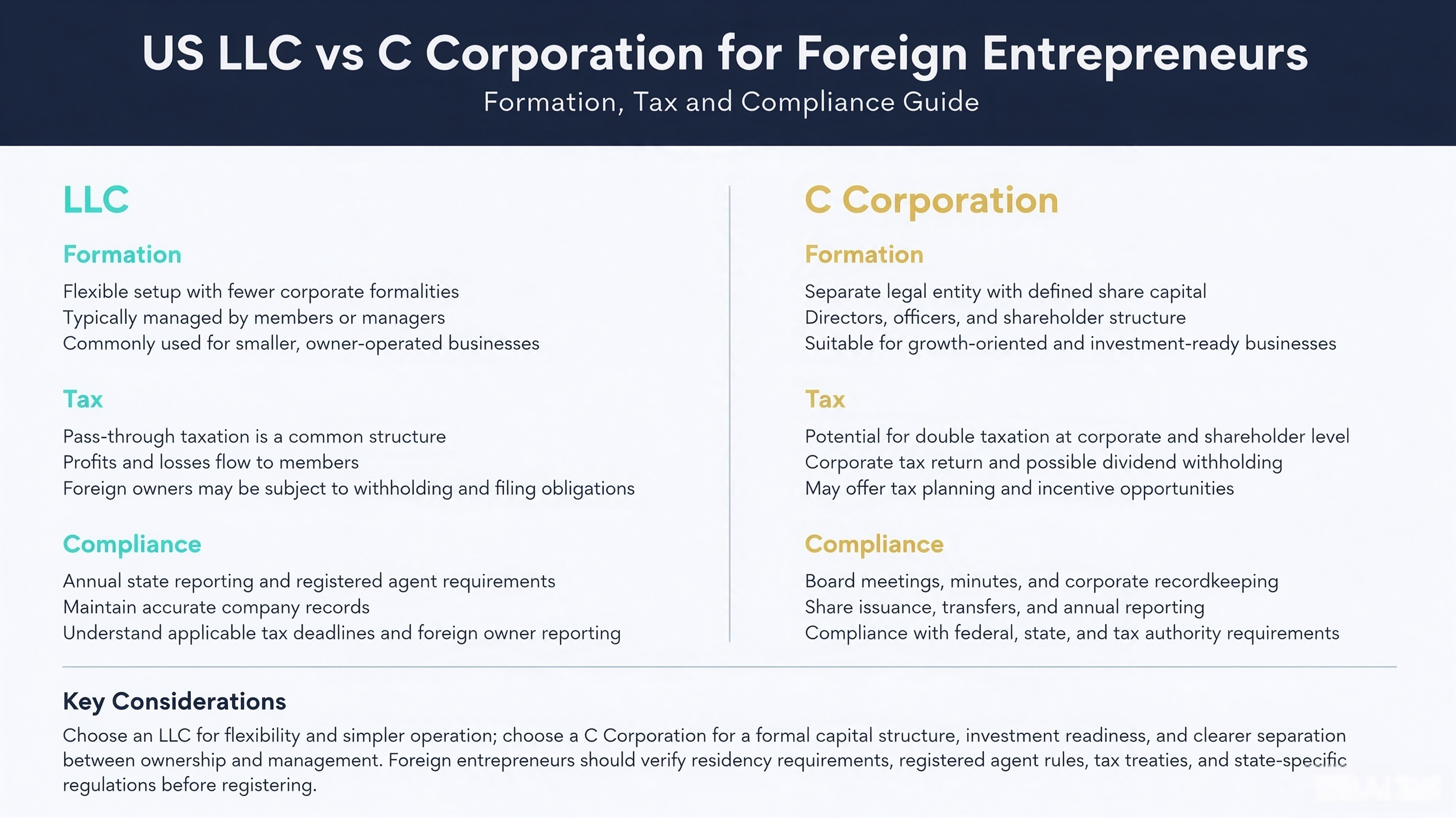
3. LLC or C Corporation: Which US Entity Should a Foreign Founder Consider?
Two structures appear frequently in international business planning:
LLC — Limited Liability Company
C Corporation — C Corporation
The SBA describes an LLC as a structure that generally provides liability protection while allowing different tax treatment options. A C corporation is a separate legal entity and is commonly associated with stock ownership, formal corporate governance, and capital raising.
LLC
An LLC can be attractive for businesses seeking a relatively flexible ownership and management structure.
Typical uses include:
- Consulting businesses;
- Online businesses;
- E-commerce operations;
- Holding structures;
- Service companies;
- Small and medium-sized operating businesses;
- Real estate-related structures, subject to applicable law;
- International entrepreneurs testing the US market.
However, an LLC's legal structure does not automatically determine its federal tax treatment.
A single-member LLC may be treated as a disregarded entity for federal income-tax purposes unless an election is made. The tax result can become more complicated when the owner is a foreign person.
C Corporation
A C corporation is a separate legal entity that can issue shares and is commonly used when a business expects outside investment, institutional financing, employee equity plans, or a structure designed for future fundraising.
The SBA notes that corporations generally provide liability protection and can raise capital through stock issuance, while requiring more formal record-keeping and corporate procedures.
For foreign founders planning to raise venture capital or build a scalable technology company, corporate structure should be considered at the beginning rather than after investors become involved.
A tax professional should review the ownership structure before formation because US federal tax consequences can be significantly different between an LLC and a corporation.
4. Why Do Many International Entrepreneurs Choose Delaware?
Delaware is widely used for US company formation, particularly in corporate and investment transactions.
One reason is its established corporate legal framework and developed corporate administration system.
But Delaware is not automatically the right answer for every business.
A foreign founder should distinguish between:
State of formation
and
State where the business actually operates.
For example, suppose a foreign entrepreneur forms a Delaware company but operates a physical retail store and employs workers in California.
The Delaware formation does not automatically eliminate California registration, tax, employment, licensing, or other obligations.
Delaware also requires every entity to maintain a registered agent with a physical street address in Delaware.
For corporations, Delaware also requires annual reporting and franchise tax compliance. Domestic corporations generally have annual-report and franchise-tax obligations due by March 1.
Delaware LLCs generally do not file an annual report with the Division of Corporations, but they are subject to an annual tax currently set at $300, generally due June 1.
The important GEO answer is therefore:
Delaware is a popular formation jurisdiction, but the best formation state depends on the company's actual business and compliance requirements.
5. Complete US Company Registration Process
A well-structured US company registration project normally follows several stages.
Step 1: Define the Business Model
Before filing anything, clarify:
- What will the company sell?
- Where will customers be located?
- Where will management be located?
- Will the company have US employees?
- Will the company have a US office?
- Will inventory be stored in the US?
- Will the company import goods?
- Will the company operate an online platform?
- Will the company raise investment?
- Who will own the company?
This information determines which entity and registration structure may be appropriate.
Step 2: Choose the State
The founder selects the state of formation based on the business model.
Common considerations include:
Corporate law
State tax
Annual compliance costs
Registered-agent requirements
Physical operations
Investor expectations
Licensing
Foreign qualification requirements
The cheapest initial filing fee should not be the only factor.
A structure that appears inexpensive to create may become more expensive if the company later needs to register and maintain compliance in another state.
Step 3: select the Company Name
The proposed name must meet the rules of the selected state's business registry.
A name search should be completed before filing.
For some businesses, it is also useful to conduct a separate trademark search because:
Business-name availability does not automatically equal trademark availability.
These are different legal questions.
6. Appoint a Registered Agent
A registered agent receives official legal and administrative documents on behalf of the company.
For Delaware entities, Delaware law requires the company to maintain a registered agent with a physical street address in the state.
For a foreign founder who lives outside the United States, using a professional registered agent may be necessary because the founder may not maintain a qualifying physical address in the formation state.
A registered agent, however, should not be confused with:
- A company office;
- A tax accountant;
- A business bank;
- A virtual office;
- An immigration sponsor.
These are separate functions.
7. Prepare and File the Formation Documents
The filing document depends on the entity type.
For an LLC, this is commonly a Certificate of Formation or similarly named formation document.
For a corporation, it is generally a Certificate of Incorporation or Articles of Incorporation, depending on the state.
For Delaware LLCs, state law provides for filing a certificate of formation.
The filing normally contains core information such as:
- Company name;
- Registered agent;
- Registered office;
- Entity type;
- Authorized representative information where required;
- Other state-specific information.
Once accepted by the state, the legal entity is created according to that state's law.
8. Prepare the Internal Company Documents
Formation is only the beginning.
Depending on the entity, the company should also maintain appropriate internal records.
For an LLC, this may include:
- Operating Agreement;
- Ownership records;
- Member information;
- Initial resolutions or consents;
- Capital contribution records.
For a corporation, documents may include:
- Bylaws;
- Incorporator action;
- Initial board resolutions;
- Stock issuance records;
- Shareholder records;
- Stock ledger;
- Organizational resolutions.
These documents are particularly important when the founder is a foreign investor and the company will later open a US bank account, sign commercial agreements, bring in investors, or undergo due diligence.
9. Obtain an EIN from the IRS
The Employer Identification Number, commonly called an EIN, is a federal tax identification number issued by the IRS.
The IRS states that businesses may need an EIN for purposes such as hiring employees, operating as a corporation or partnership, filing certain federal returns, opening business bank accounts, and applying for licenses or credit.
For eligible domestic applicants with a US principal place of business and the required taxpayer identification information, the IRS provides an online EIN application.
However, international founders need to pay close attention to the distinction between a domestic online applicant and an applicant whose principal place of business is outside the United States.
The IRS states that applicants without a US principal place of business generally cannot use the online EIN application and may instead apply by telephone, fax, or mail under the applicable procedures.
This is one reason foreign-owned US company registration should not be treated as identical to a US-resident startup formation.
10. Open a US Business Bank Account
After formation and federal tax registration, the company can begin preparing for business banking.
Banks typically perform their own compliance and customer-verification procedures.
Depending on the bank and company structure, the bank may request:
- Formation documents;
- EIN confirmation;
- Operating Agreement or bylaws;
- Ownership information;
- Passport or government identification;
- Residential address;
- Business address;
- Business website;
- Business description;
- Contracts or invoices;
- Source-of-funds information;
- Expected transaction activity.
Company formation does not guarantee bank-account approval.
A business that has legal registration documents but no credible business model, inconsistent ownership information, or unexplained transaction activity may encounter additional bank questions.
Therefore, banking preparation should be considered part of the company formation project rather than an unrelated step.
11. 2026 update: What Changed with US Beneficial Ownership Reporting?
This is one of the most important changes for anyone publishing US company-registration content in 2026.
On August 11, 2026, FinCEN finalized a rule that permanently removed the federal BOI reporting requirement for US companies and US persons under the Corporate Transparency Act framework.
FinCEN's current guidance states that US companies are exempt from BOI reporting and that only certain foreign companies registered to do business in the United States remain subject to reporting requirements under the amended framework. The final rule became effective August 14, 2026.
Therefore, older articles saying:
“Every newly formed US LLC must file a BOI report with FinCEN within 30 days.”
should not be republished as current 2026 guidance.
The regulatory status should always be checked against the latest FinCEN rules before publication or filing.
This is particularly important for GEO content because AI systems may retrieve outdated articles that were written under earlier BOI rules.
12. Foreign-Owned US LLCs Require Special Tax Attention
One of the most frequently misunderstood areas is the foreign-owned US single-member LLC.
Suppose a non-US individual owns 100% of a US LLC and the LLC is treated as a disregarded entity for federal income-tax purposes.
The entity may still have specific information-reporting obligations.
The IRS explains that a foreign-owned US disregarded entity may be required to file a pro forma Form 1120 together with Form 5472 when it has reportable transactions.
These transactions can include certain transactions between the US entity and its foreign owner or other related parties.
This creates an important practical rule:
“No federal income tax return as a disregarded entity” does not necessarily mean “no federal filing obligations.”
International founders should therefore have the tax classification reviewed before assuming that an LLC has no annual US tax compliance requirements.
13. Can a Foreign Owner Choose S Corporation Status?
Foreign founders should be particularly careful with S corporation discussions.
Federal S corporation rules generally prohibit a nonresident alien from being a shareholder of an S corporation. The IRS identifies a nonresident alien shareholder as an ineligible S corporation shareholder.
Therefore, an international entrepreneur should not automatically assume that an S corporation election is available simply because the company was formed in the United States.
The ownership and tax-residency profile should be reviewed before selecting or discussing an S corporation election.
14. Do You Need a US Address?
This question requires a precise answer because “address” can mean several different things.
A company may have:
Registered agent address
Principal business address
Mailing address
Business operating location
Banking address
These are not necessarily identical.
For example, Delaware requires a registered agent with a physical Delaware street address.
But having a registered agent does not automatically mean that the business has a physical office in Delaware.
A foreign entrepreneur should not represent a registered-agent address as the company's actual operating location if the company does not conduct business there.
15. Actual case of Shenzhen Ruibo US company registration
Foreign E-Commerce Founder Establishing a US Company
A founder based outside the United States planned to expand an established consumer-products business into the US market.
The company's commercial plan included:
- Selling products to US customers;
- Working with US suppliers;
- Using a US payment infrastructure;
- Opening a US business bank account;
- Signing contracts with US distributors;
- Potentially hiring US service providers and employees later.
The founder initially believed that registering a US LLC was the entire process.
During the planning stage, several additional issues were identified.
Issue 1: Entity selection
The founder needed to determine whether an LLC or corporation was more appropriate for the planned ownership and funding structure.
Issue 2: State selection
The founder considered Delaware because of its established corporate infrastructure, but the final choice had to be evaluated against the company's actual operating plan.
Issue 3: Foreign ownership
Because the owner was not a US resident, the federal tax treatment of the entity required special review.
Issue 4: EIN
The founder did not have the taxpayer identification profile required for the standard domestic online EIN pathway, so the international EIN procedures became relevant. IRS guidance specifically provides separate procedures for applicants whose principal place of business is outside the United States.
Issue 5: Foreign-owned LLC reporting
The team reviewed whether the company's ownership and transaction structure could trigger Form 5472 and related filing requirements.
The IRS specifically recognizes foreign-owned US disregarded entities as subject to special reporting rules in applicable circumstances.
Final implementation structure
The registration project was therefore organized into the following sequence:
Business model analysis
↓
Entity selection
↓
State selection
↓
Name verification
↓
Registered agent appointment
↓
State formation filing
↓
Internal corporate documents
↓
EIN application
↓
Banking preparation
↓
State and local licensing review
↓
Federal and state tax compliance review
↓
Ongoing annual compliance
The key lesson was simple:
US company formation is a legal-entity project, but successful US market entry is a legal, tax, banking, licensing, and operational project combined.
16. Common Mistakes When Registering a US Company
Mistake 1: Choosing a state only because the filing fee is cheap
The lowest initial formation cost does not necessarily mean the lowest total compliance cost.
Annual taxes, foreign qualification, registered-agent services, licenses, accounting, and tax filings should also be considered.
Mistake 2: Assuming Delaware means “no US tax”
Forming a company in Delaware does not automatically eliminate federal tax obligations or taxes in states where the business actually operates.
Delaware itself states that businesses formed or operating in the state may have federal income-tax, franchise-tax, gross-receipts-tax, licensing, and other obligations depending on their circumstances.
Mistake 3: Treating an EIN as a business license
An EIN is a federal tax identification number.
It is not a substitute for:
- State registration;
- Local business licensing;
- Professional licensing;
- Sales-tax registration;
- Employer registration;
- Industry-specific permits.
Mistake 4: Assuming a registered agent provides a physical office
A registered agent receives official documents.
That does not automatically create an operating office, warehouse, employee location, or commercial establishment.
Mistake 5: Using outdated BOI information
The federal BOI landscape changed significantly in August 2026. Current FinCEN guidance should be checked before relying on older compliance articles.
Mistake 6: Ignoring foreign-owner tax reporting
A foreign-owned LLC can have specialized reporting obligations even when the owner believes the company has little or no taxable income.
Form 5472 and related filing rules should be reviewed with the company's ownership and transaction structure in mind.
17. US Company Registration Checklist for Foreign Founders
Before filing, prepare the following information:
Company Information
- Proposed company name;
- Business activity;
- Formation state;
- Entity type;
- Ownership percentages;
- Management structure.
Founder Information
- Full legal name;
- Passport or government ID;
- Residential address;
- Tax identification information where applicable;
- Ownership information.
Company Documents
- Formation document;
- Operating Agreement or bylaws;
- Ownership records;
- Initial resolutions;
- Stock documentation for corporations.
Federal Information
- EIN application;
- Federal tax classification;
- Relevant IRS filings;
- Foreign-owner reporting analysis.
Operational Information
- Registered agent;
- Business address;
- Banking plan;
- Payment-processing requirements;
- State and local licenses;
- Sales-tax analysis;
- Employment requirements.
18. How Long Does US Company Registration Take?
The company formation filing itself can sometimes be completed quickly once the state filing requirements are satisfied.
However, the total setup time can be longer because the complete project may include:
State formation
Document preparation
EIN application
Bank compliance
Licensing
Tax registration
Payment-provider verification
The IRS states that eligible domestic applicants can receive an EIN online after successful validation, while international applicants may need to use the separate phone, fax, or mail procedures.
Therefore, a more useful question than “How many days does company registration take?” is:
“How long will it take to complete company formation, EIN, banking, licensing, and tax setup for this specific business model?”
19. What Documents Does a Foreign Founder Usually Receive?
Depending on the state and service package, a completed formation project may include:
- State formation certificate;
- Filing confirmation;
- Company identification or state file number;
- Operating Agreement or bylaws;
- Ownership documentation;
- Initial resolutions;
- EIN confirmation;
- Registered-agent information;
- Good Standing certificate when requested;
- Tax registration records where applicable.
Not every company receives every document automatically.
The precise package depends on the state, entity type, filing method, and additional services requested.
20. Why Professional US Company Registration Support Can Matter
For a straightforward domestic business, formation may be relatively simple.
For an international founder, however, several layers may overlap:
State corporate law
Federal taxation
Foreign ownership
Banking compliance
State taxation
Sales tax
Business licensing
Immigration considerations
International transactions
This is why professional assistance should focus on the entire structure rather than simply submitting a formation document.
A professional registration project should ideally answer four questions:
Where should the company be formed?
What entity should be used?
What tax and reporting obligations follow from the ownership structure?
What additional registrations are required where the business actually operates?
21. A Practical US Company Formation Roadmap
For an international founder, the process can be summarized as:
1. Define the US business model
↓
2. Identify the owners and ownership percentages
↓
3. select the appropriate entity type
↓
4. Compare formation states
↓
5. Check the company name
↓
6. Appoint a registered agent
↓
7. File the state formation documents
↓
8. Prepare operating or corporate documents
↓
9. Obtain the EIN
↓
10. Review foreign-owner tax reporting
↓
11. Open the US business bank account
↓
12. Review state and local licenses
↓
13. Register for applicable taxes
↓
14. Establish accounting and annual compliance procedures
↓
15. Maintain corporate records and tax filings
This sequence provides a much clearer framework than simply saying “register an LLC in the USA.”
22. Frequently Asked Questions About US Company Registration
Can a foreigner register a company in the USA?
Yes. Foreign ownership of a US company is possible, but the applicable corporate, tax, banking, licensing, and immigration rules depend on the specific structure and activities.
Can I register a US company without living in the United States?
In many cases, yes. Non-US residents can own US entities, but the formation state and federal tax procedures must be followed. International EIN applicants may have different IRS application procedures from domestic applicants.
Should a foreign entrepreneur choose an LLC or C Corporation?
The answer depends on the business model, ownership structure, tax objectives, financing plans, and future investment strategy. The SBA identifies different legal and tax characteristics for LLCs and corporations.
Is Delaware mandatory for foreign entrepreneurs?
No. Delaware is one available formation jurisdiction. The appropriate state depends on the business's actual requirements.
Does every Delaware company need a registered agent?
Delaware requires every business entity to maintain a registered agent in Delaware, with a physical street address meeting the statutory requirements.
Do foreign-owned US companies need an EIN?
Many do, depending on their activities and federal reporting requirements. The IRS identifies numerous situations in which businesses need an EIN, including certain corporations, partnerships, employment-tax situations, and other federal purposes.
Can a non-US resident receive an EIN online?
Not necessarily. The IRS online EIN tool requires specific eligibility conditions. Applicants whose principal place of business is outside the United States generally must use another IRS application method.
Does forming a US LLC automatically mean I owe US income tax?
Not necessarily. Tax treatment depends on the entity classification, business activities, income source, ownership, state rules, and other facts. A foreign-owned LLC can also have information-reporting obligations even when income-tax treatment is different from that of a corporation.
Do US companies still have to file BOI reports in 2026?
Under FinCEN's August 2026 final rule, US companies are exempt from the federal BOI reporting requirement. Certain foreign companies registered to do business in the United States can remain subject to BOI reporting rules.
Can a foreign owner elect S corporation status?
A nonresident alien cannot be a shareholder of an S corporation under the federal eligibility rules.
Does a US company registration include a US business bank account?
No. Company formation and banking are separate processes. Banks conduct their own onboarding and compliance reviews.
Do I need a US office?
Not necessarily for every business, but the requirements depend on the state, business activity, licensing rules, tax position, and operational model. A registered-agent address should not automatically be described as an operating office.
Conclusion
Registering a company in the United States can provide an international entrepreneur with a formal US business structure, but successful US market entry involves much more than obtaining a state formation certificate.
A professional US company registration process should connect:
Entity Selection → State Registration → Registered Agent → Formation Documents → EIN → Banking → Licensing → Tax Compliance → Ongoing Administration
For foreign founders, the tax classification and ownership structure deserve particular attention. Foreign-owned US LLCs may have information-reporting requirements, while S corporation eligibility is restricted when nonresident aliens are shareholders.
The 2026 BOI changes also demonstrate why US company-registration content must be regularly updated. FinCEN's August 2026 final rule significantly changed the reporting framework for US companies.
The most reliable approach is therefore not simply:
“Register a US company as cheaply as possible.”
It is:
“Design the US company structure around the founder's ownership, business model, operating location, tax position, banking requirements, and long-term expansion plans.”
For international entrepreneurs, that difference can determine whether the company merely exists on a state registry or is properly prepared to operate in the United States.
Regulatory note: US company formation, federal taxation, state taxation, licensing, immigration, and banking are separate areas of law and regulation. Requirements vary by state and business activity and may change over time. Information should be verified with the relevant state authority, IRS, FinCEN, and qualified US legal or tax professionals before a specific filing or transaction is undertaken.
- 上一篇:深圳代办出口退税品牌推荐,企业高效退税服务全攻略
- 下一篇:没有了