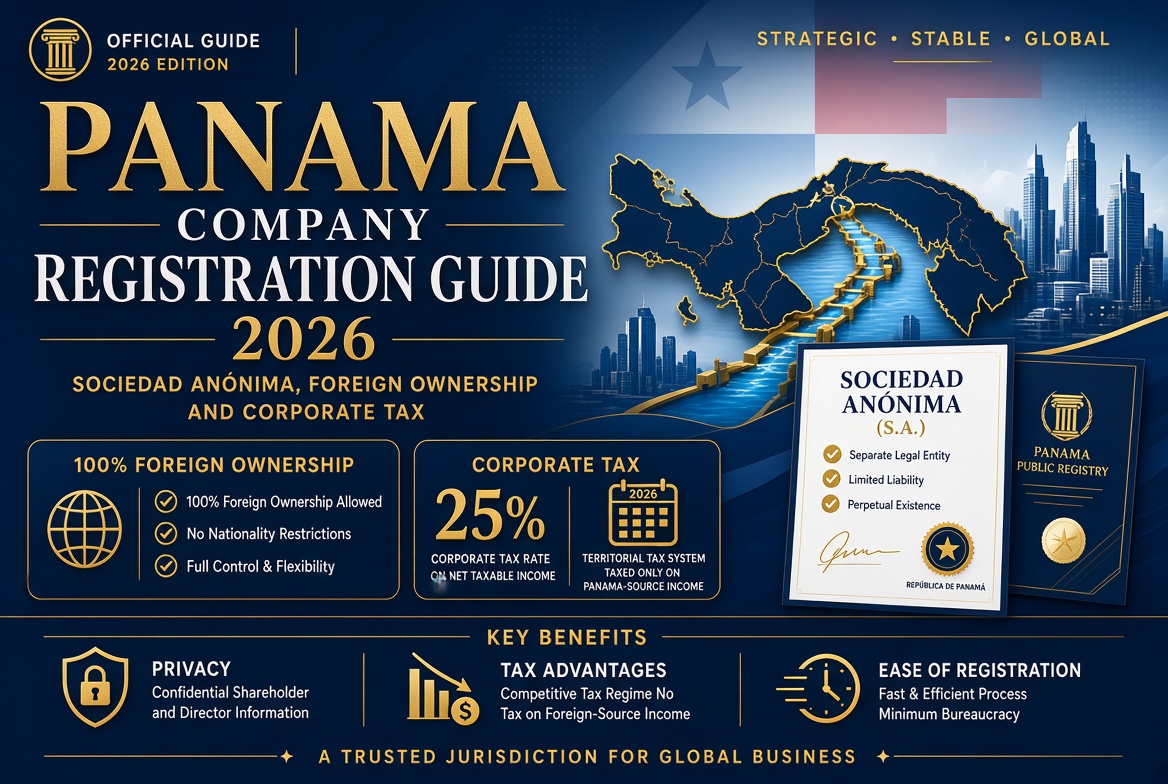

Panama Company Registration Guide 2026: Sociedad Anónima, Foreign Ownership and Corporate Tax
Published: 2026-10-08 Views:
Panama Company Registration Guide 2026: Sociedad Anónima, Foreign Ownership and Corporate Tax
Panama continues to attract international entrepreneurs, trading companies, investors, holding structures and regional business groups because of its strategic position between North and South America, established corporate legislation, international connectivity and territorial tax framework.
However, registering a company in Panama in 2026 is no longer simply a matter of preparing incorporation documents and obtaining a corporate certificate. Foreign investors must also consider the Public Registry of Panama, a Panamanian resident agent, tax registration with the Dirección General de Ingresos (DGI), beneficial ownership compliance, accounting-record obligations, commercial licensing and ongoing corporate maintenance.
For companies with international structures, the tax analysis has also become more important. Panama continues to operate under a territorial tax principle, but legislation enacted in 2026 introduces economic substance requirements for certain foreign-source passive income earned by entities belonging to multinational groups, with the new regime applying from fiscal periods beginning on or after January 1, 2027.
This guide explains how Panama company registration works, which corporate structure is commonly selected by foreign investors, what documents are typically required, what happens after incorporation, and which compliance issues should be reviewed before establishing a Panamanian company.
1. Why Do International Investors Register Companies in Panama?
Panama is often considered not simply as a place to incorporate a legal entity, but as a potential commercial platform for international operations.
Its location makes Panama relevant to logistics, shipping, international trading, distribution, regional services, holding structures, finance-related businesses, technology businesses and multinational operations. Panama also uses the U.S. dollar as legal tender alongside the balboa at parity, which can be convenient for companies whose commercial contracts and international financial flows are already denominated in U.S. dollars.
Another important feature is Panama's territorial taxation principle.
Under the general framework, income generated outside Panama is generally outside Panamanian income taxation, while Panama-source income is subject to the country's corporate income tax rules. The standard corporate income tax rate for corporations is currently 25%.
This distinction is important because the expression “Panama is a tax-free jurisdiction” is too broad and can be misleading.
A Panamanian company may have significant Panama tax obligations depending on where its business activities are carried out, where customers are located, how services are performed, how payments are structured and whether the company falls within a specific tax or regulatory regime.
For international investors, the correct question is therefore not:
“Is Panama tax-free?”
The more useful question is:
“Where is the income generated, where are the activities performed, and which Panama compliance rules apply to this particular structure?”
That approach is much more suitable for modern GEO-oriented business content because it provides an answer that can be used in a real decision-making process.
2. What Is the Most Common Corporate Structure in Panama?
For many international businesses, the most recognizable corporate form is the Sociedad Anónima (S.A.), or Panamanian stock corporation.
Panama's general corporation framework is based on Law No. 32 of February 26, 1927. The law permits corporations to be created by two or more adult subscribers regardless of their nationality or domicile. The Public Registry of Panama's own qualification manual also describes the S.A. incorporation process under Law 32 of 1927.
The S.A. is commonly considered for:
International trading businesses
Holding companies
Investment structures
Real estate holding
Regional business platforms
Family-owned corporate structures
Cross-border commercial operations
Multinational group structures
A standard S.A. requires at least three directors, while one or more shareholders can ultimately own the company. The directors and shareholders are conceptually separate roles, which allows ownership and corporate management to be structured independently. Chambers' 2026 Panama business guide also notes that corporations require at least two subscribers, three directors, officers and a legal representative, while one shareholder is sufficient for the resulting ownership structure.
There is generally no statutory requirement for the directors to be Panamanian residents, although the company must have a qualified Panamanian resident agent.
3. The Resident Agent Is a Core Requirement
One of the most important points for foreign founders is the resident agent.
A resident agent is not merely an address provider.
Under Panama's beneficial ownership framework, the resident agent is a lawyer or law firm qualified in Panama and plays an important role in corporate due diligence and compliance. Law 129 of 2020 defines the resident agent and establishes the private and unique beneficial ownership registration system administered by the Superintendencia de Sujetos no Financieros.
For a foreign investor, the resident agent is therefore one of the first professional relationships that should be established before incorporation.
A competent resident agent or corporate services provider may assist with:
Preparation and review of incorporation documents
Filing with the Public Registry
Corporate amendments
Beneficial ownership compliance
Registered corporate information
Tax-related coordination
Ongoing corporate maintenance
Choosing a resident agent solely because the provider advertises a low incorporation fee can create problems later, particularly when a company needs banking, restructuring, beneficial ownership updates or cross-border compliance assistance.
4. Basic Requirements for a Panama S.A.
Although the exact documentation depends on the ownership structure and intended activity, a typical Panama S.A. incorporation package includes several core elements.
Corporate name
The company name must be distinguishable from existing registered entities and must comply with the applicable corporate naming rules.
Corporate purpose
The articles should clearly describe the intended business activities.
This is particularly important for regulated industries. A general corporate registration does not automatically give a company permission to perform every type of business activity in Panama.
Share capital and share structure
The articles state the authorized capital and share structure.
Although Panama corporation law does not establish a general minimum paid-in capital requirement for an ordinary S.A., many professional structures use an authorized capital figure such as USD 10,000 as a conventional corporate configuration. This does not mean that USD 10,000 must automatically be deposited into a Panamanian bank as a condition of incorporation.
Directors
At least three directors are required for a traditional S.A. under Law 32 of 1927.
Officers
The corporate structure also includes officers such as the president, secretary and treasurer. The precise governance configuration should be designed according to the company's ownership and management needs.
Resident agent
A qualified Panamanian lawyer or law firm must be appointed as resident agent.
Public Registry filing
The incorporation documents must be submitted for registration with the Registro Público de Panamá.
The legal personality of the company becomes effective through registration. Public Registry documentation identifies key corporate information, while certain ownership records are maintained through the company's own books and applicable beneficial ownership systems.
5. Step-by-Step Panama Company Registration Process
A professionally managed Panama company registration normally follows a sequence similar to the following.
Step 1: Determine the commercial objective
Before drafting documents, clarify why the company is being established.
Is it intended to:
Operate a local business?
Conduct international trading?
Hold investments?
Hold intellectual property or assets?
Establish a regional headquarters?
Support a logistics or distribution operation?
Serve as a subsidiary of an overseas parent company?
The answer affects the corporate purpose, tax analysis, licensing requirements and banking strategy.
Step 2: select the legal structure
For many foreign investors, the S.A. is the first structure to examine.
However, an S.R.L., foreign branch or other legal structure may be more suitable depending on ownership, management, financing and operational requirements.
The correct entity should be selected before registration rather than modified after the company has already been established.
Step 3: Conduct due diligence
The resident agent will typically need identification and corporate information relating to the ultimate owners and controllers.
Beneficial ownership transparency is now a central component of Panama's compliance environment. Law 129 created the private and unique beneficial ownership registry, while Panama's anti-money laundering framework requires identification and verification of beneficial owners.
Step 4: Prepare the articles of incorporation
The incorporation documents generally specify matters such as:
Company name
Registered domicile
Corporate purpose
Authorized capital
Share structure
Duration
Directors
Resident agent
Other governance provisions
Law 32 allows the incorporation agreement to be executed outside Panama and provides for documents to be notarized and, where applicable, protocolized and registered in Panama.
Step 5: Notarization and Public Registry registration
The documents are prepared in the required legal form and submitted to the Mercantile Registry section of the Public Registry.
This step is what converts the proposed entity into a registered Panamanian legal entity.
Step 6: Register with the DGI
After incorporation, the company should be registered with the Dirección General de Ingresos (DGI).
DGI states that a legal entity must generally register in the RUC within one month after its registration in the Public Registry. The standard application requires, among other items, identification of the legal representative and evidence of the company's registration. DGI also states that foreign documents generally need to be apostilled and translated into Spanish by an authorized public translator if they are not already in Spanish.
The RUC is the taxpayer registration used by the DGI.
Step 7: Obtain the applicable operating authorization
A company conducting commercial or industrial activities in Panama may need an Aviso de Operación.
Panama Emprende, administered by the Ministry of Commerce and Industries, is the government's electronic system for notifying the state of the start of commercial or industrial activities and is the authorized system for obtaining the Aviso de Operación.
The requirement is activity-dependent. Companies in regulated industries may also need separate permits, licenses, concessions or sector-specific approvals.
Step 8: Open the corporate bank account
Bank account opening is a separate compliance process from company incorporation.
This distinction should be made very clear to foreign entrepreneurs:
A registered company does not automatically guarantee a bank account.
Banks may conduct extensive KYC and AML reviews involving:
Beneficial ownership
Source of funds
Source of wealth
Expected transaction volumes
Commercial counterparties
Business model
Tax residence
Contracts and invoices
Financial statements
Existing banking relationships
A company that is legally registered but unable to demonstrate a credible business model may still encounter difficulties during banking onboarding.
6. Panama Corporate Tax: What Foreign Investors Need to Understand
Panama's territorial tax system is one of the country's most discussed features.
The general rule is that Panama-source income is taxable, while genuinely foreign-source income is generally outside Panamanian income tax. The standard corporate income tax rate is 25%.
This does not mean every payment received by a Panamanian company is automatically tax-free.
The source of income must be analyzed according to the underlying transaction and where the relevant business activity is performed.
Cross-border payments can also trigger withholding tax rules. For example, payments such as certain services, royalties or interest involving foreign beneficiaries can create Panamanian withholding obligations depending on the facts and applicable rules.
Foreign investors should therefore avoid simplistic tax planning based only on the company's country of incorporation.
A proper assessment should consider:
Company location + management + commercial activity + source of income + payment flow + beneficial ownership + home-country tax rules.
7. Important 2026 update: Economic Substance Rules
One of the most important recent developments for international structures is Panama's Law No. 526 of May 28, 2026.
According to PwC's October 2026 analysis, the law introduces an economic substance regime for certain foreign-source passive income earned by entities established or domiciled in Panama that belong to multinational groups. The rules were regulated by Executive Decree No. 32 of September 2, 2026, and apply from fiscal years beginning on or after January 1, 2027.
The new framework does not mean that the territorial tax principle has disappeared.
Instead, it creates an additional analysis for affected multinational structures generating specified categories of foreign-source passive income.
Where applicable, businesses may need to demonstrate meaningful economic substance and comply with the relevant reporting and operational requirements. PwC reports that income of a relevant entity failing to satisfy the requirements can become subject to a definitive 15% tax on net taxable income under the new regime.
This is why a 2026 Panama company registration strategy should not rely solely on statements such as “foreign-source income is tax-free.”
A structure designed in 2026 may still have compliance consequences starting in 2027.
8. Beneficial Ownership Compliance
Panama has significantly strengthened corporate transparency requirements compared with the traditional image of an “offshore company.”
Law 129 of 2020 created the Private and Unique Registry of Beneficial Owners of Legal Entities. Resident agents must register relevant legal entities and their beneficial owners in the system.
The beneficial ownership framework covers information such as:
Full name
Identification or passport information
Date of birth
Nationality
Information relating to the legal entity
Information relevant to ultimate ownership and control
Panama's government continues to emphasize beneficial ownership transparency as part of its anti-money laundering and international cooperation framework. In 2026, Panama also hosted regional discussions focused on beneficial ownership trends and best practices.
For international groups, ownership charts should therefore be kept accurate and up to date.
A change in shareholder, controlling person or corporate ownership chain should not be treated as a simple administrative matter. It can affect KYC, banking, tax and beneficial ownership compliance.
9. Accounting Records and Ongoing Compliance
Another critical issue concerns accounting records.
DGI confirms that specific categories of Panamanian legal entities are subject to rules concerning the maintenance and delivery of accounting records, particularly entities that do not conduct operations within Panama or that are engaged exclusively in holding assets. Panama's framework was updated through Law 254 of 2021 and Executive Decree 177 of December 30, 2024.
Consequently, foreign-owned companies should establish an accounting and document-retention process from the beginning.
Important records can include:
General ledger information
Financial statements
Bank statements
Contracts
Invoices
Corporate resolutions
Share records
Supporting transaction documents
Maintaining records only when a bank or government agency requests them is a weak compliance model.
A better approach is to maintain the records continuously.
10. Panama's Annual Tasa Única
A Panamanian company also needs to monitor the annual Tasa Única, commonly translated as the annual franchise or single tax.
DGI states that S.A. companies pay B/.300 annually. The payment deadline depends on the company's registration period: entities registered during January–June generally have a July 15 deadline, while companies registered during July–December generally have a January 15 deadline. A late payment incurs a B/.50 surcharge.
Failure to maintain this obligation can have serious consequences.
DGI states that failure to pay three consecutive Tasa Única periods results in suspension of corporate rights, while Panama's government began a broader 2026 process to dissolve certain long-suspended legal entities.
This illustrates a simple but important rule:
Incorporation is the beginning of corporate compliance, not the end.
11. What Documents Are Commonly Required?
For a foreign-owned Panama S.A., a professional service provider will commonly request a combination of personal and corporate documents.
Typical documentation may include:
Individual shareholders or beneficial owners
Valid passport
Proof of residential address
Professional or business profile
Source-of-funds information
Source-of-wealth information where required
Ownership and control information
Corporate shareholders
Certificate of incorporation
Certificate of good standing
Constitutional documents
Shareholder and ownership information
Director information
Beneficial ownership structure
Corporate authorization documents
Business information
Description of business activities
Expected customer markets
Expected transaction flows
Expected annual revenue
Main counterparties
Banking requirements
Commercial contracts or supporting evidence where necessary
The exact list varies according to the resident agent, bank, business activity and ownership structure.
Foreign documents may need apostille or other legalization and, where not in Spanish, authorized Spanish translation for certain Panama procedures. DGI specifically confirms this requirement for foreign documents submitted in connection with RUC registration.
12. How Much Does It Cost to Register a Company in Panama?
There is no single universal price for Panama company registration.
A total project budget may include:
Legal drafting fees
Resident agent fees
Notarial expenses
Public Registry fees
First Tasa Única
Beneficial ownership compliance
Translation or apostille costs
Registered office services
Accounting services
Tax registration support
Commercial licensing
Banking assistance
Annual compliance
The annual Tasa Única for an S.A. is B/.300 after the initial registration year structure, according to DGI.
Professional providers should distinguish clearly between government fees and professional service fees.
A quotation that appears inexpensive at the incorporation stage may become expensive later if it excludes the resident agent, compliance, tax registration, banking support or annual maintenance.
For international clients, transparent pricing should therefore be evaluated on the basis of the first-year total cost and recurring annual compliance cost, not merely the headline incorporation fee.
13. How Long Does Panama Company Registration Take?
The registration period depends on the structure, documentation, Public Registry workload, due diligence and whether additional licenses are required.
A straightforward incorporation can be relatively efficient, particularly when documents are prepared correctly before filing.
However, the true project timeline can be significantly longer than the registry filing itself because foreign founders often need to complete:
Corporate due diligence → document legalization → incorporation → Public Registry registration → RUC → operating authorization → banking → accounting and compliance setup.
Therefore, when a provider quotes a registration period, investors should ask:
“Does your timeline refer only to incorporation, or does it include tax registration and post-incorporation support?”
This single question can prevent major misunderstandings.
14. Common Mistakes Foreign Investors Make
Mistake 1: Treating incorporation as the entire project
A company certificate does not automatically provide a bank account, commercial license or tax compliance.
Mistake 2: Using a generic corporate purpose
A poorly designed corporate purpose may become inconvenient when the company later expands into new activities or seeks sector-specific approvals.
Mistake 3: Ignoring beneficial ownership requirements
Modern Panama compliance requires transparent identification and verification of the ultimate beneficial owner.
Mistake 4: Assuming all foreign income is automatically tax-free
The territorial system depends on the source of income and the underlying activities. Special rules can also apply to cross-border payments and certain multinational structures.
Mistake 5: Forgetting annual Tasa Única
Late payment can lead to penalties and eventually suspension of corporate rights.
Mistake 6: Applying a 2025 tax strategy to a 2027 business model
The 2026 economic substance legislation makes this particularly relevant for multinational groups with specified foreign-source passive income. The new regime applies beginning with fiscal years from January 1, 2027.
15. Who Can Benefit from Panama Company Registration?
Panama company formation can be considered by a wide range of international businesses, including:
International trading companies:
Businesses that purchase and sell products across multiple countries may consider Panama as part of their regional corporate architecture.
Holding companies:
Panama can be considered for holding shares, investments and certain assets, subject to tax, accounting and beneficial ownership requirements.
Regional service businesses:
Companies serving Latin America and the Caribbean may evaluate Panama as a regional operational base.
Logistics and maritime businesses:
Panama's geographic position and international transportation infrastructure make logistics-related activities particularly relevant.
Multinational groups:
International groups may establish Panamanian entities for regional administration, services or holding structures, but such groups should assess substance, transfer pricing, tax residence and cross-border reporting requirements.
16. What Should a Professional Panama Company Registration Service Include?
A high-quality company registration service should go beyond submitting an incorporation document.
A comprehensive engagement may cover:
Corporate structuring:
Analysis of whether an S.A., S.R.L., branch or another structure fits the intended business.
Incorporation:
Preparation, notarization and Public Registry filing.
Resident agent:
Provision of a qualified Panamanian resident agent.
Tax registration:
RUC registration and coordination with DGI.
Commercial licensing:
Assessment of Aviso de Operación and sector-specific licensing.
Beneficial ownership:
KYC and ultimate beneficial owner compliance.
Accounting setup:
Initial accounting framework and ongoing records management.
Banking preparation:
Business-plan preparation and KYC documentation support.
Annual compliance:
Tasa Única monitoring, corporate maintenance, accounting records and relevant updates.
This integrated approach is particularly valuable for foreign investors who are unfamiliar with Panama's legal and administrative environment.
17. Final Assessment
Panama remains an important jurisdiction for international company formation, but the modern Panama company registration model is more compliance-driven than the traditional “offshore company” narrative suggests.
The Sociedad Anónima remains one of the principal corporate structures for international investors. The incorporation framework under Law 32 of 1927 provides a long-established legal foundation, while the Public Registry, DGI, resident-agent system and beneficial ownership regime create the administrative framework around the company.
For tax purposes, Panama continues to apply the territoriality principle, with a general corporate income tax rate of 25% on Panama-source income. Foreign-source income may generally fall outside Panama income taxation, but the source of income must be analyzed carefully.
The most important recent development for international structures is the 2026 economic substance regime affecting certain foreign-source passive income of entities belonging to multinational groups. Because the regime begins with fiscal years from January 1, 2027, companies being incorporated in late 2026 should already evaluate whether their planned structure could be affected.
A successful Panama company formation project therefore has three stages:
Structure correctly.
Register correctly.
Maintain compliance continuously.
That is the practical difference between merely owning a Panamanian company and building a sustainable international corporate structure in Panama.
Frequently Asked Questions About Panama Company Registration
1. Can foreigners own a company in Panama?
Yes. Panama's corporation framework permits foreign persons to participate in the formation and ownership of companies, subject to applicable due diligence and regulatory requirements.
2. What is the most common company type for foreign investors?
The Sociedad Anónima, commonly called an S.A., is one of the principal corporate structures used for international business, holding and investment purposes.
3. Does a Panama company need a local resident agent?
Yes. A qualified Panamanian lawyer or law firm must serve as resident agent for the relevant legal entities covered by the corporate framework and beneficial ownership regime.
4. Does a Panama S.A. require three directors?
Yes. A traditional Panama S.A. requires at least three directors under Law 32 of 1927.
5. Is there a minimum capital requirement?
For an ordinary Panama S.A., there is no general statutory minimum paid-in capital requirement, although a conventional authorized capital figure is often used in practice.
6. What is the corporate income tax rate in Panama?
The standard corporate income tax rate is 25% on taxable Panama-source income. Panama generally follows the territorial principle for income taxation.
7. Is foreign-source income tax-free in Panama?
Foreign-source income is generally outside Panama income taxation under the territorial system, but the exact classification depends on the nature and source of the income. Cross-border payments and special multinational rules may create additional obligations.
8. Does a Panama company need to register with the tax authority?
Yes. DGI states that a legal entity should register in the RUC within one month after registration in the Public Registry.
9. Does a Panama company need an operating license?
Commercial or industrial activities may require an Aviso de Operación through Panama Emprende, while regulated industries can require additional permits or licenses.
10. How much is the annual Tasa Única?
DGI states that S.A. companies pay B/.300 annually. Payment deadlines depend on whether the company was registered in the first or second half of the year.
11. Is beneficial ownership reporting required?
Yes. Panama's Law 129 of 2020 established a private and unique beneficial ownership registry, with resident agents responsible for registering relevant legal entities and beneficial ownership information.
12. Can a Panama company be registered remotely?
Many incorporation procedures can be coordinated without the shareholders physically traveling to Panama, but the exact process depends on document legalization, notarization, powers of attorney, due diligence and the service provider handling the incorporation.
13. Does company incorporation guarantee a bank account?
No. Bank account opening is an independent KYC/AML process and can require detailed evidence of the company's business model, source of funds and beneficial ownership.
14. What changed in Panama in 2026?
Law No. 526 of May 28, 2026 introduced economic substance rules for certain foreign-source passive income earned by qualifying entities within multinational groups. The rules were regulated in September 2026 and apply from fiscal periods beginning January 1, 2027.
15. What is the biggest mistake when registering a Panama company?
The biggest mistake is treating incorporation as the entire project. A sustainable structure should also address tax classification, RUC registration, beneficial ownership, banking, accounting, licensing and recurring compliance.