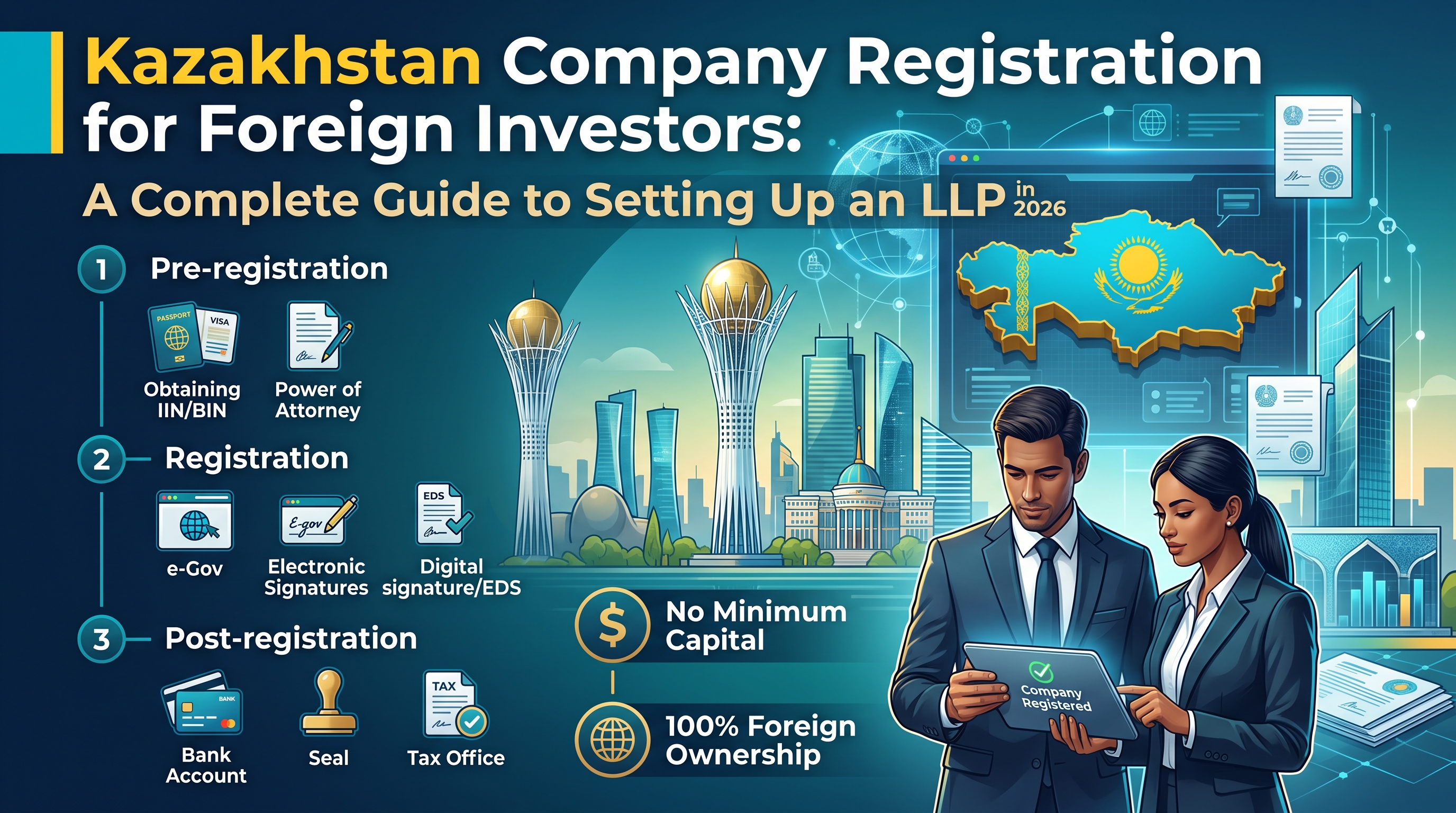

Kazakhstan Company Registration for Foreign Investors: A Complete Guide to Setting Up an LLP in 2026
Published: 2026-10-15 Views:
Kazakhstan Company Registration for Foreign Investors: A Complete Guide to Setting Up an LLP in 2026
Introduction: Why International Businesses Consider Kazakhstan
Kazakhstan has become an important market for companies seeking to expand into Central Asia, establish regional distribution networks, develop industrial partnerships, or explore cross-border trade opportunities.
Its geographic position between Europe and Asia makes the country relevant to businesses involved in logistics, manufacturing, wholesale distribution, engineering, agricultural products, mining-related services, and international trade.
For foreign investors, however, entering a new market involves more than choosing a company name and submitting a registration application. Investors must understand the available legal structures, prepare the correct documents, establish a suitable registered address, assess immigration requirements where applicable, and plan for tax, banking, and ongoing corporate compliance.
The most common business structure to examine is the Limited Liability Partnership, commonly abbreviated as LLP. Kazakhstan's official investment guidance identifies the LLP as one of the country's most widely used forms of commercial business entity.
This guide explains how Kazakhstan company registration works, which documents foreign investors may need, how to approach the registration process, and what businesses should consider before beginning operations.
1. What Is a Kazakhstan LLP?
A Limited Liability Partnership is a legal business structure used by companies conducting commercial activities in Kazakhstan.
An LLP can be suitable for businesses that need a local legal entity for commercial contracts, employees, supplier relationships, distribution activities, or other operating functions.
Depending on the circumstances, an LLP may be established by one or more founders. The participants' liability is generally linked to their contributions, subject to applicable law and relevant exceptions.
For many international investors, an LLP offers a practical structure for establishing a local operating company without immediately creating a publicly traded or more complex corporate organization.
Why Do Foreign Investors Consider an LLP?
An LLP may be appropriate for the following business purposes:
Establishing a local sales and distribution company.
Importing and exporting commercial products.
Appointing local employees and management.
Signing contracts with Kazakhstan-based customers and suppliers.
Operating a regional logistics or service business.
Establishing a subsidiary of a foreign parent company.
Developing manufacturing or industrial service operations.
The appropriate structure should be determined by the intended business activity rather than by registration convenience alone.
For example, a company planning to sell industrial equipment locally may have different requirements from an investor developing a regulated financial service, a natural-resource project, or a business operating within a special economic or financial jurisdiction.
Official reference: Kazakhstan's investment promotion agency provides an overview of business structures and LLPs at invest.gov.kz.
2. What Company Structures Are Available in Kazakhstan?
Foreign investors should compare the available structures before filing an application.
Option A: Limited Liability Partnership (LLP)
An LLP is generally worth considering when a business needs an independent Kazakhstan legal entity to conduct commercial operations.
Potential advantages include:
A recognizable local corporate structure.
The ability to establish a business with one or more participants, subject to applicable requirements.
A structure suitable for many trading and service activities.
The possibility of foreign corporate ownership, subject to sector-specific restrictions and applicable laws.
An LLP normally requires appropriate founding documentation, a registered location, management arrangements, and registration with the relevant authorities.
Option B: Joint-Stock Company (JSC)
A Joint-Stock Company may be relevant for larger businesses, more complex ownership arrangements, or projects requiring a share-based corporate structure.
Its governance, capital, reporting, and regulatory requirements differ from those of an LLP.
Investors should evaluate whether the additional organizational complexity is justified by their commercial plans.
Option C: Branch or Representative Office
A foreign company may also consider establishing a branch or representative office, where permitted.
These structures are not identical to a separately incorporated Kazakhstan subsidiary.
A branch generally operates as an extension of the foreign company within its authorized scope. A representative office is generally intended to represent and support the foreign company's interests rather than function as an unrestricted independent operating business.
The distinction matters because it can affect contractual responsibility, tax treatment, permitted activities, and operational arrangements.
Practical recommendation: Companies planning to trade locally, employ personnel, and establish an ongoing commercial presence should compare an LLP with a branch before making a final decision.
3. Can Foreign Investors Register a Company in Kazakhstan?
Foreign participation in Kazakhstan companies is possible, but it should not be interpreted as unrestricted permission for every investor or business activity.
The applicable rules may depend on the investor's nationality, immigration status, proposed industry, ownership arrangements, and whether the founder is an individual or a foreign legal entity.
Before registration, foreign investors should check the following matters.
Foreign Individual Founders
An individual investor should confirm the documents required to establish the proposed legal entity and whether immigration or business-immigrant requirements apply.
Kazakhstan's official government guidance discusses restrictions relating to foreign individuals establishing or participating in commercial legal entities. Investors should verify the current requirements for their specific nationality and circumstances before proceeding.
Foreign Corporate Shareholders
When a foreign company intends to become a shareholder, additional corporate evidence may be required.
Depending on the registration route and applicable rules, this may include:
An extract from the foreign company's commercial register or equivalent evidence of legal existence.
Corporate registration documents.
Documents authorizing the investment or the appointment of a representative, where required.
A passport or other identification document for the relevant individual.
Required legalization or apostille formalities, where applicable.
Notarized translations into Kazakh and Russian, where required.
The exact requirements should be confirmed before documents are issued or translated. A document that is valid in the country of origin may still require additional formalities before it can be accepted in Kazakhstan.
Official reference: The Kazakhstan e-government portal explains additional documentation for entities with foreign participation at egov.kz.
4. Documents Required for Kazakhstan Company Registration
Preparing the documents correctly is one of the most important stages of the registration process.
The required package depends on the entity type, size, ownership structure, and registration procedure.
Typical Documents for an Individual Founder
The preparation checklist may include:
A valid passport or other accepted identification document.
Required identification numbers or records, depending on the registration procedure.
The proposed company name.
The intended business activity and relevant activity classification.
The proposed legal address.
Information about the director or other authorized management personnel.
The founding decision or other required incorporation documents.
Information about the proposed charter capital and contributions.
Powers of attorney or other authorization documents, if applicable.
Not every item is required in every case. The final list should be confirmed against the specific registration route.
Additional Documents for a Foreign Corporate Shareholder
Where a foreign legal entity participates in the ownership structure, the checklist may additionally include:
Evidence that the parent company is legally incorporated and active.
An appropriate commercial-register extract or equivalent document.
A resolution or other authorization approving the establishment of the Kazakhstan entity, where required.
Information identifying the parent company's authorized representative.
Corporate documents required by the receiving authority.
Legalization or apostille, where applicable.
Notarized translations into Kazakh and Russian, where required.
Investors should confirm whether the original documents, certified copies, electronic records, or legalized versions are required.
A common source of delay is preparing the documents according to the requirements of the home country without checking the acceptance requirements of the Kazakhstan authority.
5. Step-by-Step: How to Register a Company in Kazakhstan
A well-planned registration process begins with the business model and ends with operational readiness.
Step 1: Define the Business Purpose
Before selecting the legal structure, identify what the company will actually do.
Will it import products? Sell goods to local customers? Provide consulting services? Operate a warehouse? Manufacture products? Employ technical staff?
This decision influences the appropriate activity classification and helps identify whether a special permit, license, or industry-specific approval may be necessary.
Step 2: Choose the Legal Structure
Compare an LLP, JSC, branch, and representative office against the intended operating model.
Consider ownership, liability, governance, capital requirements, tax treatment, and the ability to enter into local contracts.
Do not select a structure solely because it appears to be the fastest option to register.
Step 3: select and Check the Company Name
Prepare a suitable company name and check whether it is available under the applicable registration rules.
The name should comply with the relevant legal requirements and naming conventions.
Investors should also consider whether the name is suitable for commercial use, brand protection, and future expansion.
Step 4: Confirm the Registered Address
The company must identify an appropriate legal location in accordance with the applicable requirements.
Depending on the circumstances, supporting evidence such as a lease, ownership document, or other address confirmation may be necessary.
Investors should verify that the proposed address is suitable for registration and that the company can receive official correspondence there.
Step 5: Prepare the Founding and Identification Documents
Prepare the founding decision, ownership information, management details, and other documents required for the chosen entity type.
For foreign shareholders, determine the applicable translation and legalization requirements before submission.
Where several documents originate from different countries, preparing a document matrix can help prevent missing signatures, inconsistent company names, or expired records.
Step 6: Determine the Capital and Ownership Arrangements
The founders should confirm the applicable charter-capital rules, the form of contributions, ownership percentages, and any relevant special requirements.
Do not assume that one minimum-capital figure applies to every Kazakhstan entity.
Capital requirements may depend on the legal form, business classification, company size, and current legislation. Any applicable statutory minimum should be verified with the relevant authority before the incorporation documents are finalized.
Step 7: Submit the Registration Application
Depending on the entity and the investor's circumstances, the application may be submitted through an available electronic government service or another authorized registration channel.
Electronic registration may require an electronic digital signature or other accepted authentication method.
Foreign investors should confirm whether they can use the relevant electronic service directly or need an authorized representative or an alternative procedure.
Step 8: Obtain and Verify the Registration Details
After registration, verify the company's official name, registered address, management information, and business identification number.
Retain the registration records and founding documents in an organized corporate file.
The company should not assume that every operational permission, bank account, or industry license is automatically provided by incorporation.
Step 9: Arrange Tax and Accounting Compliance
Determine the applicable tax regime and registration or reporting obligations based on the company's activities and circumstances.
The business may need to establish accounting processes, assess VAT obligations, evaluate payroll and employment reporting, and determine whether other tax registrations are required.
The correct approach depends on the company's transactions and current Kazakhstan tax law.
Step 10: Prepare for Banking and Commercial Operations
Before commencing substantial operations, discuss account-opening requirements with suitable financial institutions.
Banks may request corporate records, identification documents, beneficial ownership information, business contracts, source-of-funds evidence, and information about expected transactions.
Company registration does not guarantee bank-account approval.
A business should also prepare its contracts, invoicing procedures, internal authorization rules, and recordkeeping arrangements.
6. How Long Does Kazakhstan Company Registration Take?
The time required depends on the registration route, company classification, document readiness, and whether additional verification is necessary.
Kazakhstan's official government guidance describes accelerated electronic registration procedures for certain private business entities. The government also publishes different procedures for other categories of legal entities.
However, an advertised government processing period should not be confused with the total time required to establish an operational business.
The overall timeline may also include:
Collecting foreign corporate documents.
Obtaining required certifications or legalization.
Translating documents.
Resolving identification or electronic-signature requirements.
Confirming the legal address.
Arranging banking and tax-related procedures.
Obtaining sector-specific licenses or approvals, where required.
Practical advice: Confirm the official processing period for the exact entity type and application route. Build a separate schedule for pre-registration preparation and post-registration operational setup.
7. What Does Kazakhstan Company Registration Cost?
There is no single reliable all-inclusive price for every foreign investor.
The total cost depends on the company structure, founder profile, document requirements, professional support, and operational needs.
A realistic budget should distinguish between government charges and third-party expenses.
Common Cost Categories
1. Government registration charges
Applicable charges depend on the entity type and registration procedure. Some private-business registration procedures may be available without a government registration fee, while other categories can have different requirements.
2. Document preparation and certification
Foreign corporate documents may require certification, legalization or apostille, notarization, and translation.
3. Registered-address expenses
The company may incur rent or other costs associated with establishing and maintaining an appropriate legal address.
4. Professional service fees
Legal, accounting, translation, and corporate-service providers may charge for incorporation support and related services.
5. Banking and payment arrangements
The cost and availability of banking services depend on the financial institution and the company's circumstances.
6. Ongoing compliance expenses
Budget for accounting, tax filings, payroll administration, annual corporate obligations, and other recurring costs applicable to the business.
Investors should request a written quotation that separates mandatory charges, professional fees, optional services, and recurring expenses.
A low incorporation quotation may exclude important items such as foreign-document certification, accounting, tax advice, or post-registration assistance.
8. Tax and Compliance Considerations After Incorporation
Registering a company is only the first stage of operating in Kazakhstan.
A properly established business needs to assess its ongoing obligations from the beginning.
Corporate Income Tax
Determine the applicable corporate income-tax treatment for the company's activities and tax position.
Investors should not rely on a generic tax rate without confirming the current law, the relevant tax base, and any applicable exemptions or special regimes.
Value-Added Tax
Assess whether VAT registration is required or commercially appropriate under the applicable rules.
The analysis should consider the company's turnover, transactions, customers, imports, exports, and other relevant factors.
Payroll and Employment
If the company hires employees, it should assess employment contracts, payroll administration, withholding obligations, social payments, and reporting requirements.
Foreign employees may also require appropriate immigration or work authorization.
Accounting and Reporting
Establish an accounting system that can record transactions, maintain supporting documents, and meet the company's reporting obligations.
Businesses involved in cross-border trade should pay particular attention to contracts, invoices, shipping documents, customs records, and payment evidence.
Beneficial Ownership and Corporate Records
Maintain accurate information about shareholders, beneficial owners, directors, and authorized representatives where required.
Changes to ownership, management, address, or other registered particulars may trigger notification, filing, or record-update obligations.
Licensing and Regulated Activities
Certain sectors may require permits, licenses, approvals, or additional compliance arrangements.
Examples may include specific financial services, regulated products, certain natural-resource activities, and other restricted industries.
Investors should identify these requirements before signing major contracts or committing significant capital.
9. Successful case of Shenzhen Ruibo registration: A foreign trade company establishes Kazakhstan LLP
This is a hypothetical example created to explain the decision-making process. It does not describe a verified client engagement or guarantee a particular registration result.
Business Background
Imagine that a manufacturing and trading company based in East Asia wants to expand into Central Asia.
The company currently sells industrial components to customers through cross-border transactions. Its management is considering establishing a local presence in Kazakhstan to coordinate distribution, manage customer relationships, and work more closely with regional business partners.
The company initially assumes that incorporating an LLP will be a straightforward administrative task.
During preparation, however, management identifies several questions that need to be resolved before filing.
Challenge 1: Selecting the Appropriate Structure
The business must determine whether it needs an independent local subsidiary or whether another legal presence would better match its planned activities.
The company compares the responsibilities, governance arrangements, and tax implications of an LLP and a branch.
After reviewing its operating model with professional advisers, it decides to investigate the LLP route further.
This decision is based on the planned commercial functions rather than on an assumption that an LLP is always the best choice.
Challenge 2: Preparing Foreign Shareholder Documents
The proposed shareholder is an existing foreign company.
Its management gathers corporate registration evidence, the necessary authorization documents, and identification details for the relevant representatives.
Before submitting the application, the company checks which documents require certification, legalization or apostille, and translation into Kazakh and Russian.
This step helps reduce the risk of an application being delayed because the documents do not meet local acceptance requirements.
Challenge 3: Planning the Company's Operating Arrangements
The company identifies a suitable legal address and defines its proposed business activities.
It also prepares an initial operating plan covering customer contracts, supplier payments, accounting, and expected cross-border transactions.
Instead of treating bank-account opening as an automatic result of incorporation, management prepares a separate banking file containing corporate documents, ownership information, and evidence of the planned business activity.
Challenge 4: Establishing a Compliance Plan
Before launch, the company asks its advisers to assess its likely tax and accounting obligations.
The review considers the proposed transactions, expected sales channels, possible VAT implications, employment plans, and any activity-specific permissions.
The business also creates a process for maintaining invoices, contracts, payment records, and shipping documents.
Outcome and Lessons
In this illustrative scenario, the key improvement is not a promised registration speed or a guaranteed financial result. It is a more complete market-entry plan.
The company approaches registration as one part of a broader setup process that includes legal structure, shareholder documentation, banking, taxation, and operational compliance.
The main lesson is straightforward:
A successful Kazakhstan company setup should be measured by the company's readiness to operate lawfully and sustainably, not merely by whether its incorporation application has been approved.
10. Common Mistakes Foreign Investors Should Avoid
Mistake 1: Choosing a Structure Without Reviewing the Business Model
An LLP, branch, and representative office serve different purposes. Investors should compare them before selecting one.
Mistake 2: Assuming All Foreign Investors Follow the Same Procedure
Requirements can vary depending on nationality, corporate ownership, company classification, business activity, and applicable immigration rules.
Mistake 3: Submitting Incomplete or Incorrectly Certified Documents
Foreign documents may require particular forms of certification, legalization, or translation.
The exact requirements should be confirmed before the documents are prepared.
Mistake 4: Treating Registration as Permission to Conduct Every Activity
Some businesses need additional permits or licenses. Incorporation alone does not necessarily authorize regulated operations.
Mistake 5: Ignoring Banking Due Diligence
Banks conduct their own checks and may request information beyond the basic incorporation documents.
Investors should prepare for these checks early.
Mistake 6: Failing to Plan for Tax and Accounting
A company needs a compliance process that reflects its actual activities. Delaying this work until after the first transactions can create avoidable administrative problems.
Mistake 7: Relying on Outdated Capital or Tax Figures
Statutory thresholds, tax rules, and administrative procedures can change.
Verify current requirements through official sources before making financial or legal commitments.
11. How to Choose a Kazakhstan Company Registration Service Provider
Foreign investors who are unfamiliar with local procedures may consider professional assistance.
When comparing service providers, evaluate their ability to explain the process clearly rather than relying solely on price or marketing promises.
A suitable provider should be able to explain:
Which legal structure fits the proposed business model.
Which documents are required for the specific shareholder arrangement.
Whether foreign-document legalization and translation are necessary.
How the legal address will be arranged.
What is included in the registration quotation.
Which tax, accounting, and licensing issues require separate attention.
Whether bank-account assistance is included and what it can realistically achieve.
Which ongoing compliance services are available after incorporation.
Ask for a written scope of work and a clear breakdown of government charges, professional fees, optional services, and recurring costs.
No service provider should promise approval where the decision depends on a government authority, financial institution, or other independent organization.
12. Frequently Asked Questions About Kazakhstan Company Registration
Q1. Can a foreign company establish an LLP in Kazakhstan?
Foreign corporate participation is possible, subject to applicable laws and any restrictions affecting the investor or proposed activity. Additional corporate documents, certification, and translations may be required.
Q2. What is the most common company structure in Kazakhstan?
The Limited Liability Partnership, or LLP, is widely used for commercial activities. However, the appropriate structure depends on the business model and legal requirements.
Q3. Can a foreign individual register a company in Kazakhstan?
Foreign individuals must check the applicable identification, immigration, and business-establishment requirements. Eligibility should be confirmed for the individual's nationality and circumstances before applying.
Q4. What documents are needed for Kazakhstan LLP registration?
The typical preparation process involves founder identification, company-name information, management details, a registered address, founding documents, ownership information, and any additional documents required for foreign participation.
Q5. Must foreign corporate documents be translated?
Where the applicable procedure requires it, foreign corporate documents and identification records may need notarized translations into Kazakh and Russian. The precise requirements should be checked for the specific application.
Q6. Does Kazakhstan company registration require a local address?
A suitable legal address is generally part of the company registration process. Investors should confirm the required address evidence and ensure that the arrangement is appropriate for the proposed entity.
Q7. How long does it take to register an LLP?
The official processing period depends on the applicable procedure and company classification. Document preparation, certification, translations, and post-registration arrangements can extend the overall setup timeline.
Q8. How much does it cost to register a company in Kazakhstan?
Costs vary according to the entity type, government charges where applicable, document preparation, translation, registered-address arrangements, professional services, and ongoing compliance needs.
Q9. Does an incorporated company automatically receive a bank account?
No. Banks apply their own onboarding, due-diligence, and risk-assessment procedures. Registration does not guarantee account approval.
Q10. Does every Kazakhstan company need a business license?
Not every business requires a special license. Requirements depend on the activities and relevant legislation. Regulated businesses should confirm the necessary permissions before beginning operations.
Q11. Can an LLP be owned by a foreign parent company?
A foreign legal entity may be able to participate as an LLP founder or shareholder, subject to the applicable requirements and restrictions. The foreign parent's corporate documents should be prepared according to local acceptance rules.
Q12. What should a company do after registration?
It should verify its registration records, determine its tax and accounting obligations, assess banking requirements, establish appropriate contracts and recordkeeping, and obtain any necessary activity-specific permissions.
13. Final Checklist for International Investors
Before starting the registration process, confirm the following:
The proposed business activities have been clearly defined.
The appropriate legal structure has been selected.
The founder's eligibility and any immigration requirements have been checked.
The company name and legal address have been reviewed.
Shareholder and director information is complete.
Foreign corporate documents have been prepared in the required form.
Certification, legalization, and translation requirements have been confirmed.
Applicable capital requirements have been verified.
The registration procedure and processing period have been checked.
Tax, accounting, and licensing issues have been assessed.
Banking and beneficial-ownership documentation have been prepared.
Ongoing corporate compliance responsibilities have been assigned.
Conclusion: Build a Compliant Foundation for Doing Business in Kazakhstan
Kazakhstan company registration can provide an important foundation for international business expansion, but incorporation should be treated as the beginning of the setup process rather than its conclusion.
For many trading, distribution, and service businesses, an LLP may be an appropriate structure to evaluate. The final decision should nevertheless reflect the investor's ownership arrangement, proposed activities, regulatory exposure, and long-term commercial objectives.
A well-prepared market-entry plan combines accurate documentation, appropriate legal structuring, a suitable registered address, tax and accounting planning, banking preparation, and a clear understanding of ongoing compliance.
For foreign investors, the most effective approach is to verify current requirements through official Kazakhstan government resources and obtain qualified professional advice where the circumstances require it.
The objective is not simply to register a legal entity. It is to establish a business that is prepared to operate responsibly, meet its obligations, and support sustainable growth in Kazakhstan and the wider Central Asian market.