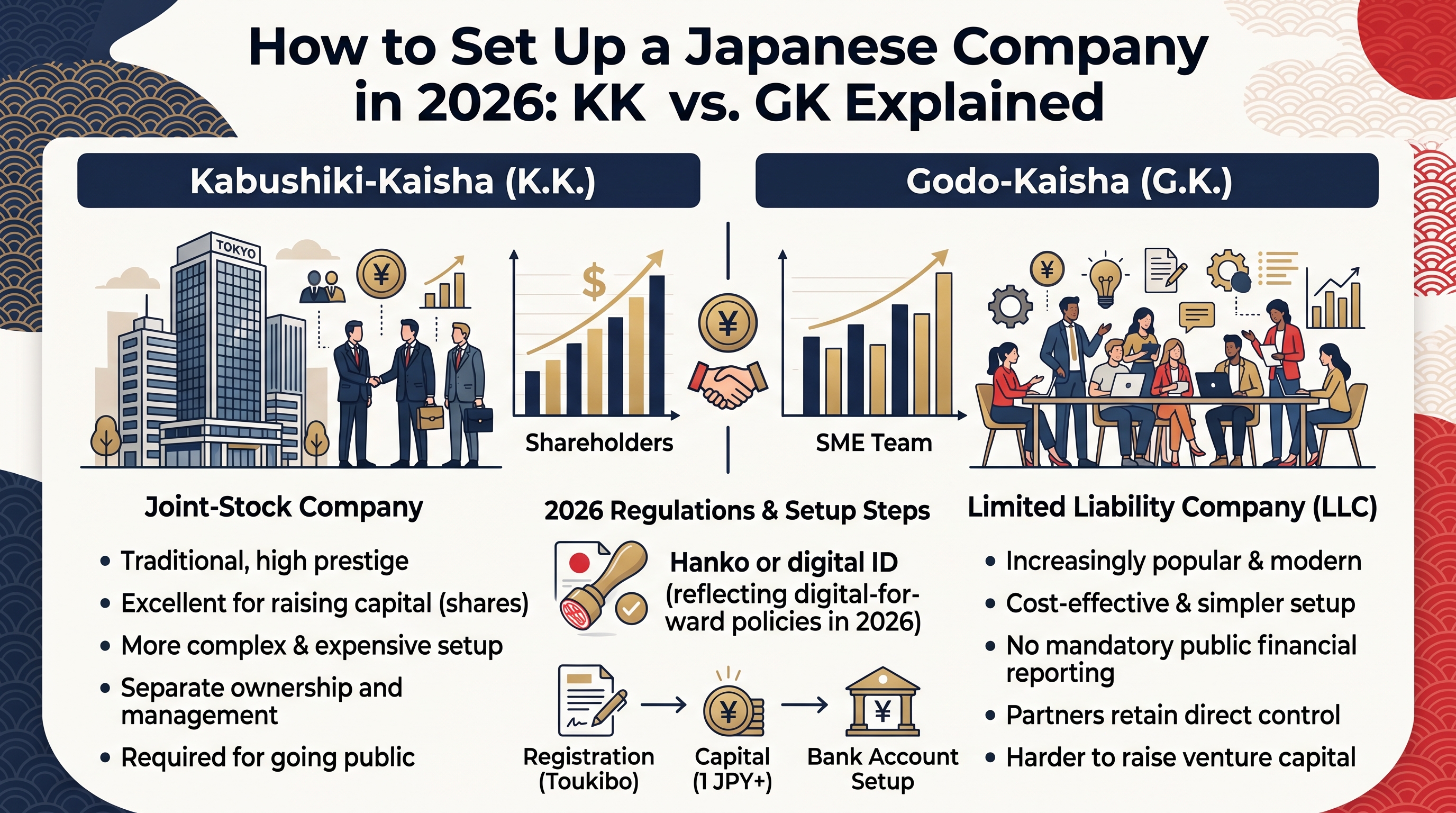

How to Set Up a Japanese Company in 2026: KK vs. GK Explained
Published: 2026-10-19 Views:
How to Set Up a Japanese Company in 2026: KK vs. GK Explained
Introduction: Why International Businesses Choose Japan
Japan remains an important destination for international businesses seeking access to a sophisticated consumer market, advanced manufacturing capabilities, reliable infrastructure, and established commercial networks. Companies entering Japan may be looking to sell products locally, establish a regional headquarters, develop technology partnerships, operate an e-commerce business, or build long-term relationships with Japanese customers.
However, entering the Japanese market requires more than registering a company name. Foreign investors must consider the appropriate legal structure, corporate documentation, registered office, capital arrangements, tax obligations, banking requirements, and any industry-specific permits.
Japan company registration is the legal process of establishing a business entity and recording its required information with the appropriate Legal Affairs Bureau. For many foreign entrepreneurs, a Kabushiki Kaisha (KK) or Godo Kaisha (GK) is a practical starting point.
The Japan External Trade Organization (JETRO) provides official guidance covering company incorporation, taxation, immigration status, office establishment, and related business procedures. Its guidance is a useful starting point for foreign investors planning to establish a business presence in Japan.
This guide explains how to register a company in Japan, which structure may be appropriate, what documents are commonly required, how the registration process works, and what businesses should prepare before starting operations.
1. What Is Japan Company Registration?
Japan company registration refers to the legal establishment of a company under Japanese law and the registration of its corporate particulars.
Once incorporation is completed, the company can generally conduct business activities within the scope of applicable laws, its corporate purposes, and any required licenses or permits.
Depending on the company's circumstances, incorporation may be followed by additional procedures involving:
Corporate tax registration and notifications.
Consumption tax assessment and related procedures.
Opening a corporate bank account.
Social insurance and employment-related registration.
Industry-specific licenses and regulatory approvals.
Foreign investment notifications where applicable.
Immigration and residence-status procedures for foreign founders or executives.
These procedures are related but are not interchangeable. A certificate of incorporation does not automatically provide a business license, guarantee bank account approval, or grant a foreign founder the right to reside and work in Japan.
Who Needs to Register a Company in Japan?
Japan company formation may be relevant to:
Foreign entrepreneurs establishing a local business.
Overseas companies creating a Japanese subsidiary.
E-commerce businesses selling to Japanese customers.
Manufacturers establishing sales, distribution, or production operations.
Technology companies developing local partnerships.
International trading companies purchasing or distributing products in Japan.
Consulting and professional service businesses, subject to applicable licensing requirements.
Investors acquiring or establishing a Japanese operating company.
The appropriate structure depends on the business model, ownership arrangements, risk exposure, investment plan, and long-term commercial objectives.
2. What Types of Business Entities Can Foreign Investors Establish in Japan?
Foreign investors should compare the available business structures before preparing incorporation documents.
2.1 Kabushiki Kaisha (KK): Japanese Joint-Stock Company
A Kabushiki Kaisha, commonly abbreviated as KK, is a Japanese joint-stock company.
It is often considered by businesses that plan to build a substantial local presence, work with larger corporate customers, raise investment, or establish a recognizable corporate structure.
Key characteristics include:
A separate legal entity from its shareholders.
Ownership represented by shares.
Corporate governance requirements under Japanese law.
Potential suitability for larger commercial operations and future investment.
Formal incorporation procedures, including preparation and authentication of articles of incorporation as generally required.
A KK is not automatically better than other structures. Its suitability depends on the company's commercial and financing plans.
2.2 Godo Kaisha (GK): Japanese Limited Liability Company
A Godo Kaisha, or GK, is another common structure for foreign-owned businesses.
It is frequently considered by small and medium-sized enterprises, wholly owned subsidiaries, consulting businesses, and companies seeking a comparatively flexible governance arrangement.
Typical characteristics include:
Separate legal personality.
Limited liability for members, subject to applicable legal exceptions.
Flexible internal management arrangements.
No general statutory minimum capital requirement beyond the applicable incorporation framework.
Articles of incorporation that generally do not require notarization in the same manner as those of a KK.
A GK may be suitable when the owners prioritize operational flexibility and straightforward internal governance.
2.3 Branch Office of a Foreign Company
An overseas company may establish a branch in Japan instead of incorporating a new Japanese subsidiary.
A branch is an extension of the foreign parent company rather than a separate Japanese company in the same sense as a KK or GK.
This structure may suit an established overseas business that wants to conduct commercial operations in Japan while retaining the parent company's organizational framework.
The parent company must consider the registration requirements, representative arrangements, liability implications, and Japanese tax treatment associated with the branch.
2.4 Representative Office
A representative office may be appropriate for preliminary activities such as market research, information gathering, and liaison work.
However, it generally cannot conduct ordinary revenue-generating commercial activities in the same way as a registered branch or incorporated subsidiary.
Businesses should verify the permitted activities before selecting this structure.
KK vs. GK vs. Branch Office: Which Is Better?
| Factor | KK | GK | Branch Office |
|---|---|---|---|
| Separate Japanese legal entity | Yes | Yes | Generally no; it is part of the foreign company |
| Ownership structure | Shareholders | Members | Foreign parent company |
| Governance | More formal corporate framework | Generally more flexible | Governed within the parent-company framework |
| Typical use | Investment, trading, larger operations | SMEs, wholly owned subsidiaries, service businesses | Existing foreign companies expanding into Japan |
| Parent-company liability | Generally limited, subject to exceptions | Generally limited, subject to exceptions | Parent company bears branch-related liabilities |
| Incorporation approach | Formal company establishment | Formal company establishment | Registration of the foreign company's Japanese business office |
Practical recommendation: Consider a KK when your business model benefits from a share-based structure and more formal corporate governance. Consider a GK when flexible management and a simpler internal structure are priorities. Consider a branch when an existing overseas company wants to operate in Japan directly.
The best choice should be confirmed after reviewing the company's ownership, financing, operational, and tax requirements.
3. Can a Foreigner Register a Company in Japan?
Yes. Foreign nationals and foreign-owned businesses can establish companies in Japan, subject to applicable company law, investment regulations, and any industry-specific restrictions.
The Japanese Ministry of Justice states that a Japanese company can be registered even when all its representative directors reside outside Japan. A Japanese-resident representative director is therefore not a universal requirement for incorporation.
However, several distinctions are important.
Foreign Ownership
Foreign investors can generally own Japanese companies, including wholly owned subsidiaries, unless a specific regulatory restriction or approval requirement applies to the relevant business or investment.
Registered Office
The company needs an appropriate registered address in Japan. The address must satisfy applicable registration requirements and be supported by a legitimate arrangement for using the premises.
An address service should not be assumed to satisfy every banking, licensing, immigration, or operational requirement.
Capital
Japan does not generally impose a universal high minimum capital requirement for establishing a KK or GK. A company may legally be incorporated with very low capital in appropriate circumstances.
Nevertheless, legal minimum capital and commercially practical capital are different questions.
A business should consider operating expenses, office costs, product development, staffing, banking expectations, licensing conditions, and any immigration-related requirements before determining its capital amount.
Residence Status and Business Management
Incorporating a company does not automatically grant a founder a Japanese residence status or permission to work in Japan.
Foreign entrepreneurs who intend to move to Japan and manage the business must separately assess the applicable immigration rules. Requirements may differ according to the founder's circumstances and the residence status being sought.
For this reason, company incorporation and immigration planning should be treated as related but distinct workstreams.
4. What Documents Are Required for Japan Company Registration?
The exact documents depend on the company structure, nationality and residence of the founders, identity-document format, ownership arrangements, and whether a foreign corporate shareholder is involved.
Common preparation items include the following.
Personal Documents
Passport or other accepted identification.
Address and contact information.
Signature or seal-related documents where applicable.
Documents supporting the identity and authority of shareholders, members, directors, or other relevant persons.
Notarized, apostilled, legalized, or translated documents where required for the particular submission.
Corporate Documents
Proposed company name.
Registered office address.
Business purposes.
Capital amount and contribution arrangements.
Shareholder or member details.
Director and representative information.
Articles of incorporation.
Incorporation resolutions and other supporting records, where applicable.
Evidence of capital payment in the prescribed form.
Registration application and supporting documents.
Additional Documents for Foreign Corporate Shareholders
Where an overseas company will own the Japanese entity, additional documentation may be needed to verify the parent company's existence, corporate authority, ownership, and the authority of the individual signing the incorporation documents.
Foreign-language documents may require Japanese translations. Formal authentication requirements should be confirmed for the relevant document and jurisdiction before submission.
Important: Do not prepare every document using a generic checklist without reviewing the actual ownership structure. A foreign individual establishing a GK may face different documentation requirements from an overseas corporation establishing a wholly owned KK subsidiary.
5. Step-by-Step Process for Registering a Company in Japan
The following process provides a general framework for a foreign entrepreneur or overseas business establishing a Japanese subsidiary.
Step 1: Define the Business Model
Before filing registration documents, determine what the company will actually do.
For example, a trading company importing industrial components will have different operational needs from a software consultancy or an e-commerce business.
Clarify the expected customers, revenue model, suppliers, staffing needs, office arrangements, and any regulated activities.
Step 2: Choose the Legal Structure
Compare KK, GK, and branch-office options.
Consider ownership, governance, liability, investment plans, reporting obligations, and future restructuring.
Step 3: Confirm the Company Name and Registered Address
select a company name that complies with Japanese naming and registration rules.
Check whether the proposed address can be used as the registered office and whether the landlord, building management, or service provider permits the intended use.
Step 4: Prepare the Articles of Incorporation
The articles of incorporation establish key corporate rules and information, including the company's purposes and other legally required particulars.
A KK generally requires notarization of its articles of incorporation. A GK generally follows a different procedure and does not ordinarily require the same notarization step.
The articles should accurately reflect the intended ownership and management structure.
Step 5: Arrange the Capital Contribution
Complete the capital payment process in accordance with the requirements applicable to the chosen structure.
The supporting evidence must be consistent with the incorporation documents and the identity of the relevant contributors.
If a foreign investor is contributing funds from overseas, confirm the practical documentation requirements and any applicable foreign-exchange or investment reporting obligations.
Step 6: Submit the Incorporation Registration
Submit the required registration application and supporting documents to the competent Legal Affairs Bureau.
The application may be prepared and submitted using an available permitted method, subject to the applicable filing rules.
The registration date is an important corporate milestone. Do not confuse document preparation, filing acceptance, and completed registration.
Step 7: Obtain Corporate Registration Records
Following successful registration, obtain the appropriate corporate registration certificate and other records needed for banking, contracts, tax procedures, and business administration.
The company should verify that its registered details are accurate before using them in commercial documentation.
Step 8: Complete Tax and Other Required Notifications
Depending on the business and its circumstances, post-incorporation procedures may include notifications to national and local tax authorities, consumption tax-related assessments, payroll and withholding tax arrangements, and social insurance procedures.
Some filings have specific deadlines. These should be tracked from the relevant incorporation or operational dates.
Step 9: Apply for a Corporate Bank Account
Prepare a clear explanation of the business model and expected transactions.
A bank may request corporate registration records, beneficial ownership information, identification, transaction forecasts, contracts, supplier information, website details, and evidence of the business address.
Company registration does not guarantee that a bank will approve an account. Banks conduct their own compliance and risk assessments.
Step 10: Obtain Required Licenses and Begin Operations
Before starting regulated activities, confirm whether the company needs specific licenses, registrations, approvals, or qualified personnel.
Depending on the business, this may apply to areas such as financial services, employment placement, travel services, food operations, importation, or other regulated activities.
The company should also establish accounting, invoicing, recordkeeping, employment, and compliance procedures before commencing regular operations.
6. How Much Does It Cost to Register a Company in Japan?
The total cost depends on the chosen structure, capital amount, document requirements, professional assistance, office arrangements, and the company's operational needs.
It is important to distinguish government charges from professional fees and ongoing operating expenses.
Main Cost Categories
| Cost category | What to consider |
|---|---|
| Registration tax | Statutory registration tax, calculated under the applicable rules and subject to minimum amounts |
| Notarization | Generally relevant to KK articles of incorporation; treatment differs for GK |
| Document preparation | Translation, authentication, certification, and related expenses |
| Professional support | Judicial scrivener, lawyer, tax accountant, administrative scrivener, or other qualified support as appropriate |
| Registered office | Rent, deposits, service fees, and other premises-related costs |
| Capital | Funds contributed to the company; not the same as a government registration fee |
| Banking and administration | Account setup requirements, accounting systems, bookkeeping, and compliance support |
| Licensing | Costs that may apply to regulated business activities |
How Is Registration Tax Calculated?
For a typical KK, the registration tax for incorporation is generally calculated at 0.7% of stated capital, subject to a statutory minimum of JPY 150,000.
For a typical GK, the rate is generally 0.7%, subject to a statutory minimum of JPY 60,000.
These figures concern registration tax, not the entire incorporation budget. Special cases and legal changes should be checked before filing.
Notarization fees, professional charges, translations, office expenses, and other items can increase the total cost.
How Much Capital Should a Foreign Investor Prepare?
There is no single capital amount appropriate for every business.
A small consulting company may have a very different funding requirement from a company that imports inventory, hires staff, rents a commercial office, or establishes a production facility.
A realistic capital plan should account for:
Initial setup costs.
Several months of operating expenses.
Staffing and office costs.
Product development and marketing.
Importation and inventory financing.
Banking and payment-processing needs.
Any applicable licensing or immigration-related financial criteria.
Very low capital may be legally possible but commercially impractical. Choose capital based on the business plan rather than focusing only on the minimum permitted by law.
7. How Long Does Japan Company Registration Take?
There is no universal completion time for every foreign-owned company.
The timeline depends on the complexity of the ownership structure, preparation of documents, authentication and translation requirements, availability of relevant signatories, registration processing, and any additional regulatory procedures.
A straightforward incorporation with complete documents may progress more quickly than a case involving an overseas corporate shareholder, complicated ownership arrangements, or industry-specific approvals.
For planning purposes, separate the timeline into these stages:
Business and structure planning.
Document collection and verification.
Articles of incorporation and capital arrangements.
Registration submission and processing.
Tax notifications and banking.
Licensing, immigration, and operational preparation.
Do not assume that the company can begin every intended activity immediately after registration. Bank onboarding, permits, and immigration procedures can create additional lead time.
8. Shenzhen Ruibo Successful Case: An overseas e-commerce company establishes a Japanese subsidiary
Business Background
An overseas e-commerce company sells household products and accessories to customers in several Asian markets. After receiving increasing inquiries from Japanese customers, the company decides to establish a local business presence.
Its objectives are to:
Build stronger relationships with Japanese distributors.
Improve local customer service.
Explore domestic inventory and fulfillment arrangements.
Work with Japanese marketing partners.
Develop a long-term expansion strategy.
The founders initially assume that registering a Japanese company will automatically provide a bank account and allow them to operate without further regulatory steps.
During planning, they discover that incorporation, banking, tax compliance, immigration, and product-related requirements must be assessed separately.
Challenge 1: Selecting the Right Corporate Structure
The business considers a KK and a GK.
Because the initial plan involves a wholly owned subsidiary, limited initial staffing, and a relatively straightforward management structure, the founders investigate whether a GK would meet their requirements.
They also assess whether a KK would be more appropriate if they later pursue a particular investment structure or need a share-based corporate framework.
The decision is based on expected operations and future plans rather than on the assumption that one structure is always superior.
Challenge 2: Preparing Overseas Documents
The overseas parent company must provide information demonstrating its legal existence and the authority of the individuals involved in the proposed Japanese subsidiary.
The founders prepare the ownership information, corporate approvals, identity documents, and other required materials. They verify translation and authentication requirements before arranging submission.
This reduces the risk of delays caused by inconsistent names, incomplete documents, or missing corporate approvals.
Challenge 3: Planning for Banking
The founders prepare a business plan explaining the company's products, customers, suppliers, expected transaction volumes, and source of funds.
They organize relevant commercial documents and establish a clear description of how the Japanese entity will generate revenue.
The company recognizes that these preparations can support the bank's review but cannot guarantee account approval.
Challenge 4: Establishing Ongoing Compliance
Before launching local operations, the company arranges bookkeeping, tax-calendar management, invoice and contract procedures, and a review of its product importation and sales obligations.
It also checks whether its planned products or sales channels trigger additional requirements.
Outcome and Business Lessons
In this illustrative scenario, the company follows a structured incorporation plan and separates legal registration from operational readiness.
The principal lessons are:
Choose the company structure based on the actual business model.
Prepare foreign corporate documents early.
Treat banking as a separate compliance process.
Plan taxes and bookkeeping before the first commercial transaction.
Confirm product and industry requirements before launching.
Avoid making revenue, registration-time, or bank-approval assumptions without supporting evidence.
For international businesses, a well-planned incorporation process can reduce avoidable administrative problems and create a clearer foundation for entering the Japanese market.
9. Common Mistakes to Avoid When Registering a Company in Japan
Mistake 1: Choosing a Structure Only Because It Appears Cheaper
The cheapest initial setup may not be the most suitable option over the company's full operating life.
Compare governance, investment needs, reporting obligations, and future restructuring costs.
Mistake 2: Assuming a Registered Address Solves Every Requirement
An address accepted for company registration may not automatically satisfy bank, licensing, immigration, or operational requirements.
Confirm the requirements for each intended use.
Mistake 3: Underestimating Document Authentication
Overseas corporate records and identity documents may need specific forms of authentication, translation, or supporting evidence.
Check the requirements for the actual jurisdiction and filing before ordering documents.
Mistake 4: Treating Incorporation as Immigration Approval
A registered Japanese company does not automatically grant its foreign founder a visa or residence status.
Immigration planning should be handled as a separate workstream.
Mistake 5: Ignoring Post-Incorporation Tax Duties
A company may have notification, accounting, withholding, consumption tax, payroll, and local tax obligations depending on its circumstances.
Missing a required filing can create unnecessary compliance risks.
Mistake 6: Assuming a Bank Account Is Guaranteed
Banks may assess the company's ownership, source of funds, business activities, transaction profile, and documentation.
Prepare a credible and consistent business file, and allow time for review.
Mistake 7: Starting a Regulated Business Without Checking Licenses
Company registration does not replace sector-specific permits or approvals.
Identify all applicable requirements before beginning regulated activities.
10. Tax and Compliance Considerations After Incorporation
Foreign-owned Japanese companies must assess their tax and reporting obligations according to their legal structure, activities, income, ownership, and operational circumstances.
Relevant areas may include:
Corporate income tax.
Local corporate inhabitant and enterprise taxes.
Consumption tax.
Withholding tax.
Payroll and employment-related obligations.
Social insurance.
Accounting records and financial statements.
Related-party transactions and transfer pricing, where applicable.
Cross-border payments and treaty considerations.
Tax outcomes can depend on factors such as capital, taxable income, location, company size, transaction type, and available exemptions or special rules.
Foreign parent companies should also assess how the Japanese entity's transactions are documented and priced. Intercompany service charges, royalties, loans, and product sales may require particular attention.
The company should appoint appropriate accounting and tax support based on the complexity of its operations. A basic incorporation package should not be assumed to include all ongoing compliance work.
11. Why Professional Japan Company Registration Support Can Be Valuable
Foreign investors may need to coordinate corporate documentation, registration, tax planning, office arrangements, banking preparation, and regulatory reviews.
Professional assistance can help organize these workstreams and identify potential problems before documents are submitted.
Depending on the scope of support, services may include:
Comparing KK, GK, and branch-office structures.
Preparing incorporation checklists.
Coordinating articles of incorporation and registration documents.
Reviewing foreign shareholder documentation.
Arranging translations and authentication where required.
Coordinating with a qualified judicial scrivener for registration procedures.
Assisting with tax registration and bookkeeping arrangements.
Supporting corporate bank account preparation.
Identifying potential licensing and immigration issues.
Coordinating ongoing accounting and compliance support.
The relevant professional should be appropriately qualified for the service provided. For example, judicial scriveners commonly handle corporate registration work, while tax accountants handle tax matters within their professional scope.
Before appointing a service provider, clarify the deliverables, government fees, professional fees, estimated schedule, excluded services, and responsibility for follow-up filings.
12. Frequently Asked Questions About Japan Company Registration
Q1. Can a foreigner own 100% of a Japanese company?
Foreign investors can generally establish wholly owned Japanese companies, subject to applicable industry restrictions, foreign investment rules, and any required notifications or approvals.
Q2. Can I register a company in Japan without living there?
Company incorporation may be possible even when the representative directors live outside Japan. The Ministry of Justice confirms that a Japanese-resident representative director is not universally required. Banking, immigration, documentation, and operational requirements must still be considered separately.
Q3. What is the difference between KK and GK in Japan?
A KK is a joint-stock company with a share-based ownership structure and more formal corporate governance. A GK is a limited liability company with generally more flexible internal management arrangements. The appropriate choice depends on ownership, investment, and operational plans.
Q4. What is the minimum capital required to register a company in Japan?
Japanese law generally permits the incorporation of a KK or GK with very low capital, potentially as little as JPY 1. However, practical funding requirements, licensing conditions, banking expectations, and immigration criteria may require a different amount.
Q5. How much does Japan company registration cost?
Costs include statutory registration tax, applicable notarization fees, document preparation, professional services, and other setup expenses. The total depends on the legal structure and circumstances. A reliable estimate should separate government charges from service fees and operating costs.
Q6. How long does it take to establish a Japanese company?
The timeline varies with document readiness, structure, filing requirements, and additional procedures. Banking, permits, and immigration matters may take additional time beyond incorporation.
Q7. Do I need a Japanese director to register a company?
A Japanese-national director is not a universal requirement. Japanese company registration may be accepted even when all representative directors reside abroad. Other business-specific or immigration-related requirements may still apply.
Q8. Can a foreign company establish a subsidiary in Japan?
Yes. A foreign company can generally establish a Japanese subsidiary, subject to applicable restrictions and procedures. It should assess whether a KK or GK better suits its ownership and operational plans.
Q9. Does registering a company in Japan guarantee a corporate bank account?
No. Banks conduct independent compliance reviews and may request detailed information about ownership, business activities, transaction plans, and source of funds.
Q10. Does company registration give me a Japanese business visa?
No. Company incorporation and immigration status are separate matters. Foreign founders intending to live and manage a business in Japan should assess the applicable residence-status requirements.
Q11. Do I need a physical office in Japan?
The company needs a suitable registered office arrangement that meets applicable requirements. Whether a particular shared office, serviced office, or other arrangement is sufficient depends on the registration, banking, licensing, immigration, and operational requirements involved.
Q12. Does a Japanese company have to pay corporate tax if it makes no profit?
A company with no taxable profit may still have filing obligations and may be subject to certain local taxes or other charges. The precise treatment depends on its circumstances and the applicable tax rules.
Q13. Can I register a Japanese company for e-commerce?
Yes, in many cases. The company should also evaluate import rules, consumer protection, product safety, labeling, privacy, payment processing, consumption tax, and any sector-specific requirements relevant to its products and sales model.
Q14. Can I use a Japanese company to trade internationally?
A Japanese company can generally engage in international trade, subject to applicable export controls, import requirements, sanctions, product regulations, and other relevant laws.
Q15. Should I choose a KK or a GK for a wholly owned subsidiary?
Both structures may be suitable. A GK can offer flexible internal governance, while a KK may better match certain investment, ownership, or commercial requirements. The decision should reflect the parent company's strategy and the Japanese subsidiary's planned activities.
13. Final Checklist Before Registering a Company in Japan
Before filing, confirm that you have addressed the following points:
Defined the intended Japanese business activities.
Compared KK, GK, and branch-office options.
Confirmed the company name and registered address.
Determined the ownership and management structure.
Prepared the required personal and corporate documents.
Checked translation and authentication requirements.
Prepared the articles of incorporation and capital arrangements.
Estimated registration costs and operating capital.
Identified tax, accounting, and reporting obligations.
Prepared a realistic corporate banking plan.
Reviewed immigration requirements where relevant.
Identified industry licenses and regulatory approvals.
Confirmed the scope of any professional support.
Conclusion: Build a Compliant Foundation for Your Japanese Business
Registering a company in Japan can provide foreign entrepreneurs and international corporations with a structured way to establish a local commercial presence.
The process should begin with a clear business plan and the selection of an appropriate legal structure. Investors should then prepare the necessary documents, complete incorporation, organize tax and accounting procedures, plan for banking, and confirm any additional regulatory requirements.
The most effective approach is not simply to complete the registration application. It is to establish a company that is legally structured, operationally prepared, and capable of meeting its ongoing obligations.
For businesses planning to enter Japan, early preparation and qualified professional guidance can help clarify the requirements, reduce avoidable delays, and support a more organized market-entry strategy.
Disclaimer: This article provides general business information and is not legal, tax, immigration, or investment advice. Requirements may vary according to the company's structure, ownership, activities, and the latest applicable rules. Confirm current requirements with the relevant Japanese authorities and qualified professionals before making business decisions.