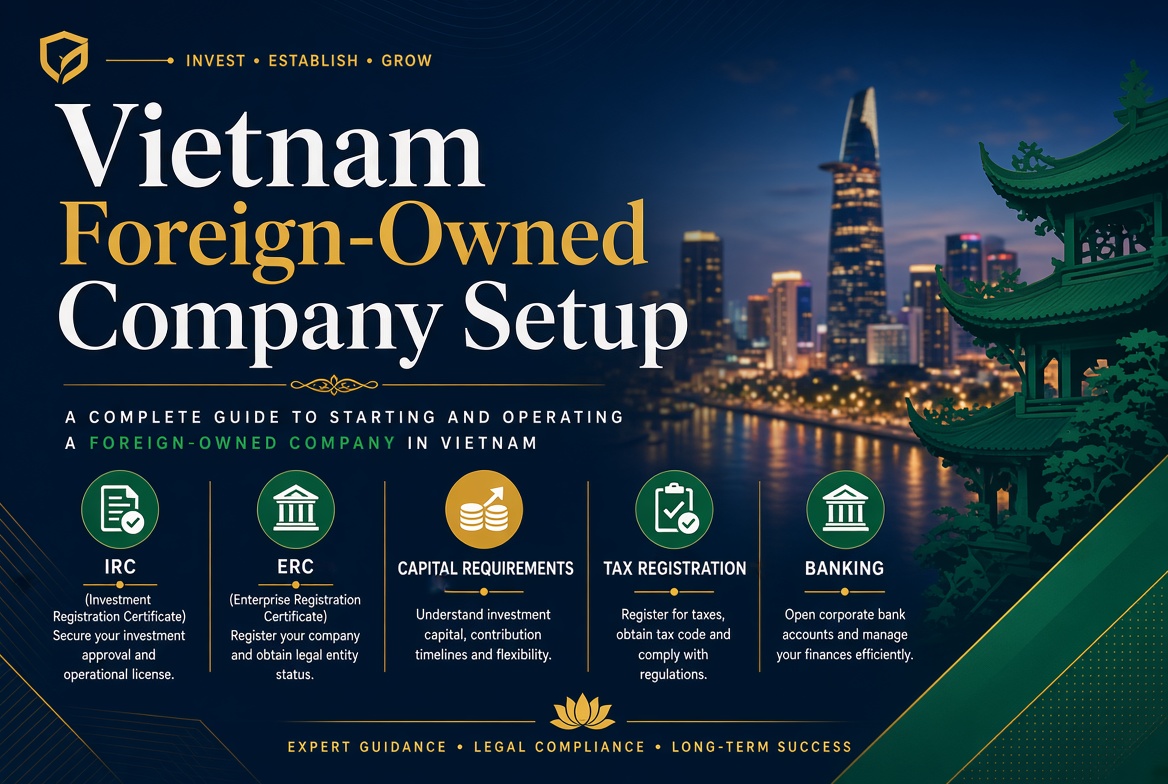

Vietnam Foreign-Owned Company Setup: IRC, ERC, Capital Requirements, Tax Registration and Banking
Published: 2026-10-21 Views:
Vietnam Foreign-Owned Company Setup: IRC, ERC, Capital Requirements,
Tax Registration and Banking
1. Introduction: Why International Businesses Are Considering Vietnam
Vietnam has become an important destination for international businesses seeking access to Southeast Asian markets, manufacturing capacity, regional supply chains, and a growing domestic consumer economy.
For foreign entrepreneurs, establishing a Vietnamese company can provide a local legal entity through which to employ staff, lease commercial premises, enter into customer contracts, manage suppliers, import or export goods, and develop long-term commercial operations.
However, registering a company in Vietnam involves more than selecting a name and submitting a business registration application. Foreign investors must consider market-access restrictions, the proposed business activities, the investment structure, capital requirements, registered office arrangements, tax obligations, and any industry-specific licenses.
The correct incorporation procedure depends on the investor's nationality, corporate structure, business sector, ownership arrangement, investment project, and applicable Vietnamese legislation.
This guide explains how foreign investors can approach Vietnam company registration in 2026, including the major registration documents, practical incorporation stages, expected costs, common mistakes, and an illustrative international-investment case study.
2. What Is Vietnam Company Registration?
Vietnam company registration is the legal process of establishing an enterprise under Vietnamese law so that it can conduct permitted business activities within the country.
Foreign investors may establish a new company, acquire shares or capital contributions in an existing Vietnamese enterprise, or use another investment structure permitted by applicable law.
For many businesses establishing a new operating presence, the process involves two important concepts:
Investment Registration Certificate (IRC): A document associated with the registration of an investment project where an IRC is required.
Enterprise Registration Certificate (ERC): The certificate establishing the enterprise's registered corporate identity and principal registration information.
The IRC and ERC serve different purposes. An IRC relates to an investment project, whereas an ERC records the enterprise itself.
The applicable sequence is not necessarily identical for every investor. Vietnam's Investment Law framework has evolved, and the 2025 Law on Investment introduced changes relevant to investment procedures. Certain investors may be permitted to obtain enterprise registration before completing investment registration, provided the applicable legal conditions are satisfied.
Consequently, investors should verify the current procedure for their specific project rather than assume that every foreign-owned company must follow one universal sequence.
Official reference: Vietnam's investment guidance portal explains the general foreign-invested enterprise establishment process and the role of the relevant certificates.
3. Can Foreign Investors Own a Company in Vietnam?
Foreign individuals and foreign-incorporated businesses can establish or invest in Vietnamese enterprises, subject to the market-access conditions and other requirements applicable to their proposed activities.
Foreign ownership is permitted in many business sectors. However, the precise ownership percentage and any additional conditions depend on the sector, applicable laws, and relevant international commitments.
Before selecting a company structure, an investor should confirm the following:
Whether the proposed business activity is open to foreign investors.
Whether foreign ownership is unrestricted or subject to a maximum percentage.
Whether a Vietnamese business partner is required.
Whether special licenses, professional qualifications, or operating conditions apply.
Whether the project requires investment-policy approval, an IRC, or other project-specific approvals.
A company providing ordinary business consulting may face a different regulatory process from a company operating in logistics, education, telecommunications, financial services, real estate, or regulated distribution.
Important: Do not assume that a business activity is unrestricted simply because Vietnamese companies are permitted to conduct it. Foreign investors must assess the conditions applicable specifically to foreign investment.
4. Which Company Structure Is Suitable for Foreign Investors?
The most appropriate structure depends on the investor's ownership plans, governance requirements, financing needs, and intended commercial activities.
4.1 Single-Member Limited Liability Company
A single-member limited liability company is commonly considered when one investor wants to own the Vietnamese enterprise.
The sole owner may be an eligible individual or corporate entity, subject to the applicable investment and market-access rules.
Potential advantages include:
A clearly defined ownership structure.
Separation between the company's assets and the owner's personal assets, subject to applicable law.
A governance arrangement suitable for a wholly owned subsidiary.
A structure that can support local hiring, contracting, and commercial operations.
This structure may suit a foreign manufacturer establishing a Vietnamese subsidiary or an international service company opening a local operating entity.
4.2 Multi-Member Limited Liability Company
A multi-member limited liability company may be suitable when two or more investors want to establish a business together.
The investors should agree on their respective capital contributions, ownership interests, management responsibilities, voting arrangements, and procedures for transferring ownership.
A written shareholders' or members' arrangement can help prevent disputes over financing, profit distribution, management authority, and future exits.
4.3 Joint-Stock Company
A joint-stock company may be appropriate for businesses that anticipate multiple shareholders, more complex governance, or future capital-raising activities.
Its suitability depends on the intended ownership arrangement and the legal requirements applicable to the proposed business.
Investors should compare governance costs and administrative obligations before selecting this structure.
4.4 Representative Office or Branch
A representative office may be useful for certain permitted activities, such as market research, liaison, and business development. It is not generally a substitute for a fully operational trading company.
A branch may be available for eligible businesses under the applicable rules but is subject to separate requirements.
If the commercial objective is to sell products locally, issue invoices, employ an operating team, or enter into customer contracts through a Vietnamese enterprise, investors should assess whether establishing a company is more appropriate.
5. Vietnam Company Registration Requirements for Foreign Investors
Preparing the project correctly before submitting applications can reduce delays and unnecessary revisions.
5.1 Investor Identification and Corporate Documents
For an individual investor, the documentation commonly includes:
A valid passport.
Residential address information.
Contact details and other requested personal information.
Documents required to verify identity or source of funds, where applicable.
For a corporate investor, the documentation may include:
Certificate of incorporation or equivalent registration document.
Constitutional documents, such as articles of association.
Information about directors and authorized representatives.
Corporate resolutions approving the investment.
Evidence of signing authority.
Ultimate beneficial ownership information, where required.
Foreign-issued documents may require consular legalization or another accepted authentication process, together with a Vietnamese translation completed in accordance with the applicable rules.
Requirements depend on the document, issuing jurisdiction, applicable treaties, and the receiving authority's current procedures.
5.2 Proposed Company Name
The proposed name must comply with Vietnamese enterprise naming requirements and must not conflict with applicable naming restrictions.
Investors should prepare alternative names before filing, particularly when the preferred name contains common industry terms or resembles an existing registered enterprise.
A name that is available in one language or commercial context should not automatically be assumed to be acceptable in every form of registration.
5.3 Registered Office Address
The company needs a lawful registered office address that satisfies the applicable requirements.
Before signing a lease, confirm that the premises can lawfully be used for the intended purpose and that the landlord can provide the documentation needed for registration and subsequent operations.
A mailing address or informal virtual office arrangement may not satisfy every regulatory requirement.
Companies planning manufacturing, warehousing, food production, education, or other regulated activities may need additional premises-related approvals.
5.4 Business Lines and Foreign Market Access
Business lines should accurately reflect the activities the company intends to conduct.
Investors should not simply copy a long list of unrelated business activities from another company's registration documents.
Each proposed activity should be checked against the relevant Vietnamese industry classification, foreign-investment market-access conditions, and licensing requirements.
Where necessary, the company should obtain additional sector-specific approvals before commencing regulated activities.
5.5 Investment Capital and Capital Contribution Schedule
Vietnam does not impose one universal minimum charter capital amount for every company across all business sectors.
The appropriate capital level depends on the business model and any applicable sector-specific requirements.
Authorities may consider whether the proposed investment capital is consistent with the project scope, operating costs, premises, staffing, equipment, and implementation schedule.
Investors should distinguish between:
Charter capital: Capital committed by the owners in accordance with the company's registration and governing documents.
Total investment capital: The overall funding allocated to the investment project, which may include charter capital and other permitted funding sources.
The capital contribution schedule should be realistic and consistent with applicable law and the company's registered commitments.
A company should not declare an artificially high capital amount merely to appear financially strong, nor should it choose an amount that is inadequate for its actual operations.
6. Step-by-Step Vietnam Company Incorporation Process
The following is a practical framework. The exact order, forms, authority, and approval requirements must be confirmed for the particular investment project under the rules in force when the application is filed.
Step 1: Define the Business Model
Start by identifying the company's intended activities.
For example, a trading company importing industrial components has different operational needs from a factory manufacturing electronic products or a software company providing regional technology services.
Prepare a clear business description covering:
Products or services.
Target customers.
Expected suppliers and markets.
Proposed operating location.
Staffing requirements.
Estimated start-up costs.
Planned funding sources.
Expected commencement date.
A clear project description makes it easier to assess market access, licensing, capital adequacy, and premises requirements.
Step 2: Conduct a Foreign Investment Eligibility Review
Confirm whether the investor can conduct the proposed activities under the intended ownership structure.
This stage should identify any restrictions on foreign equity, local-partner requirements, conditional business lines, and investment-policy approval requirements.
If the project involves land, industrial facilities, construction, environmental impacts, fire prevention, or other regulated matters, determine which additional approvals may apply.
Step 3: select the Company Structure and Location
Choose an appropriate legal structure and determine where the company will operate.
Common locations considered by international businesses include Ho Chi Minh City, Hanoi, Hai Phong, Da Nang, and industrial zones in various provinces.
The decision should be based on commercial factors rather than reputation alone.
Consider logistics access, suppliers, labor availability, customers, lease costs, local infrastructure, and any incentives for which the project may qualify.
Step 4: Prepare the Investment and Registration Documents
Compile the investor documents, company name proposal, registered office information, business activities, investment explanation, capital structure, and authorized representative details.
For a corporate investor, confirm that the investment has been properly approved under the parent company's internal governance procedures.
All documents should use consistent names, addresses, ownership percentages, capital figures, and project descriptions.
Step 5: Complete the Applicable Investment Procedures
Where required, prepare and submit the investment project dossier and apply for an Investment Registration Certificate.
The dossier may contain information concerning:
The investor and investment project.
Project objectives and scope.
Proposed location.
Investment capital and funding sources.
Capital contribution and financing schedules.
Project implementation timetable.
Land use and infrastructure requirements, where relevant.
Proposed incentives, where applicable.
Some projects may require investment-policy approval before subsequent procedures. Others may be subject to a different process.
The competent authority and filing route depend on the nature, location, and regulatory classification of the project.
Step 6: Obtain Enterprise Registration
Prepare the enterprise registration dossier, including the prescribed application, company charter, owner or member information, legal representative details, and other required documents.
Where the applicable framework permits enterprise registration before investment registration, the company must still complete the investment procedures required for its project.
The Enterprise Registration Certificate establishes the enterprise's registered identity, but it does not automatically authorize every regulated business activity.
Step 7: Complete Tax, Banking, and Accounting Arrangements
After registration, establish the company's financial and administrative systems.
Depending on the business, this may include:
Confirming its tax identification information.
Opening an appropriate corporate bank account.
Arranging accounting and bookkeeping services.
Establishing electronic tax and invoice procedures.
Setting up payroll and social insurance processes, where applicable.
Organizing documentation for capital contributions and cross-border payments.
Reviewing foreign exchange and banking requirements.
Banks may request additional corporate, beneficial ownership, identity, business-purpose, and source-of-funds documentation.
Corporate bank account approval is a separate process and should not be assumed to be automatic upon company registration.
Step 8: Obtain Additional Business Licenses if Necessary
Certain activities require further licenses, registrations, or operating approvals.
Examples may include regulated distribution, food production, education, financial services, transport, healthcare, manufacturing activities with specific environmental obligations, and other conditional business sectors.
Before accepting customers or commencing regulated operations, confirm that all required conditions have been satisfied.
Step 9: Establish Ongoing Compliance Procedures
Create a compliance calendar covering tax filings, accounting records, invoices, employment obligations, annual reporting where applicable, and updates to registered information.
The company should also monitor capital contribution deadlines, project implementation commitments, investment reporting requirements, and changes in ownership or management.
Good compliance starts when the company is incorporated, not when the first tax deadline arrives.
7. How Long Does Vietnam Company Registration Take?
There is no single reliable timeline for every foreign-owned company.
The total time depends on the investment structure, sector, location, document preparation, legalization requirements, approval sequence, and any supplementary licenses.
A practical planning framework is:
| Stage | Planning Consideration |
|---|---|
| Business and ownership assessment | Depends on sector complexity and investor readiness |
| Document collection and authentication | Depends on the issuing country and document type |
| Investment procedures, where required | Depends on the project and approval authority |
| Enterprise registration | The statutory processing period may be short once a valid dossier is accepted |
| Banking and tax setup | Depends on bank checks and operational readiness |
| Sector-specific approvals | May add substantial time for regulated projects |
Vietnam's official investment guidance states that a valid enterprise registration dossier may be processed within three working days after receipt. This is a statutory processing benchmark for the relevant registration step, not a guarantee that the entire foreign-investment project can be completed within three days.
Investors should obtain a project-specific timetable before committing to factory opening dates, customer delivery deadlines, hiring plans, or commercial launch announcements.
8. How Much Does It Cost to Register a Company in Vietnam?
The total cost varies considerably. A simple consulting subsidiary and a manufacturing investment project can have very different budgets.
There is no single government fee or standard package price that represents the total cost for every foreign investor.
The main cost categories include:
1. Government and registration expenses
These may include applicable application, registration, publication, certification, and administrative charges.
2. Document preparation and authentication
Foreign corporate documents may require notarization, consular legalization or another accepted authentication method, certified translation, and local document preparation.
3. Professional services
Legal, investment, accounting, tax, and company-secretarial services may be needed depending on the project's complexity.
4. Office or industrial premises
Rent, deposits, utilities, fit-out costs, and any premises-related compliance expenses should be budgeted separately.
5. Banking and capital funding
Consider bank documentation, international transfers, currency conversion, and the timing of capital contributions.
6. Tax and accounting operations
Bookkeeping, tax compliance, electronic invoicing, payroll, and annual accounting work may create recurring expenses.
7. Sector-specific licenses and approvals
Regulated activities may involve additional application work, inspections, technical documentation, or professional requirements.
How Should Investors Compare Incorporation Quotes?
Request a written quotation that separates:
Government charges.
Professional service fees.
Translation and authentication costs.
Registered office and rental expenses.
Accounting and tax services.
Additional licensing costs.
Recurring annual expenses.
Taxes and other exclusions.
A low headline price may cover only preparation of an enterprise registration dossier. It may not include investment registration, licensing, banking support, or post-incorporation compliance.
For accurate budgeting, investors should compare the same scope of work rather than comparing package prices alone.
9. Tax and Accounting Considerations After Incorporation
Company registration is the beginning of the compliance process, not the end.
The tax treatment of a Vietnamese enterprise depends on its activities, revenue, transactions, applicable incentives, and the tax rules in force during the relevant period.
Corporate Income Tax
Vietnamese enterprises may be subject to corporate income tax on taxable income under the applicable rules.
Investors should not assume that every company automatically qualifies for a preferential tax rate or tax holiday.
Any incentive should be assessed against the project's location, industry, eligibility conditions, and supporting documentation.
Value-Added Tax
VAT treatment depends on the nature of the goods or services, transaction structure, applicable rate, and relevant exemptions or special rules.
Companies should establish correct invoice and supporting-document procedures from the beginning.
Foreign Contractor and Cross-Border Tax Issues
Payments to overseas service providers, licensors, contractors, or related companies may require a review of foreign contractor tax, withholding obligations, treaty eligibility, transfer pricing, and documentation requirements.
The treatment depends on the transaction and the applicable law.
Payroll and Employment Compliance
Hiring local or foreign employees can trigger employment contracts, payroll administration, social insurance, personal income tax, and work-permit or immigration considerations.
The company should review these obligations before employing staff.
Accounting and Reporting
A proper accounting system helps the business maintain accurate financial statements, substantiate transactions, monitor cash flow, and meet statutory reporting requirements.
International groups should also consider intercompany agreements, related-party transactions, and transfer-pricing documentation where applicable.
10. Common Mistakes Foreign Investors Should Avoid
Mistake 1: Choosing Business Activities Without Checking Market Access
A business activity may be available to domestic investors but subject to additional conditions for foreign investors.
Better approach: Complete the market-access assessment before finalizing the ownership structure.
Mistake 2: Assuming There Is One Minimum Capital Amount for All Businesses
Capital requirements depend on the sector, project, and applicable regulations.
Better approach: Prepare a capital plan based on realistic operating expenses and legal requirements.
Mistake 3: Using an Unsuitable Office Address
A registration address may be insufficient for a factory, warehouse, or regulated operation.
Better approach: Check the lawful use of the premises and any relevant zoning, lease, or licensing conditions before signing a long-term contract.
Mistake 4: Treating Registration as Permission to Conduct Every Activity
An ERC does not automatically replace all specialized operating licenses.
Better approach: Create a separate licensing checklist for each business line.
Mistake 5: Ignoring Capital Contribution Deadlines
Failure to meet applicable contribution obligations can lead to legal and administrative consequences.
Better approach: Maintain a documented funding schedule and coordinate contributions with banking and foreign exchange requirements.
Mistake 6: Underestimating Banking Requirements
A registered company may still need to satisfy extensive bank due diligence.
Better approach: Discuss the proposed ownership structure, source of funds, expected transactions, and documentation requirements with prospective banks early.
Mistake 7: Neglecting Post-Registration Compliance
Missed filings, incorrect invoices, inadequate accounting records, and unreported changes can create avoidable risks.
Better approach: Establish a compliance calendar and assign responsibility for each obligation.
11. Shenzhen Ruibo Successful Case: A foreign manufacturer sets up a subsidiary in Vietnam
Background
A hypothetical overseas manufacturer, referred to here as Meridian xxxxx., wants to establish a wholly owned Vietnamese subsidiary to supply industrial components to customers in Southeast Asia.
The parent company intends to lease a suitable operating facility, recruit local employees, purchase production equipment, and gradually expand its customer base.
Its management initially expects that registering a company will be the only major legal step.
Challenge 1: Determining Whether the Proposed Activities Are Permitted
The proposed business includes industrial component trading and a potential manufacturing operation.
These activities need to be assessed separately because the relevant market-access conditions, premises requirements, and operating approvals may differ.
The investor therefore prepares a detailed activity description and evaluates the proposed foreign ownership structure before committing to a long-term industrial lease.
Challenge 2: Developing a Defensible Capital Plan
Rather than selecting an arbitrary capital figure, the company prepares a financial forecast covering:
Equipment and installation.
Lease deposits and facility preparation.
Initial inventory.
Staff recruitment and payroll.
Logistics and distribution.
Working capital for the first operating period.
This approach helps align the declared investment with the actual project plan and expected cash requirements.
Challenge 3: Preparing Consistent Documentation
The parent company's legal name, registered address, ownership information, authorized representative, and investment approvals must be reflected consistently in the relevant documents.
The team also checks authentication and translation requirements before submitting the dossier.
This reduces the risk of corrections caused by inconsistent company names, capital amounts, or descriptions of the proposed project.
Challenge 4: Planning for Banking and Operations
The investor contacts prospective banks and prepares corporate ownership documents, source-of-funds information, and an explanation of the planned cross-border transactions.
At the same time, the project team arranges accounting procedures and identifies any additional permits required before manufacturing begins.
Illustrative Outcome
Under this approach, Meridian xxxxx. would be better positioned to coordinate company formation, investment compliance, capital funding, premises arrangements, and operational licensing as one integrated project.
The main lesson is not that every investor can register within a fixed number of days. It is that early legal and operational planning can reduce avoidable delays and help prevent a company from being registered without being ready to conduct its intended business.
12. Is Professional Assistance Necessary for Vietnam Company Registration?
Some investors may be able to prepare straightforward registration documents internally. However, foreign-owned projects can involve several interconnected areas of law and administration.
Professional assistance may be valuable when:
The investor is a foreign individual or overseas company.
The proposed sector has foreign ownership restrictions.
Investment registration or investment-policy approval may be required.
Foreign documents need authentication and Vietnamese translation.
The company will manufacture, import, export, distribute, or operate in a regulated sector.
The investor needs assistance coordinating tax, accounting, banking, and licensing arrangements.
The parent company requires reliable reporting and ongoing compliance support.
When selecting a service provider, ask for a clear scope of work, written fee breakdown, realistic timeline, identification of excluded services, and an explanation of which steps require official approval.
Investors should also verify the provider's qualifications, relevant experience, contractual responsibilities, and ability to coordinate with appropriately licensed local professionals.
No service provider should promise guaranteed approval when the decision rests with a competent authority.
13. Frequently Asked Questions About Vietnam Company Registration
Q1. Can a foreigner register a company in Vietnam?
Yes, foreign individuals and foreign companies may establish or invest in Vietnamese enterprises, subject to applicable market-access rules, ownership restrictions, and sector-specific requirements.
Q2. Can a foreign investor own 100% of a Vietnamese company?
Full foreign ownership is possible in many sectors, but it is not universally available. The permitted ownership percentage must be checked against the relevant laws and market-access commitments.
Q3. What are IRC and ERC in Vietnam?
An IRC is an Investment Registration Certificate associated with an investment project when required. An ERC is an Enterprise Registration Certificate recording the enterprise's registration information. They serve different legal purposes.
Q4. Must an investor obtain an IRC before an ERC?
Not necessarily in every case. The applicable sequence depends on the current investment framework, the project, and the investor's eligibility. Some investors may be permitted to complete enterprise registration before investment registration, subject to the applicable conditions.
Q5. What is the minimum capital required to establish a company in Vietnam?
There is no single minimum charter capital amount that applies to every company. Sector-specific laws, project requirements, and practical operating needs may affect the appropriate amount.
Q6. How long does Vietnam company registration take?
The overall timeline depends on document readiness, investment procedures, sector, location, and additional approvals. A statutory processing period for one certificate should not be confused with the time needed to complete the entire project.
Q7. Can a foreign company establish a Vietnamese subsidiary remotely?
Certain preparation and authorization procedures may be handled remotely, depending on the investor, documents, and relevant authority. Identity verification, original documents, authentication, banking checks, or other steps may still be necessary.
Q8. Does every Vietnamese company need a local shareholder?
No. A local shareholder is not universally required. Whether one is necessary depends on the sector and the applicable foreign investment conditions.
Q9. Can a company operate immediately after receiving its ERC?
Not always. The enterprise must satisfy the requirements applicable to its actual activities. Additional business licenses, premises approvals, tax arrangements, and other conditions may need to be completed before operations begin.
Q10. Does a registered company automatically qualify for tax incentives?
No. Incentives depend on the applicable law and the project's eligibility, location, industry, and compliance with relevant conditions.
Q11. Can an overseas parent company be the owner of a Vietnamese subsidiary?
Yes, subject to the applicable foreign investment requirements. Corporate investors may need to provide incorporation documents, internal approvals, representative information, and authenticated or translated documents.
Q12. What should investors prepare before requesting an incorporation quotation?
Prepare the investor's country of incorporation, proposed business activities, intended ownership structure, planned location, estimated investment budget, expected staffing, and any special licensing needs. These details help a service provider assess the project more accurately.
14. Final Checklist Before Registering a Company in Vietnam
Before starting the registration process, confirm that you have addressed the following points:
The proposed business activities have been reviewed for foreign market access.
The ownership structure has been selected.
The registered office or project location has been assessed.
The investor's identification and corporate documents are available.
Authentication and translation requirements have been checked.
The investment and capital contribution plans are realistic.
The applicable IRC, ERC, and investment-policy procedures have been identified.
Banking and cross-border funding requirements have been considered.
Additional licenses have been identified.
Accounting, tax, employment, and ongoing compliance responsibilities have been assigned.
Conclusion: Build the Right Structure Before Entering the Vietnamese Market
Vietnam company registration can provide international businesses with a practical platform for serving local customers, building supply chains, expanding manufacturing, and developing regional operations.
However, successful incorporation requires more than obtaining a registration certificate. Investors need to understand foreign ownership conditions, investment procedures, capital commitments, licensing requirements, banking arrangements, and continuing compliance obligations.
The most effective approach is to evaluate the business model first, select a legally appropriate structure, prepare consistent documentation, and coordinate registration with the company's operational plans.
For foreign investors, careful preparation can make the difference between simply obtaining a certificate and establishing a Vietnamese business that is genuinely ready to operate.
Disclaimer: This article is for general informational purposes only and does not constitute legal, tax, accounting, or investment advice. Vietnamese legislation and administrative procedures may change. Confirm the applicable requirements with the competent Vietnamese authorities and qualified local professionals before making an investment or submitting an application.