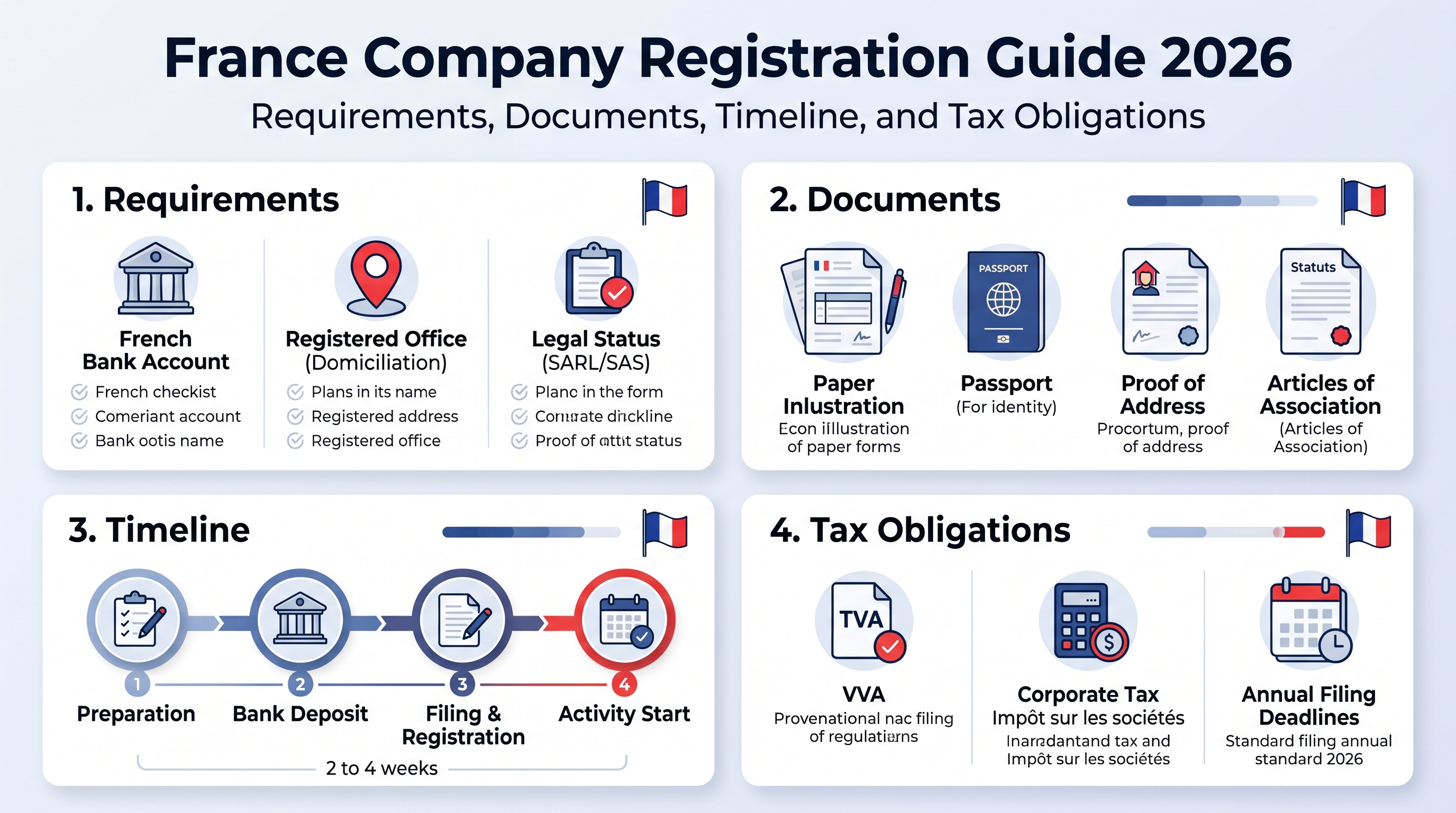

France Company Registration Guide 2026: Requirements, Documents, Timeline and Tax Obligations
Published: 2026-10-27 Views:
France Company Registration Guide 2026: Requirements, Documents, Timeline and Tax Obligations
Introduction: Why Register a Company in France?
France is one of Europe's major business markets, offering access to the European Union, an established legal system, developed infrastructure, skilled professionals and a broad consumer market. For international entrepreneurs, registering a French company can provide a local legal entity for selling products, providing services, hiring employees, entering commercial contracts and developing long-term European operations.
However, company registration in France is not simply a matter of submitting a form. Foreign investors must select an appropriate legal structure, prepare incorporation documents, establish a registered office, arrange share capital where required, publish a legal notice and complete the relevant registration formalities.
The right approach depends on the business model, ownership structure, investment budget, management arrangements and expected tax position.
This guide explains how to register a company in France in 2026, including the main legal structures, registration requirements, incorporation steps, taxation considerations, common mistakes and a representative business case study.
1. What Is Company Registration in France?
Company registration in France is the legal process through which a business entity is established and entered into the relevant French business registers.
For most commercial companies, the process involves preparing the articles of association, depositing share capital, establishing a registered office, publishing a legal announcement and submitting an application through the official business formalities portal.
Following successful registration, the company receives a SIREN identification number. Establishments are identified by SIRET numbers, and commercial companies are generally registered in the Trade and Companies Register, known as the Registre du commerce et des sociétés (RCS), where applicable.
Foreign investors should distinguish between three separate matters:
Company incorporation: Establishing the French legal entity.
Tax and operational registration: Addressing corporate tax, VAT, payroll and other applicable obligations.
Immigration and business authorization: Determining whether a foreign founder or manager needs a visa, residence permit or specific authorization to live and work in France.
Registering a company does not automatically grant its foreign shareholders or directors the right to reside or work in France.
2. Which Legal Structure Should You Choose in France?
Choosing the correct legal structure is one of the most important decisions in French company formation. It affects management powers, shareholder liability, taxation, social security treatment and future investment flexibility.
The following are common options for international entrepreneurs.
2.1 SAS — Société par actions simplifiée
The SAS is a simplified joint-stock company and is widely considered by businesses that require flexible governance.
Key characteristics include:
One or more shareholders.
A minimum share capital requirement that can be as low as €1, subject to the company's structure and funding needs.
Limited shareholder liability, generally limited to contributions.
Flexible arrangements for voting rights, share transfers and corporate governance, within applicable legal limits.
A president who represents the company under the applicable rules.
Corporate income tax as the standard tax treatment, subject to applicable exceptions and elections.
An SAS may suit international trading companies, technology businesses, consulting firms, subsidiaries of foreign groups and companies expecting to attract investors.
Its flexibility is useful, but the articles of association must be drafted carefully. Poorly designed provisions on shareholder decisions, transfers and management powers can create disputes later.
2.2 SASU — Société par actions simplifiée unipersonnelle
An SASU is an SAS with a single shareholder.
It is frequently considered by a foreign entrepreneur who wants to establish a French company independently or by an overseas parent company creating a wholly owned French subsidiary.
The principal advantages include a single-shareholder structure, flexible governance and limited liability in the usual circumstances.
An SASU is not automatically cheaper to operate than every alternative. Its accounting, tax filings, management remuneration and social security implications must still be considered.
2.3 SARL — Société à responsabilité limitée
The SARL is a limited liability company commonly used by small and medium-sized businesses.
Its principal characteristics include:
Between 2 and 100 shareholders under the standard SARL structure.
Shareholder liability generally limited to contributions.
A manager, known as a gérant, rather than the SAS president structure.
A more legally defined governance framework than an SAS.
Corporate income tax as the usual default, with certain exceptions and elections depending on the circumstances.
A SARL can be appropriate for family businesses, established trading companies and businesses whose owners prefer a more prescribed governance structure.
2.4 EURL — Entreprise unipersonnelle à responsabilité limitée
An EURL is a single-member form of SARL.
It may suit an entrepreneur who wants a one-owner limited liability company under the SARL legal framework.
Its tax treatment depends partly on the identity of the sole shareholder and applicable elections. For example, an EURL owned by an individual is generally subject to personal income tax by default, while certain structures may elect corporate income tax.
The choice between an EURL and an SASU should not be made solely on the basis of the registration fee. Management status, social security contributions, remuneration, dividends and expected profits may lead to different overall outcomes.
Quick Comparison of French Company Structures
| Feature | SAS | SASU | SARL | EURL |
|---|---|---|---|---|
| Shareholders | One or more | One | Generally 2–100 | One |
| Minimum share capital | No general statutory minimum above €1 | No general statutory minimum above €1 | No general statutory minimum above €1 | No general statutory minimum above €1 |
| Management | President | President | Manager (gérant) | Manager (gérant) |
| Typical use | Growing or investor-oriented business | Single-owner company or subsidiary | SME or closely held business | Single-owner business |
| Standard tax approach | Corporate income tax | Corporate income tax | Corporate income tax | Personal income tax for an individual owner, generally, subject to exceptions |
Important: A low statutory minimum capital does not mean that €1 is sufficient to finance a real business. Banks, suppliers, landlords and commercial partners may expect capital that reflects the company's activities and financial needs.
The legal structure should be selected after reviewing ownership, governance, taxation and social security implications.
3. Can a Foreign Investor Register a Company in France?
Yes. Foreign nationals and overseas businesses can establish companies in France, subject to the applicable rules.
In many ordinary business activities, French nationality is not a general requirement for shareholders. However, the founder's nationality, place of residence, proposed management role and industry may affect the additional formalities.
Before beginning registration, a foreign investor should review the following matters.
3.1 Foreign Shareholders
A foreign individual or overseas company may be able to hold shares in a French company, including all of its shares, depending on the applicable activity-specific rules.
For a corporate shareholder, the documentation may include:
Certificate of incorporation or an equivalent company registration document.
Constitutional documents or articles of association.
Evidence identifying the company's directors and authorized representatives.
Ownership information and ultimate beneficial owner details.
A board resolution or other authorization approving the French investment, where appropriate.
Certified translations or other formalities when required.
The exact requirements depend on the documents, country of origin, receiving institution and registration circumstances.
3.2 Foreign Directors and Managers
Foreign nationals may be appointed to management positions when the relevant legal requirements are satisfied.
Nevertheless, the right to manage or own a French company is not the same as the right to work physically in France. A person who intends to relocate and actively perform duties in France should check the applicable immigration and residence rules.
Some regulated activities also require professional qualifications, approvals, licenses or specific authorizations.
3.3 Foreign Investment Screening
Certain investments may be subject to French foreign investment screening, particularly in activities involving national security, critical infrastructure, sensitive technologies or other protected sectors.
An overseas investor should determine whether prior authorization is necessary before completing a transaction or implementing a controlled investment.
Practical recommendation: Review the proposed business activity before drafting the articles of association. This helps identify licensing, ownership, immigration and investment-control issues before money is committed.
4. What Documents Are Required for French Company Registration?
The document package depends on the chosen structure, shareholder profile and business activity.
For a standard SAS, SASU, SARL or EURL, the following documents are commonly relevant.
4.1 Shareholder and Director Documents
Valid passport or other accepted identity document.
Residential address information.
Details of shareholders and directors or managers.
Information identifying the ultimate beneficial owners.
Additional declarations or supporting documents required by the applicable filing rules.
4.2 Corporate Documents
Signed articles of association.
Information on share capital and shareholder contributions.
Appointment documents for the president or manager, where applicable.
Evidence of the registered office.
Certificate confirming the deposit of share capital, when required.
Evidence of publication of the legal formation notice.
Beneficial ownership information.
Any activity-specific authorization or supporting documentation.
If a foreign company is a shareholder, its corporate documents may require translation or additional authentication, depending on their origin and the filing requirements.
4.3 Registered Office in France
A French company must establish an eligible registered office.
Possible arrangements may include:
Commercial premises leased by the company.
Eligible premises made available by a founder or director.
A registered-office or domiciliation service provider.
Another legally acceptable address arrangement.
The address must be supported by appropriate evidence and comply with the rules applicable to the chosen arrangement.
A registered-office address is not necessarily the same as a factory, shop, warehouse or operational office. The company must also consider whether its actual activities require separate premises, local permissions or additional registrations.
5. How to Register a Company in France: Step-by-Step Process
Step 1: Define the Business Model
Start by identifying the company's intended activities.
For example, an overseas business may plan to establish a French company to sell products within the European Union, distribute imported goods, provide consulting services, develop software or manage a regional subsidiary.
The business model influences the legal structure, tax treatment, registered-office requirements, licenses and expected operating costs.
Step 2: Choose the Legal Structure
Decide whether an SAS, SASU, SARL or EURL is appropriate.
Review the number of shareholders, expected investment, management arrangements, financing plans and tax consequences before making the choice.
Step 3: select the Company Name
Choose a name that complies with applicable requirements and does not improperly infringe another party's rights.
Before committing to a brand, check relevant company-name records, trademarks, domain names and commercial usage.
A registered company name does not automatically provide comprehensive trademark protection.
Step 4: Establish the Registered Office
Obtain a suitable French address and prepare the evidence needed to support the registration.
If using a domiciliation service, verify that the provider can supply the required documents and that the proposed arrangement is suitable for the company's intended activities.
Step 5: Draft and Sign the Articles of Association
The articles of association establish the company's governance framework.
They should address matters such as:
Company name and registered office.
Business purpose.
Share capital and shareholding.
Management appointment and powers.
Shareholder decision-making procedures.
Share transfers and other relevant governance arrangements.
For an SAS with multiple shareholders, the articles deserve particular attention because the structure allows considerable flexibility within the law.
Step 6: Deposit the Share Capital
Arrange the required capital deposit through an eligible institution or other permitted channel.
The institution will issue the appropriate evidence of deposit when the applicable conditions are satisfied.
The capital amount should reflect the company's funding needs rather than merely meeting the lowest possible legal threshold.
Step 7: Publish the Legal Formation Notice
For the relevant commercial company structures, a notice of formation must generally be published through an authorized legal announcement medium.
The announcement provides prescribed information about the newly established company.
The publication must be consistent with the final articles and other incorporation documents.
Step 8: Submit the Registration Application
Submit the incorporation application through France's official business formalities portal.
The filing generally includes the articles of association, registered-office evidence, management information, capital-deposit evidence, publication evidence and other applicable declarations.
Authorities or the filing system may request corrections or additional documentation if information is incomplete or inconsistent.
Step 9: Obtain Registration Evidence
Once the application is accepted, the company receives its identification information and is entered into the relevant registers.
For a registered commercial company, a Kbis extract is commonly used as official evidence of registration in the RCS.
The company should verify its registered details and retain the relevant incorporation documents.
Step 10: Complete Post-Incorporation Formalities
Registration is the beginning of the company's compliance obligations, not the end.
Depending on its activities, the company may need to:
Confirm its tax and VAT position.
Establish bookkeeping and financial reporting procedures.
Open or activate its operating bank account.
Register as an employer before hiring staff.
Arrange payroll and social security compliance.
Obtain required professional or sector-specific authorizations.
Implement invoicing, data protection and contractual procedures.
6. How Much Does It Cost to Register a Company in France?
There is no single total cost applicable to every French company.
The final budget depends on the legal structure, government and registry charges, legal announcement fees, professional assistance, registered-office arrangements, banking requirements and the complexity of the ownership structure.
A useful budget should distinguish between one-time incorporation costs and recurring business expenses.
6.1 One-Time Formation Expenses
Potential expenses include:
Applicable registration and registry charges.
Publication of the legal formation notice.
Legal drafting or professional incorporation assistance.
Translation and document authentication, if required.
Registered-office setup.
Banking and capital-deposit administration, where fees apply.
Share capital should be treated separately from service fees. It is funding contributed to the company, not simply a government registration charge.
6.2 Ongoing Expenses
After incorporation, the company may incur:
Accounting and annual financial statement preparation.
Corporate tax and VAT compliance.
Registered-office fees.
Bank account fees.
Payroll and employer social security costs.
Insurance, rent and other operating expenses.
Annual filings and activity-specific compliance costs.
For budgeting purposes, request an itemized quotation that distinguishes official charges, professional fees, share capital and recurring services.
Do not rely on an advertised incorporation package unless its scope, exclusions and conditions are clearly stated.
6.3 How Long Does Registration Take?
The time required depends on document readiness, the selected structure, the shareholder's country of origin, bank procedures, publication requirements and any regulatory approvals.
A straightforward application may progress relatively quickly after all required documents are complete. A case involving overseas corporate shareholders, complex ownership arrangements, regulated activities or additional authentication may take longer.
There is no universal processing time that applies to every application.
If a business has a fixed launch date, allow additional time for banking, tax setup, supplier onboarding and any necessary authorizations.
7. Corporate Tax and VAT in France
Tax planning should begin before incorporation because the legal structure and business model influence the company's obligations.
7.1 Corporate Income Tax
The standard French corporate income tax rate is 25% for companies subject to the ordinary corporate tax regime.
Eligible small and medium-sized businesses may qualify for a reduced rate of 15% on the first €42,500 of taxable profit, subject to conditions including the applicable turnover threshold, fully paid-up capital and qualifying ownership requirements.
The reduced rate is not automatically available to every newly incorporated company.
Eligibility should be confirmed against the company's ownership structure, turnover and relevant tax period.
7.2 Value Added Tax
VAT treatment depends on the company's activities, turnover, customers, transactions and applicable exemptions or special schemes.
A business selling goods, providing services or trading across EU borders should determine:
Whether it must register for French VAT.
Which VAT rate applies to each transaction.
Whether it must file periodic VAT returns.
Whether intra-EU reporting obligations apply.
Whether import VAT or customs procedures are relevant.
How invoices should be issued and retained.
A French company is not automatically exempt from VAT obligations simply because its revenue is low or it has recently been incorporated. Eligibility for any exemption or simplified regime must be checked separately.
7.3 Accounting and Annual Compliance
French companies must comply with the accounting, reporting and filing rules applicable to their legal form and circumstances.
Depending on the company, obligations may include maintaining accounting records, preparing annual financial statements, obtaining shareholder approval, filing accounts where required and submitting tax returns.
Failure to maintain appropriate records can create problems during tax inspections, financing applications, business sales or shareholder disputes.
For foreign-owned companies, a bilingual accounting and compliance process can help align the French entity's reporting with the overseas parent company's internal requirements.
8. Can You Register a French Company Remotely?
In some cases, yes. A foreign shareholder may be able to complete much of the incorporation process without personally travelling to France.
However, remote incorporation does not eliminate identity verification, document checks, capital-deposit requirements, registered-office obligations or other legal formalities.
The practical process may involve:
Confirming the identity of all relevant shareholders and managers.
Preparing the articles of association and corporate approvals.
Arranging the registered office.
Completing the capital-deposit process through an acceptable institution.
Signing documents using an accepted method.
Publishing the required formation notice.
Submitting the registration application.
Completing any additional tax, banking or regulatory checks.
Banks and financial institutions may apply separate customer due diligence requirements. They may request information about the beneficial owners, source of funds, intended transactions and business model.
A company can therefore be legally incorporated before every banking or operational arrangement is fully finalized.
Foreign founders should also check whether their intended management activities require a visa or residence authorization.
9. Shenzhen Ruibo Registration Success Case: A Foreign Trading Company Enters the French Market
The following is an illustrative case study based on a common international expansion scenario. It is not presented as a verified real client engagement.
Business Background
A fictional overseas trading company, Meridian X X X., plans to sell home accessories and consumer products to French and other EU customers.
Initially, the company expects to work with local distributors, third-party logistics providers and online sales channels. It wants a French legal entity to support local contracts, customer relationships and future recruitment.
The founders have three main priorities:
Establishing a credible local operating company.
Maintaining clear ownership and management arrangements.
Understanding the tax and compliance requirements before launching sales.
Step 1: Selecting the Structure
The founders compare an SASU with an SAS.
Because the initial plan involves a single shareholder and the possibility of bringing in another investor later, they select an SASU as the initial structure for further professional review.
This decision is based on their ownership and governance preferences, not on a claim that an SASU is always the cheapest or most tax-efficient option.
Step 2: Preparing the Documents
The founders prepare the shareholder's corporate documents, identification information, proposed business purpose and registered-office arrangements.
They also review whether the planned product categories require specific import, labeling, safety or distribution compliance measures.
Step 3: Establishing the Company
The company prepares and signs its articles of association, arranges the required capital deposit, publishes the legal formation notice and submits its registration application through the official portal.
The registration documents are checked for consistency before submission.
Step 4: Planning Tax and Operations
Before the first commercial shipment, the founders work with qualified French advisers to review VAT, invoicing, import arrangements, accounting and contractual responsibilities.
They also establish a process for keeping the French company's records separate from those of the overseas parent.
Step 5: Preparing for Growth
Once the company is registered and the relevant operational requirements are addressed, it can begin implementing its French market-entry plan.
If the business later adds shareholders, hires employees or changes its activities, it reviews the resulting corporate, tax and employment implications.
Key Lessons from the Case
This scenario illustrates three important principles.
First, the best company structure depends on the business model and future plans.
Second, incorporation and operational readiness are separate milestones. A registration certificate alone does not resolve every tax, banking, licensing or immigration issue.
Third, early document preparation and tax planning can reduce avoidable delays and inconsistencies.
The same principles apply to many foreign businesses establishing a French subsidiary, although the precise requirements differ by industry and ownership structure.
10. Common Mistakes to Avoid When Registering a Company in France
Mistake 1: Choosing a Structure Based Only on the Registration Fee
A small difference in initial fees may be insignificant compared with long-term accounting, payroll, management and tax consequences.
Compare the complete operating model before choosing an SAS, SASU, SARL or EURL.
Mistake 2: Treating €1 Share Capital as a Recommended Budget
A low legal minimum does not demonstrate that the company has enough working capital.
Consider rent, professional services, insurance, inventory, salaries, marketing and cash-flow requirements.
Mistake 3: Using an Inadequate Registered Office
The proposed address must satisfy the applicable rules and be supported by valid evidence.
Confirm the provider's arrangements and the address's suitability before filing.
Mistake 4: Assuming Registration Automatically Solves Tax and VAT Matters
Tax obligations depend on the actual activities, ownership structure and transactions.
Review the relevant tax position before trading, importing goods, hiring employees or paying dividends.
Mistake 5: Overlooking Foreign Shareholder Documentation
Overseas corporate documents can require additional preparation, translation or authentication.
Identify these requirements early, especially when a parent company owns the French entity.
Mistake 6: Confusing Company Ownership with Permission to Work in France
A person may be able to own shares without automatically acquiring a right to reside or work in France.
Check immigration requirements separately if the founder intends to relocate or actively work in the country.
Mistake 7: Ignoring Ongoing Compliance
Registration does not remove the need for accounting, tax returns, annual filings and other applicable obligations.
Set up a compliance calendar before operations begin.
11. How to Choose a French Company Registration Service Provider
Foreign investors may decide to work with a French lawyer, accountant, corporate service provider or another appropriately qualified professional.
Before appointing a provider, evaluate the following factors.
1. Scope of service
Confirm whether the service covers legal structure selection, articles of association, registered-office arrangements, capital-deposit coordination, legal publication and registration filing.
2. Cross-border experience
A provider familiar with overseas corporate shareholders may be better equipped to identify document and ownership issues early.
3. Tax and accounting support
Ask how the provider handles VAT, corporate tax, bookkeeping, annual accounts and coordination with the overseas parent company.
4. Transparent pricing
Request a written breakdown of official charges, professional fees, registered-office costs, translation costs and ongoing services.
5. Communication and document tracking
Confirm who handles filing questions, how additional document requests are managed and how progress is reported.
6. Professional qualifications
Verify that any legal, tax, accounting or regulated services are performed by professionals authorized to provide them.
No provider can legitimately guarantee that every company will be registered within the same number of days or that every foreign investor will receive the same banking or tax outcome.
12. Frequently Asked Questions About France Company Registration
Q1. Can a foreigner register a company in France?
Yes. Foreign individuals and overseas businesses can establish French companies, subject to applicable company law, sector-specific restrictions and any additional formalities relating to their nationality, residence or intended activities.
Q2. What is the most common company structure for foreign investors in France?
The SAS and SASU are frequently considered because of their flexible governance arrangements. SARL and EURL structures may also be suitable. The appropriate choice depends on ownership, management, taxation and business objectives.
Q3. What is the minimum share capital for a French SAS or SARL?
For an ordinary SAS, SASU, SARL or EURL, the statutory minimum can generally be €1. However, the appropriate capital amount depends on funding needs, credibility, contractual requirements and the nature of the business.
Q4. Can a foreign company own 100% of a French subsidiary?
Full foreign ownership is possible for many ordinary business activities, subject to applicable restrictions, regulatory approvals and any relevant foreign investment screening rules.
Q5. Do I need to live in France to register a French company?
Not necessarily. A foreign investor may be able to own and incorporate a French company while living abroad. Residence and work authorization are separate questions.
Q6. What documents are required?
Typical documents include shareholder and manager identification, articles of association, registered-office evidence, capital-deposit evidence, a legal formation announcement and the applicable ownership declarations. Overseas corporate shareholders may need additional documentation.
Q7. How long does French company registration take?
There is no universal processing time. The duration depends on document readiness, the ownership structure, bank procedures, filing review and any sector-specific approvals.
Q8. Can I register a French company online?
Yes. The official business formalities portal provides the online filing channel for company creation. Supporting documents and other formalities must still satisfy the applicable requirements.
Q9. What is the corporate income tax rate in France?
The standard corporate income tax rate is 25%. Eligible small and medium-sized companies may qualify for a 15% rate on the first €42,500 of taxable profit, subject to the relevant statutory conditions.
Q10. Does every French company need to register for VAT?
Not necessarily. VAT registration and filing obligations depend on the company's activities, transactions, turnover and eligibility for applicable exemptions or simplified schemes.
Q11. Can I open a bank account after incorporation?
A company can apply for an operating account, but acceptance is subject to the financial institution's due diligence and internal requirements. Incorporation does not guarantee account approval.
Q12. Can a French company hire employees?
Yes, subject to applicable employment, payroll, social security and immigration requirements. Employer registration and other formalities may need to be completed before employment begins.
Q13. Is a registered office compulsory?
A French company must establish an eligible registered office and provide the required evidence for registration.
Q14. Can I change the company structure later?
Certain changes may be possible, but they can require corporate approvals, formal filings, professional advice and tax analysis. It is generally better to evaluate the intended growth path before incorporation.
Q15. What should I do before starting the registration process?
Define the business activity, ownership structure, management arrangements, expected funding and operating model. Then review the legal form, registered-office options, required documents, tax position and any regulatory restrictions.
Conclusion: Build a Compliant Foundation for Your French Business
Registering a company in France can provide foreign investors with a legal platform for entering the French market and developing broader European operations.
A successful incorporation project requires more than obtaining a registration certificate. The investor must select an appropriate legal structure, prepare consistent documents, establish a compliant registered office, arrange capital, complete the filing process and plan for ongoing tax and accounting obligations.
For many international businesses, an SAS or SASU may offer useful governance flexibility, while a SARL or EURL may be more appropriate for other ownership and management arrangements. The correct choice depends on the specific circumstances.
Before committing funds, verify current procedures through the official French business formalities portal and obtain qualified legal and tax advice where necessary.
Disclaimer: This article provides general information about French company formation and is not a substitute for legal, tax, immigration or accounting advice. Requirements, fees and procedures may change. Confirm the rules applicable to your specific business before acting.