
Canada Business Registration for Non-Residents: Registered Office, Directors, BN and GST/HST
Published: 2026-09-20 Views:
Opening:
Canada remains an important market for international companies that need a North American operating base, a local subsidiary, a trading entity, a technology business, a manufacturing platform or a corporate structure connected to Canadian customers and supply chains.
However, registering a Canadian company is not simply a matter of submitting a form and receiving a certificate of incorporation.
For a foreign founder, the more important question is:
What type of Canadian entity should be established, where should it be incorporated, who can serve as a director, what registrations are required after incorporation, and how should the company remain compliant once it starts operating?
Canada allows businesses to incorporate federally or under the legislation of a province or territory. After incorporation, the company may also need a federal Business Number, CRA program accounts, extra-provincial registrations, permits and licences depending on its activities and locations.
As of September 2026, a federal business corporation can generally be incorporated online through Corporations Canada for CAD 200, with a standard service standard of one business day. Express service is available for an additional CAD 100, with a stated service standard of four business hours for eligible online applications.
The following guide explains the Canadian company registration process from the perspective of an international entrepreneur or foreign-owned business.
1. What Does “Registering a Company in Canada” Actually Mean?
A Canadian business setup normally contains several different stages.
The first stage is incorporation.
The second is tax and business registration.
The third is operational compliance.
These are related, but they are not identical.
For example, a founder may successfully incorporate a federal corporation but still need to obtain a Business Number, Corporation Income Tax account, GST/HST account, payroll account or import-export registration, depending on the company's activities.
The federal government explains the basic corporate registration sequence as:
Incorporate federally or provincially/territorially.
Obtain a federal Business Number and corporation income tax account.
Register extra-provincially or extra-territorially where required.
Apply for applicable permits and licences.
This distinction is extremely important for foreign investors because incorporation is the beginning of the Canadian compliance lifecycle, not the end of it.
2. Federal or Provincial Incorporation: What Is the Difference?
One of the first decisions is choosing the jurisdiction.
A company can be incorporated federally under the Canada Business Corporations Act (CBCA) or under the corporate law of a province or territory.
Federal incorporation
Federal incorporation is administered by Corporations Canada.
The federal online process includes choosing a corporate name, preparing articles of incorporation, establishing the registered office and first board of directors, filing information about individuals with significant control, and submitting the application and fee.
For international businesses planning to operate across multiple Canadian jurisdictions, federal incorporation can be considered as one structural option because the corporation is governed under federal corporate legislation.
However, federal incorporation does not eliminate all provincial registration obligations. If the corporation conducts business in another province or territory, extra-provincial or extra-territorial registration may still be required.
Provincial or territorial incorporation
A business may instead incorporate directly in a province or territory.
This can be appropriate where the company's principal operations, management, employees, customers or physical facilities are concentrated in a specific jurisdiction.
The rules differ between provinces.
For example, British Columbia states that its Business Corporations Act eliminated director residency requirements, meaning a BC company does not need a resident BC director simply because it is incorporated there.
Ontario also removed its statutory Canadian-resident director requirement effective July 5, 2021.
By contrast, a federal corporation generally must have at least 25% resident Canadian directors, and if there are fewer than four directors, at least one must be a resident Canadian, subject to specific exceptions.
This difference can materially affect the structure chosen by a non-resident founder.
Simplified comparison
| Issue | Federal Corporation | Provincial Corporation |
|---|---|---|
| Governing legislation | Canada Business Corporations Act | Provincial/territorial law |
| Online federal filing fee | CAD 200 | Varies by jurisdiction |
| Processing | Federal standard generally 1 business day | Depends on province |
| Director residency | Generally 25% resident Canadian; at least one if fewer than four directors | Depends on province |
| Registered office | Required | Required |
| ISC information | Required federally | Depends on jurisdiction |
| Multi-province operation | Extra-provincial registrations may be required | Other registrations may be required |
| CRA registration | Generally required | Generally required |
The correct structure depends on the company's intended activities rather than simply choosing the jurisdiction with the lowest filing fee.
3. Can a Non-Resident Register a Company in Canada?
Yes, foreign investors can establish Canadian businesses, but the incorporation and investment-compliance questions should be considered separately.
Under the Investment Canada Act framework, non-Canadians who establish a new Canadian business or acquire control of an existing Canadian business may have notification or review obligations unless an exemption applies. The federal government states that a non-Canadian establishing a new Canadian business generally must submit a notification or an application for review, depending on the circumstances.
This means an international founder should not assume that:
“I can register the corporation” = “there are no additional foreign-investment requirements.”
The corporate filing, tax registration, immigration status and foreign-investment compliance are separate legal questions.
For example, national-security review under the Investment Canada Act can potentially apply to foreign investments regardless of transaction value.
Certain industries and transactions can therefore require additional analysis before implementation.
4. The Five Core Requirements for a Canadian Federal Corporation
For a standard federal incorporation, the process can be understood through five core components.
4.1 Corporate Name
A federal corporation can generally use either a word name or a numbered name, such as:
12345678 Canada Inc.
Corporations Canada states that a numbered name can be selected during online incorporation, while proposed word names are reviewed to ensure they satisfy the applicable requirements.
The practical issue is not simply whether the name sounds good.
The name should also be checked for:
corporate name conflicts;
trademark considerations;
confusingly similar business names;
domain availability;
intended Canadian market positioning.
A corporate name approval is not automatically the same thing as trademark protection.
4.2 Articles of Incorporation
The articles create the legal framework of the corporation.
Depending on the structure, the articles can address matters such as:
corporation name;
number or range of directors;
share structure;
restrictions on share transfers;
restrictions on business activities;
other corporate provisions.
Corporations Canada confirms that articles may be prepared in English, French or both official languages.
For a company expected to bring in investors, issue multiple share classes or establish a parent-subsidiary structure, the share provisions should be considered before filing rather than added as an afterthought.
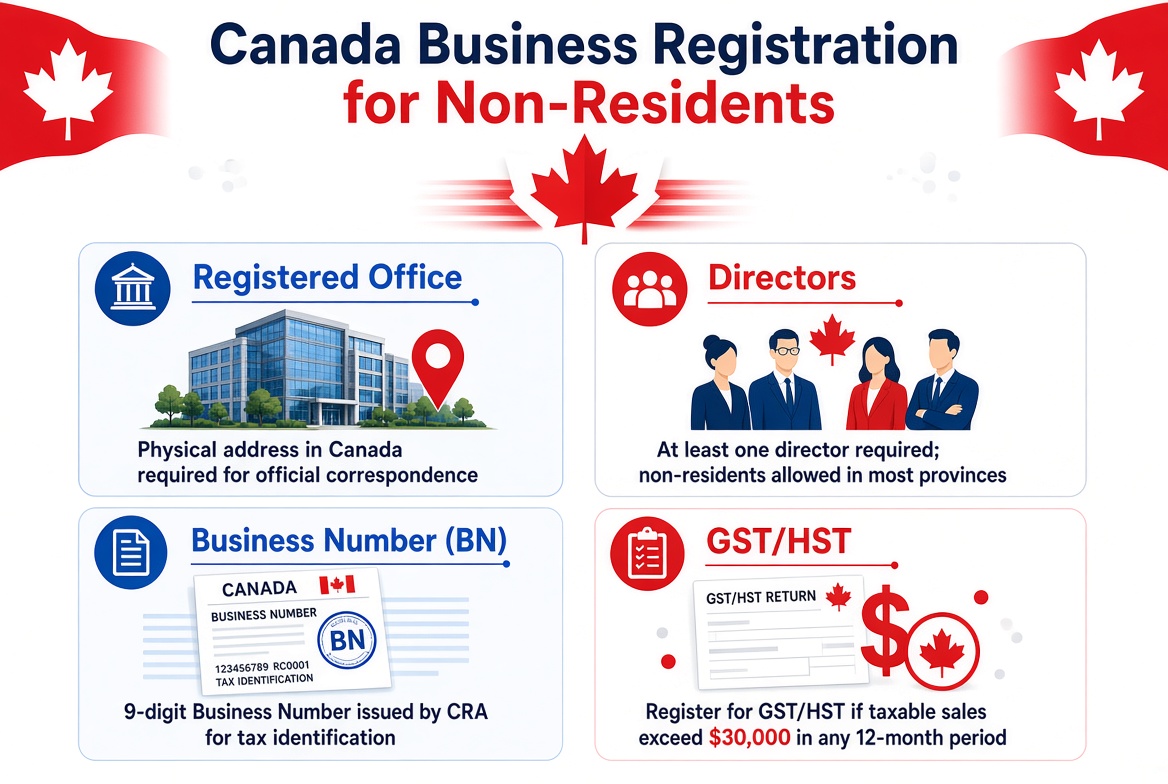
4.3 Registered Office
Every incorporated federal business must have a registered office address.
This is not merely a mailing convenience.
The registered office is where corporate records are maintained and where official documents can be served on the corporation. Corporations Canada specifies that the registered office address must be a street address within the province or territory identified in the corporation's articles and cannot simply be a post-office box.
For overseas founders without a Canadian physical location, obtaining a compliant registered-office solution can therefore become one of the earliest practical challenges.
4.4 Directors
Directors are one of the most important structural considerations for foreign founders.
Under the federal rules, a corporation needs at least one director, and ordinarily at least 25% of the directors must be resident Canadians. Where the corporation has fewer than four directors, at least one must be a resident Canadian.
This is one reason why a foreign-owned company may consider a provincial jurisdiction where local law does not impose the same director-residency requirement.
However, director residency is only one factor.
The company should also consider:
who controls the corporation;
who has signing authority;
who manages banking;
where management decisions are made;
how shareholder rights are structured;
how corporate records will be maintained.
Corporate structuring should therefore be designed around the actual business model rather than a single registration requirement.
4.5 Individuals with Significant Control
Canadian corporate compliance increasingly focuses on corporate transparency.
Federal corporations must file information regarding their Individuals with Significant Control (ISC).
The information is required upon incorporation and must also be updated annually and within 15 days when relevant information changes.
This means that corporate registration should not be approached as a nominal-name exercise.
The ownership and control structure needs to be accurately documented.
5. Step-by-Step Canada Company Registration Process
A practical registration roadmap for an international founder can be organised into the following stages.
Step 1: Define the business model
Before incorporation, identify:
industry;
expected revenue source;
Canadian operating location;
expected employees;
ownership structure;
parent company;
expected shareholders;
import/export requirements;
expected provinces of operation.
This prevents the common mistake of incorporating first and designing the corporate structure later.
Step 2: select the jurisdiction
Compare federal incorporation with the relevant provincial or territorial regime.
The decision should take into account corporate law, director requirements, operating location, extra-provincial registration and long-term expansion plans.
Step 3: Choose the corporate name
Determine whether a word name or numbered corporation is more appropriate.
For a brand-led business, a word name may be important. For a holding structure or fast implementation, a numbered corporation may sometimes be simpler.
Step 4: Prepare the articles
Define the legal ownership structure and shares.
This becomes particularly important when there are:
multiple shareholders;
foreign parent companies;
joint ventures;
investment rounds;
preferred shares;
employee equity plans.
Step 5: Establish the registered office
The company needs a compliant address and a reliable mechanism for handling official correspondence.
Step 6: Appoint directors
Confirm eligibility and, for federal corporations, satisfy the applicable residency requirement.
Step 7: File ISC information
Document the individuals who ultimately own or control the company and file the required information with the relevant authority.
Step 8: Submit incorporation application
For a federal corporation, the current online filing fee is CAD 200, with a standard service standard of one business day according to Corporations Canada.
Step 9: Obtain the Business Number and CRA accounts
The company may need a Business Number and corporation income tax account, along with other CRA program accounts depending on its activities.
CRA's Business Registration Online system is used for BN and program-account registrations; since July 14, 2026, access to BRO is through a CRA account or supported authentication method.
6. GST/HST Registration: A Critical Post-Incorporation Issue
Many new business owners confuse company incorporation with GST/HST registration.
They are separate matters.
For most businesses, the CRA's current small-supplier threshold is CAD 30,000 based on the applicable taxable-supply tests.
If the threshold is exceeded in a single calendar quarter, the business can cease to be a small supplier immediately in accordance with the CRA rules. If the threshold is exceeded over the relevant four-consecutive-quarter period without exceeding it in a single quarter, the registration timing follows a different rule.
Some businesses may also voluntarily register before they are required to do so.
For foreign e-commerce businesses, additional GST/HST rules can apply. CRA guidance separately addresses non-resident vendors and digital-economy businesses.
Therefore, an international founder should assess GST/HST at the business-model stage rather than waiting until sales have already started.
7. Import and Export Registration
Canada is also a major trading market, so international businesses often need customs-related registrations.
Importers and exporters generally need a nine-digit Business Number before registering for an import-export RM program account.
The Canada Revenue Agency directs importers and exporters to the Canada Border Services Agency's CARM system for import-export account registration and management.
For companies involved in international trade, the post-incorporation sequence may therefore look like:
Incorporation → BN → Tax Accounts → Import/Export Registration → Banking → Operations
rather than simply:
Incorporation → Start Selling
8. Corporate Tax Compliance After Registration
A newly incorporated Canadian corporation should establish its accounting and tax calendar immediately.
Corporations generally file a T2 Corporation Income Tax Return within six months after the end of their tax year.
Corporate tax balances are generally due two months after the tax year-end, although eligible Canadian-controlled private corporations claiming the small business deduction can qualify for a three-month balance-due period subject to the stated conditions.
This is separate from the federal corporate annual return.
That distinction is extremely important.
Annual return
A federal corporation must file an annual return with Corporations Canada every year.
The current online filing fee is CAD 12, and the annual return and ISC information are generally due within 60 days following the corporation's anniversary date.
Tax return
The T2 is a tax filing submitted to the CRA.
Annual corporate filing
The Corporations Canada annual return maintains the corporation's corporate information.
They serve different purposes.
A company can therefore be current on one obligation while being late on another.
9. Why Non-Resident Founders Should Be Careful About Tax Residency
A Canadian company may create Canadian tax-residency consequences.
CRA explains that a corporation incorporated in Canada after April 26, 1965, is generally deemed resident in Canada for Canadian income-tax purposes. CRA also notes that central management and control can be relevant in determining corporate residence under common-law principles in circumstances where the deeming rule does not settle the issue.
For a foreign parent establishing a Canadian subsidiary, this means the corporate structure should be designed with tax advice in mind before funds, employees and management are transferred.
The incorporation jurisdiction, ownership, management, related-party transactions and cross-border flows can all become relevant to the company's tax position.
10. Company Registration Does Not Automatically Give a Foreign Founder the Right to Work in Canada
This is another frequently misunderstood issue.
A foreign person can have an ownership interest in a Canadian company, but company ownership and Canadian work authorization are separate questions.
IRCC states that most foreign nationals need a work permit to work in Canada, while certain business visitors may conduct qualifying business activities without a work permit. Business visitors must satisfy specific conditions, including maintaining their main place of business and source of income and profits outside Canada.
Therefore:
Canadian company incorporation ≠ automatic Canadian work authorization.
This distinction should be made clear to every foreign founder before establishing the company.
The Canadian Start-Up Visa program is also currently paused to new applicants, according to IRCC's 2026 information, so founders should not assume that incorporating a company automatically creates an immigration route.
11. What Documents Does a Foreign Founder Typically Prepare?
The exact list depends on the jurisdiction and structure, but a practical preparation package often includes:
Corporate information
proposed company name;
business activity;
registered-office information;
director information;
shareholder information;
share structure;
parent-company information where applicable.
Ownership and KYC information
passport or government ID;
proof of address;
shareholder details;
ultimate beneficial ownership information;
corporate documents of foreign parent entities, where applicable.
Business information
business plan or company profile where relevant;
expected Canadian activities;
expected sales channels;
proposed employees;
Canadian operating address;
expected banking arrangements.
For non-resident businesses dealing directly with the CRA, the CRA has a dedicated non-resident business registration process that can cover the Business Number and certain CRA program accounts, depending on the business circumstances.
12. Common Mistakes in Canada Company Registration
Mistake 1: Choosing a jurisdiction only because the filing fee is low
A low incorporation fee does not necessarily mean the structure is operationally suitable.
The founder should also consider director rules, registered office requirements, provincial registration, banking, taxation and actual business location.
Mistake 2: Ignoring director residency requirements
This can create a structural problem for a federal company before filing.
A foreign shareholder who does not understand Canadian director requirements may discover that the intended board structure cannot be used as planned.
Mistake 3: Treating the corporation as the whole compliance package
Incorporation is only one stage.
BN, CRA accounts, GST/HST, payroll, import/export registration, permits and extra-provincial registration may follow.
Mistake 4: Forgetting annual filings
Federal corporations must file an annual return every year, together with applicable ISC information. Failure to maintain annual filings can put the corporation at risk of administrative dissolution.
Mistake 5: Mixing company registration with immigration planning
Owning a Canadian company does not automatically provide authorization to work in Canada.
Mistake 6: Waiting until after incorporation to design the shareholder structure
Share classes and ownership arrangements should be considered before filing when investors, holding companies or joint-venture partners are involved.
13. A Practical Canada Company Registration Timeline
For a straightforward federal incorporation, the government currently states a standard online processing service of one business day, with eligible express applications processed on a four-business-hour service standard for an additional CAD 100.
However, the complete business setup can take longer because additional activities may be required after incorporation.
A practical project can therefore be organised as:
Stage 1 — Structure Design
Business model, jurisdiction, ownership, directors and shares.
↓
Stage 2 — Corporate Filing
Name, articles, registered office, director information and ISC information.
↓
Stage 3 — CRA Registration
BN, corporation income tax and relevant program accounts.
↓
Stage 4 — Operational Registration
GST/HST, payroll, import/export, permits and extra-provincial registrations where applicable.
↓
Stage 5 — Banking and Operations
Corporate bank account, accounting system, contracts, invoicing and financial controls.
↓
Stage 6 — Ongoing Compliance
Annual return, ISC updates, tax filings, payroll compliance, corporate records and other regulatory filings.
This workflow is generally more reliable than treating “incorporation completed” as the final project milestone.
14. Frequently Asked Questions About Registering a Company in Canada
Can a foreigner register a company in Canada?
Yes. Non-Canadians can establish Canadian businesses, although the corporate structure, director requirements, Investment Canada Act obligations, tax registration and immigration issues should be assessed separately.
How much does federal company registration cost in Canada?
The current online federal incorporation fee for a business corporation is CAD 200, according to Corporations Canada. Express service adds CAD 100 where available.
How long does federal incorporation take?
Corporations Canada currently states a standard online service standard of one business day. Express service can provide a four-business-hour service standard for eligible applications.
Does a federal corporation need a Canadian resident director?
Ordinarily, at least 25% of directors must be resident Canadians; where there are fewer than four directors, at least one must be a resident Canadian, subject to applicable exceptions.
Does every Canadian company need a registered office?
An incorporated federal business must have a registered office. The federal registered office must be a physical street address in the province or territory specified in the articles and cannot be a post-office box.
Is GST/HST registration automatic when a company is incorporated?
No. GST/HST registration is a separate tax-registration issue and depends on the company's circumstances. For most businesses, the small-supplier threshold is CAD 30,000 under the applicable CRA rules.
Does a Canadian corporation need to file an annual return?
Yes. A federal business corporation must file an annual return every year, generally within 60 days following its anniversary date. Applicable ISC information is filed at the same time.
Can an overseas parent company own a Canadian corporation?
A foreign-owned Canadian corporate structure can be established, but the exact ownership, investment, tax and regulatory structure should be reviewed based on the business and sector. The Investment Canada Act may require notification or review for non-Canadian investments.
Does incorporation give the owner a Canadian work permit?
No. Corporate ownership and immigration/work authorization are separate issues. Most foreign nationals need a work permit to perform work in Canada unless an exemption applies.
Is federal incorporation always better than provincial incorporation?
There is no universal answer. Federal and provincial regimes have different corporate-law and registration requirements. The appropriate choice depends on the company's ownership, directors, operations, provinces of activity and long-term structure.
15. Final Checklist for Foreign Investors
Before registering a Canadian company, an international founder should be able to answer the following questions:
What will the Canadian entity actually do?
Where will the business operate?
Should it be federally or provincially incorporated?
Who will own the shares?
Who will be the directors?
Does the selected jurisdiction impose a director-residency requirement?
Where will the registered office be located?
Who are the Individuals with Significant Control?
Does the company need a BN, GST/HST or payroll account?
Will the company import or export?
Will it operate in multiple provinces?
Does the Investment Canada Act require notification or another filing?
Will the foreign owner personally work in Canada, and if so, what immigration authorization is required?
What annual corporate and tax filing calendar will be maintained?
Answering these questions before incorporation can eliminate many of the structural problems that otherwise appear after the company has already been created.
Conclusion
Registering a company in Canada in 2026 is a multi-stage process involving corporate incorporation, ownership structure, directors, registered office, tax registration and ongoing compliance.
For federal incorporation, the current online government filing fee is CAD 200, while the standard federal processing service is one business day. However, foreign founders should look beyond the incorporation certificate itself. Director residency, ISC reporting, CRA registrations, GST/HST, import-export requirements, provincial registrations, corporate tax filings and foreign-investment rules can all become important after the entity is established.
The real objective is therefore not simply to “register a company in Canada.”
The objective is to establish a Canadian corporate structure that can legally operate, receive investment, conduct business, interact with customers and suppliers, manage taxation and remain compliant as the business grows.
For an international investor, the most effective registration strategy starts with the business structure first and the filing form second.