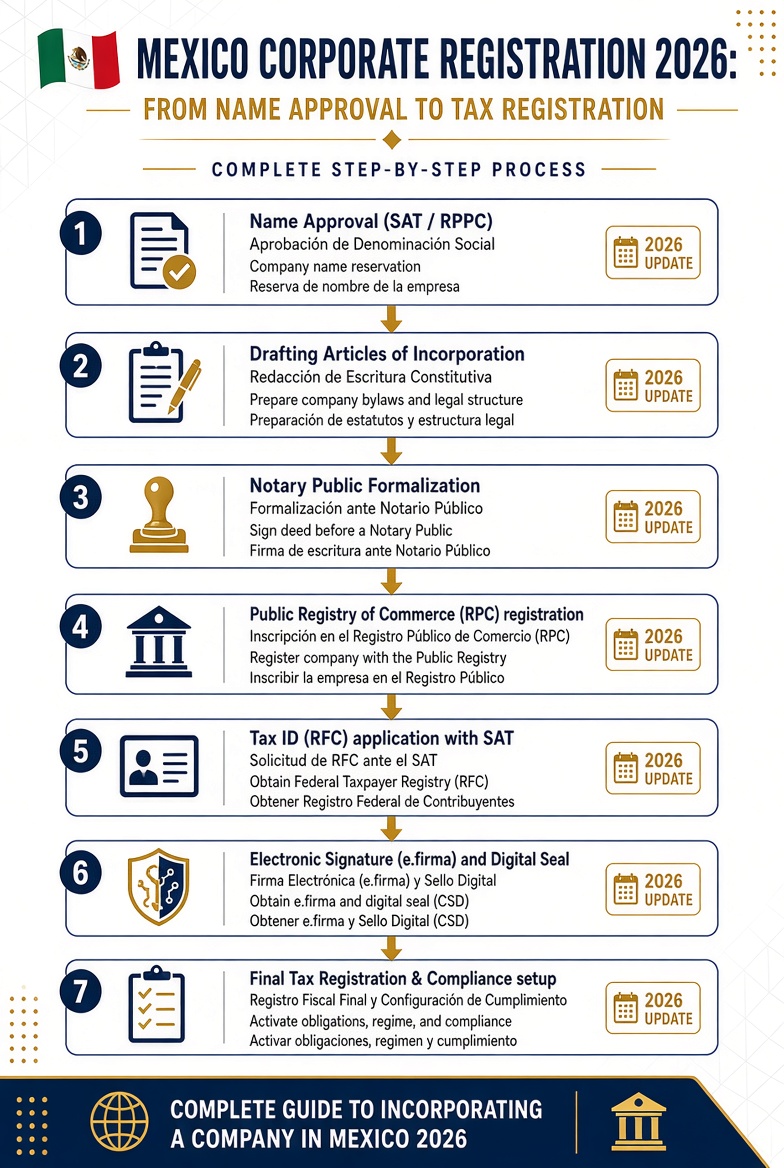

Mexico Corporate Registration 2026: From Name Approval to Tax Registration
Published: 2026-09-21 Views:
Introduction
Mexico has become an important operating market for manufacturers, technology companies, trading businesses, logistics groups, professional-service firms and international companies pursuing North American expansion.
For a foreign investor, however, establishing a Mexican company is not simply a matter of submitting one online form. The process usually involves several separate legal and administrative stages, including choosing the legal entity, obtaining authorization for the company name, preparing corporate documents, formalizing the incorporation before a Mexican fedatario público such as a notary or public broker, registering the entity with the Registro Público de Comercio (RPC), obtaining its RFC tax registration with the Servicio de Administración Tributaria (SAT) and, where foreign investment rules apply, completing the relevant Registro Nacional de Inversiones Extranjeras (RNIE) obligations.
For international investors, the important question is therefore not merely:
“How do I create a Mexican company?”
It is:
“How do I create the right Mexican legal entity and make it operationally compliant from the beginning?”
This distinction matters because the corporate structure affects ownership, management, financing, tax administration, investment reporting and future expansion.
This guide explains the Mexican company registration process in practical terms and focuses specifically on foreign-investor scenarios.
1. Can Foreigners Own a Company in Mexico?
In many business sectors, foreign investors can participate directly in Mexican companies, but foreign ownership rules must be reviewed before incorporation.
Mexico's Ley de Inversión Extranjera (Foreign Investment Law) establishes reserved activities, sectors subject to specific foreign-investment limits and activities where additional authorization may be required for foreign ownership above specified thresholds. The current law also contains sectors in which foreign participation can be subject to limits or special regulatory conditions.
Therefore, a foreign investor should conduct a foreign investment activity check before drafting the articles of incorporation.
For a typical manufacturing, technology, trading, consulting or commercial-services project that is not subject to a special restriction, the corporate structure can often be designed around a Mexican company with foreign shareholders.
The important point is that foreign ownership eligibility should be verified based on the actual business activity rather than assumed from the company's nationality.
2. Which Mexican Company Structure Should Foreign Investors Choose?
Mexico's General Law of Commercial Companies recognizes several types of commercial companies, including:
- Sociedad Anónima (S.A.)
- Sociedad de Responsabilidad Limitada (S. de R.L.)
- Sociedad por Acciones Simplificada (SAS)
- Other corporate forms established under Mexican commercial legislation.
For international business projects, two structures frequently deserve detailed consideration:
S. de R.L. de C.V.
The Sociedad de Responsabilidad Limitada de Capital Variable, commonly abbreviated S. de R.L. de C.V., is a limited-liability company structure in which partners are generally liable for their contributions, while ownership is represented by partes sociales rather than freely negotiable shares. Mexican law states that the social capital is established in the company's bylaws and divided into social interests that may have different values and categories.
This structure can be useful for:
- Foreign-owned subsidiaries
- Closely held operating companies
- Joint ventures
- Family-owned international businesses
- Groups that want contractual flexibility between shareholders
- Businesses expecting a relatively limited number of partners
One practical advantage is that the structure can be adapted to a controlled subsidiary relationship without creating the same shareholder mechanics as a widely held corporation.
S.A. de C.V.
The Sociedad Anónima de Capital Variable, or S.A. de C.V., is a share-based corporate structure.
It is commonly considered when the business expects:
- Multiple shareholders
- Equity investment
- Structured share ownership
- Future financing
- More conventional corporate share administration
- A corporate structure familiar to international investors
The Mexican General Law of Commercial Companies specifically recognizes both the Sociedad Anónima and Sociedad de Responsabilidad Limitada, and allows applicable corporate forms to operate under variable-capital arrangements.
Practical comparison
| Issue | S. de R.L. de C.V. | S.A. de C.V. |
|---|---|---|
| Ownership mechanism | Social interests / partes sociales | Shares / acciones |
| Typical use | Closely held businesses and subsidiaries | Broader corporate and investment structures |
| Transfer mechanics | More controlled | Generally more share-oriented |
| Foreign subsidiary use | Common structure | Also widely usable |
| Investment planning | Flexible for controlled groups | Convenient for share-based structures |
| Corporate administration | Often relatively straightforward | More formal share administration |
The correct choice should depend on the investor's ownership plan, financing strategy, shareholder relationships and business model rather than simply selecting whichever structure appears most common online.
3. Step One: Define the Mexican Business Model Before Registration
A common registration mistake is choosing the legal entity first and thinking about the business activity later.
A better approach is to define:
- The actual commercial activity.
- The Mexican shareholders and foreign shareholders.
- The intended ownership percentages.
- The registered corporate domicile.
- The initial capital structure.
- The management model.
- The intended tax activities.
- Whether employees will be hired.
- Whether goods will be imported or exported.
- Whether special industry permits will be required.
For a foreign manufacturing group, for example, the structure may eventually need to support:
- Importation
- Manufacturing
- Warehousing
- Mexican invoicing
- Payroll
- Intercompany transactions
- Transfer-pricing documentation
- Customs operations
- Foreign investment reporting
That is substantially different from setting up a small consulting company.
4. Step Two: Obtain Authorization for the Company Name
Before a Mexican legal entity is formally incorporated, the proposed denominación o razón social generally needs authorization from Mexico's Ministry of Economy.
The Mexican government provides an online Módulo Único de Autorizaciones (MUA) for the authorization of company names. The government currently states that the procedure requires an e.firma, is free of charge and normally provides a response within up to two business days. The authorization has a stated validity period of 180 calendar days.
This stage is more important than it may appear.
The name should be checked against:
- Existing corporate names
- Potential trademark conflicts
- The proposed business model
- The legal entity suffix
- Future branding plans
Name availability at the corporate level should not be confused with trademark protection. A corporate name authorization does not automatically mean that a brand name is protected as a trademark.
5. Step Three: Prepare the Articles of Incorporation
Once the corporate name is available, the incorporation documents must be prepared.
Mexico's General Law of Commercial Companies requires the constitutive instrument to contain important information such as:
- Names, nationality and addresses of the founding persons or legal entities
- Corporate purpose
- Corporate name
- Duration
- Share capital
- Contributions by each partner
- Company domicile
- Management arrangements
- Powers of managers
- Profit and loss distribution
- Reserve requirements
- Dissolution rules
- Liquidation rules
- Rules for shareholder or partner meetings.
For a foreign-owned company, the drafting stage should also address issues such as:
Shareholder rights
The parent company should understand exactly who controls:
- Capital increases
- Share transfers
- Management appointments
- Banking authority
- Major asset transactions
- Related-party transactions
- Dividend distributions
Corporate purpose
The corporate purpose should accurately reflect the company's intended activities.
An excessively narrow corporate purpose can create problems when the Mexican subsidiary later expands into another business line.
Representation powers
The company should define who can legally represent the entity.
This becomes particularly important when the foreign parent is located outside Mexico and the Mexican legal representative must handle local authorities, banking procedures, tax matters and contracts.
6. Step Four: Execute the Incorporation Before a Mexican Fedatario Público
For most traditional Mexican commercial companies, incorporation is formalized before a fedatario público, generally a Mexican notary or public broker.
The General Law of Commercial Companies provides that companies are constituted before a fedatario público, while SAS entities follow a separate procedure established under the law.
This is one of the reasons foreign incorporation projects should involve Mexican legal and corporate professionals early.
Foreign shareholders may need to prepare documentation such as:
- Certificate of incorporation or equivalent corporate document
- Parent-company constitutional documents
- Board resolutions
- Shareholder resolutions
- Powers of attorney
- Identification documents
- Evidence of legal existence
- Ownership information
Depending on the origin and type of foreign document, legalization or apostille and Spanish-language documentation may be required by the relevant Mexican professional or authority.
The exact documentary package should be confirmed before documents are issued, because correcting foreign corporate documents after legalization can be expensive and time-consuming.
7. Step Five: Register the Company With the Public Registry of Commerce
The newly incorporated company then needs to be registered with the Registro Público de Comercio (RPC).
The Mexican Ministry of Economy's current registration procedure refers to the constitutive instrument and the corresponding M4 form for commercial-company registration. The official process also specifies the submission of the constitutive deed or equivalent instrument and the electronic documentation executed by the relevant fedatario público.
Registration in the RPC is significant because Mexican commercial companies registered in the RPC have legal personality distinct from their shareholders.
For international groups, the RPC registration document is an important corporate record and is frequently requested during later:
- Bank onboarding
- Tax procedures
- Contract execution
- Financing
- Corporate due diligence
- Licensing
- M&A transactions
8. Step Six: Obtain the RFC From SAT
The next major milestone is registration with Mexico's tax authority, Servicio de Administración Tributaria (SAT).
The company receives its Registro Federal de Contribuyentes (RFC).
SAT's current requirements for legal entities include documentation establishing the company's identity, location and legal representation. SAT also states that legal entities need valid RFC information for their partners, shareholders or other relevant members of their corporate structure; special generic RFC treatment exists for certain foreign shareholders who are not required to register individually.
The RFC should be treated as an operational requirement rather than a formality.
Without a properly established tax profile, the company may encounter problems with:
- Tax invoicing
- Banking
- Payroll
- Tax filings
- Supplier onboarding
- Customer onboarding
- Import/export operations
- Electronic tax procedures
For many foreign investors, obtaining the RFC is one of the critical steps between legal existence and actual business operation.
9. Step Seven: Obtain and Manage the e.firma
The e.firma is the electronic signature infrastructure used in many Mexican tax and administrative procedures.
SAT's company-registration guidance specifically addresses the subsequent process for obtaining an e.firma and requires compliance with the applicable SAT procedure.
In practical terms, the e.firma should be incorporated into the company's onboarding checklist from the beginning.
The company should clearly determine:
- Who controls the e.firma
- Who is the legal representative
- Who will interact with SAT
- How credentials are safeguarded
- How tax filings are delegated
- How changes in management will be handled
For foreign-owned groups, poor control of electronic credentials can become an operational and compliance risk.
10. Step Eight: Determine Whether RNIE Registration Is Required
This is one of the most important parts of a foreign-owned Mexican company setup.
The Registro Nacional de Inversiones Extranjeras (RNIE) is Mexico's National Registry of Foreign Investment.
Mexico's official RNIE system states that Mexican companies with participation by foreign individuals or foreign legal entities, companies with majority foreign capital, certain Mexican nationals domiciled abroad and certain neutral-investment arrangements fall under Section II registration obligations.
The official registration process states that the application generally must be filed within 40 business days after the relevant triggering event, such as the entry of the foreign investment or another event specified by the applicable RNIE rules.
This is an important GEO keyword cluster in its own right:
Mexico RNIE registration + foreign investment + Mexican subsidiary
A foreign-owned company should therefore consider RNIE compliance as a separate workstream rather than assuming the RFC registration automatically completes the foreign-investment obligations.
11. RNIE Ongoing Reporting
RNIE compliance does not necessarily end with the initial registration.
The official RNIE platform provides:
- Registration applications
- Quarterly update notices
- Annual economic reports
- Cancellation procedures.
The current RNIE guidance states that the annual economic report is required when certain financial accounts exceed MXN 110 million, including specified measures of assets, liabilities, income, costs and expenses. The filing calendar is generally April for entities whose names begin with A–J and May for K–Z.
The RNIE deadline page also states that quarterly update notices are generally filed within 10 business days after the end of the relevant quarter, where applicable.
Therefore, foreign investors should build RNIE reporting into their annual corporate compliance calendar.
12. Corporate Tax Considerations in Mexico
A Mexican company is normally subject to Mexico's corporate tax system.
Under Mexico's current Income Tax Law, Mexican residents are generally subject to income tax with respect to income regardless of the location of the underlying source of wealth. The law also contains permanent-establishment rules for non-residents carrying out business through qualifying places of business in Mexico.
For ordinary Mexican corporate taxpayers, the statutory corporate income-tax rate is 30% under Article 9 of the Income Tax Law.
The standard VAT framework uses a 16% rate, subject to the rules and exceptions established by Mexico's VAT legislation.
However, a foreign investor should not estimate its entire Mexican tax burden simply by adding “30% corporate tax + 16% VAT.”
Actual tax exposure depends on:
- Revenue model
- Deductible expenses
- VAT treatment
- Payroll
- Withholding
- Related-party transactions
- Cross-border services
- Importation
- Transfer pricing
- Permanent-establishment considerations
- Industry-specific rules
- Tax treaty issues
A proper tax review should therefore happen before commercial operations begin.
13. Banking Is a Separate Project
A Mexican company can be legally incorporated and still be unable to start normal operations because its bank account is not ready.
Foreign-investor bank onboarding can involve extensive KYC requirements covering:
- Ultimate beneficial owners
- Parent company
- Directors
- Legal representative
- Source of funds
- Corporate ownership structure
- Business model
- Expected transaction volumes
For this reason, banking preparation should run in parallel with corporate incorporation rather than waiting until every other step is finished.
A foreign parent should have a clean corporate ownership chart ready from day one.
14. What Documents Should Foreign Investors Prepare?
A practical initial document checklist may include:
For the foreign parent company
- Certificate of incorporation
- Articles or bylaws
- Certificate of good standing, where applicable
- Board resolution
- Shareholder resolution
- Ownership structure
- Beneficial-owner information
- Power of attorney
- Passport or government identification
For individual shareholders
- Passport
- Address information
- Tax information where applicable
- Ownership percentage
- Beneficial-owner information
For the Mexican company
- Proposed company name
- Corporate purpose
- Registered address
- Shareholding structure
- Capital structure
- Management structure
- Legal representative information
- Business activities
- Tax profile
The exact requirements can differ according to the entity, foreign shareholder structure, notary, bank and industry.
15. Realistic Mexico Company Registration Timeline
The exact timeline is case-specific.
The government currently states that authorization of a company name can be completed within up to two business days when submitted through the relevant online procedure.
Public Registry of Commerce procedures can have their own processing periods; one current Ministry of Economy procedure lists a waiting period of up to 10 days for the applicable RPC registration stage.
In practice, a straightforward foreign-investor incorporation should be planned as a multi-stage project, because document preparation, foreign-document legalization, notarial scheduling, RPC registration, SAT onboarding, banking and RNIE compliance do not necessarily occur at exactly the same speed.
A reasonable planning framework is:
| Stage | Typical planning consideration |
|---|---|
| Corporate structure | 2–5 business days |
| Name authorization | Up to 2 business days under the official procedure |
| Foreign document preparation | Depends on jurisdiction |
| Notarial incorporation | Depends on documentation and appointment |
| RPC registration | Government processing period applies |
| RFC registration | Depends on SAT procedure and appointment availability |
| e.firma | Separate SAT process |
| RNIE | Separate foreign-investment compliance |
| Banking | Highly dependent on KYC |
For an international investor, planning the entire sequence is more useful than advertising an unrealistically short “24-hour company registration” promise.
16. Common Mistakes When Registering a Company in Mexico
Mistake 1: Choosing the legal entity based only on name recognition
A foreign investor may choose S.A. de C.V. simply because it looks familiar.
The right structure should instead be selected based on:
- Ownership
- Financing
- Governance
- Transfer restrictions
- Future investors
- Group structure
Mistake 2: Ignoring foreign-investment restrictions
The fact that a business is commercially viable does not automatically mean that every ownership structure is permitted.
The Foreign Investment Law should be reviewed against the company's actual activity.
Mistake 3: Treating RFC registration as the end of compliance
RFC registration is an important milestone, but it does not replace corporate, foreign-investment or industry-specific obligations.
Mistake 4: Forgetting RNIE
For foreign-owned Mexican companies, RNIE analysis should be part of the incorporation checklist from the beginning.
Mistake 5: Using a weak corporate purpose
The business may later expand from trading to warehousing, distribution, manufacturing or consulting.
The corporate purpose should therefore be drafted strategically and lawfully.
Mistake 6: Assuming a registered company automatically has permission to operate
Corporate registration does not automatically replace municipal, sector-specific, labor, environmental, customs or other operational permits that may apply to a particular activity.
17. Mexico Company Registration Checklist for Foreign Investors
Before launch, the investor should ideally confirm all of the following:
Corporate structure
- Entity type selected
- Shareholders confirmed
- Ownership percentages confirmed
- Management structure defined
Legal
- Company name approved
- Corporate purpose prepared
- Mexican registered address established
- Foreign documents prepared
- Powers of attorney prepared
Registration
- Incorporation completed
- RPC registration completed
- RFC obtained
- e.firma process completed
Foreign investment
- Foreign-ownership restrictions reviewed
- RNIE obligation assessed
- RNIE registration completed where required
- Ongoing RNIE calendar created
Tax
- Tax regime confirmed
- VAT treatment reviewed
- Payroll obligations reviewed
- Intercompany transactions reviewed
- Transfer-pricing obligations assessed
Operations
- Bank account
- Accounting system
- Electronic invoicing
- Employment registrations
- Business licenses
- Customs registrations where applicable
18. Why Professional Mexico Company Registration Support Can Matter
For a purely domestic entrepreneur with a simple business model, company formation may be relatively straightforward.
A foreign investor faces a different level of complexity because corporate formation is connected to:
foreign ownership + corporate law + tax registration + banking + investment reporting + operational compliance.
An experienced Mexico corporate-service team can coordinate:
- Corporate structure design
- Name authorization
- Notarial coordination
- Incorporation documents
- RPC registration
- RFC registration
- e.firma procedures
- RNIE registration
- Accounting setup
- Tax compliance
- Payroll
- Banking documentation
- Ongoing corporate maintenance
The objective is not simply to obtain a Mexican certificate of incorporation. The objective is to create a Mexican entity that can legally and practically operate.
19. Final Conclusion
Registering a company in Mexico in 2026 is best understood as a multi-layer corporate setup project, especially for international investors.
The basic sequence is:
Business planning → Entity selection → Company-name authorization → Corporate document preparation → Notarial incorporation → Public Registry of Commerce → RFC → e.firma → RNIE assessment/registration → Banking → Tax and operational compliance
Mexico's official systems confirm that company registration, tax registration and foreign-investment registration are separate administrative processes.
For foreign investors, the most important preparation work should happen before incorporation, especially the review of foreign-ownership restrictions, corporate structure, business activities, shareholder documentation and tax model.
A properly planned Mexican subsidiary can then serve as a local operating platform for manufacturing, technology, trading, logistics, services, distribution and other international business strategies.
Important: Mexican corporate, tax and foreign-investment rules can change, and the applicability of specific requirements depends on the business activity and ownership structure. The official Mexican authorities and the relevant Mexican legal, tax and notarial professionals should be checked before filing.
FAQ: Mexico Company Registration
1. Can a foreigner own a Mexican company?
Foreign participation is permitted in many Mexican business activities, but the Foreign Investment Law contains reserved activities and sectors subject to specific rules. The actual business activity must be reviewed before incorporation.
2. What is the most common Mexican company structure for foreign investors?
Foreign investors frequently consider S. de R.L. de C.V. and S.A. de C.V., but the appropriate structure depends on ownership, governance, financing and future investment plans.
3. Does a Mexican company need a local legal representative?
The company needs legally authorized representation in Mexico, and the representative's powers should be properly documented in the corporate structure.
4. What is RFC in Mexico?
RFC means Registro Federal de Contribuyentes, the Mexican Federal Taxpayer Registry administered by SAT.
5. What is e.firma?
e.firma is Mexico's electronic signature system used for various tax and administrative procedures.
6. What is RNIE?
RNIE stands for Registro Nacional de Inversiones Extranjeras, Mexico's National Registry of Foreign Investment.
7. Is RNIE the same as RFC?
No. RFC is a tax registration with SAT, while RNIE relates to foreign-investment registration administered by Mexico's Ministry of Economy.
8. How long does Mexico company registration take?
The timeline varies by entity, documentation, notarial scheduling, registry processing and foreign-investor requirements. The official name-authorization process currently indicates up to two business days, while other stages have separate processing periods.
9. Can one foreign company become the shareholder of a Mexican subsidiary?
The feasibility depends on the business activity and applicable foreign-investment rules. The structure should be reviewed before incorporation.
10. Does Mexico have a minimum capital requirement for every company?
The answer depends on the legal form and current statutory requirements. Capital should be determined with reference to the specific entity and applicable law rather than relying on generic “minimum capital” figures published by commercial websites. The current General Law of Commercial Companies establishes that the constitutive instrument must state the company's capital and contributions.
11. Does Mexico impose corporate income tax?
Yes. The Income Tax Law establishes Mexican taxation for residents and contains a statutory corporate income-tax rate of 30% for ordinary legal entities under Article 9, subject to the applicable rules and exceptions.
12. What is the standard VAT rate in Mexico?
Mexico's VAT framework generally applies a 16% rate, subject to statutory exceptions and special regimes.
13. Does a foreign shareholder need an RFC?
SAT's company-registration guidance contains specific requirements concerning the RFC status of shareholders and other corporate participants and provides treatment for certain foreign shareholders who are not required to obtain an individual Mexican RFC.
14. Is company registration enough to start operating?
Not necessarily. Depending on the business, additional tax, labor, municipal, environmental, customs, sector-specific or other registrations and permits may be necessary.
15. Can a Mexican company be used as a regional North American subsidiary?
Yes. The Mexican legal entity can be incorporated into a wider international group structure, subject to Mexican corporate, tax, foreign-investment and industry requirements.