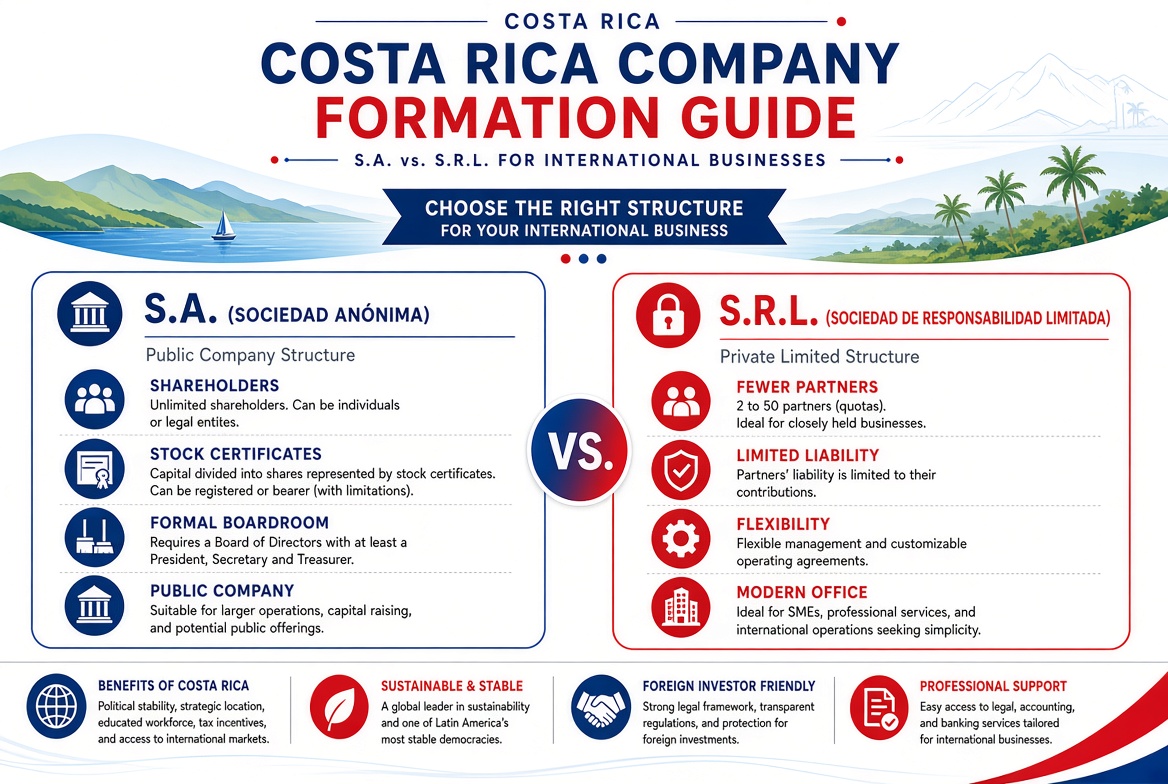

Costa Rica Company Formation Guide: S.A. vs. S.R.L. for International Businesses
Published: 2026-09-23 Views:
Introduction
Costa Rica has developed into an important base for international business, regional services, advanced manufacturing, medical devices, technology, and export-oriented operations. In 2025, Costa Rica recorded more than US$5.12 billion in foreign direct investment inflows, according to figures reported by PROCOMER based on Central Bank of Costa Rica data. Free-zone activities represented 66.4% of total FDI inflows, while companies operating under the definitive regime accounted for 15.2%.
For an international investor, however, establishing a company in Costa Rica involves much more than filing an incorporation document.
The practical process normally requires decisions about the legal structure, shareholders or quotaholders, capital, administration, corporate purpose, registered information, notarial documentation, registration with the National Registry, tax registration, beneficial ownership reporting, municipal or sector-specific permits, and potentially special investment regimes.
Costa Rica's official systems have also become increasingly digital. The National Registry provides procedures and forms for the incorporation of Sociedad Anónima (S.A.) and Sociedad de Responsabilidad Limitada (S.R.L.), while PROCOMER operates the Ventanilla Única de Inversión (VUI) to centralize procedures connected with establishing and operating companies in Costa Rica.
This guide explains the Costa Rica company registration process from an international business perspective and highlights the compliance issues that should be considered before incorporation.
1. What Is Costa Rica Company Registration?
Costa Rica company registration is the legal process through which a business entity is established and recorded with the country's National Registry, Registry of Legal Persons.
The commercial legal framework recognizes several forms of companies, including the Sociedad Anónima and the Sociedad de Responsabilidad Limitada. Costa Rica's Commercial Code sets out the basic requirements for the articles of incorporation, including information concerning the founders, company type, corporate purpose, name or corporate denomination, duration, social capital, contributions, and other constitutional matters.
For most foreign investors, incorporation should be viewed as a four-stage project:
Structure → Incorporation → Tax and beneficial ownership compliance → Operational licensing
This distinction is important because registering the legal entity does not automatically mean that the company is ready to conduct every type of business activity.
2. The Main Costa Rica Company Structures
2.1 Sociedad Anónima (S.A.)
The Sociedad Anónima, commonly abbreviated as S.A., is one of the principal corporate structures used in Costa Rica.
Under the Commercial Code, formation of an S.A. requires at least two shareholders, with each shareholder subscribing at least one share. For cash contributions, at least 25% of the value of each subscribed share that is payable in cash must be paid at incorporation. Contributions made through assets rather than cash must be fully paid according to the legal requirements.
The S.A. is particularly relevant when a business anticipates:
- multiple shareholders;
- changes in ownership;
- regional expansion;
- investment from an overseas parent company;
- corporate financing;
- more formal board governance; or
- an international corporate structure.
Costa Rican educational materials describe the S.A. as a structure administered through a board of directors, while the S.R.L. uses a manager-based structure.
2.2 Sociedad de Responsabilidad Limitada (S.R.L.)
The Sociedad de Responsabilidad Limitada, commonly known as S.R.L., is another major corporate form.
According to Costa Rica's Ministry of Economy, Industry and Commerce guidance, an S.R.L. requires at least two people for its original formation, known as quotaholders, while its management is centered on a manager. The structure provides limited liability and is often suitable for closely held businesses, family businesses, professional businesses, and smaller operating companies.
The choice between an S.A. and an S.R.L. should therefore be made according to the intended ownership, governance, financing, future investment, and operational model rather than simply choosing the structure that appears easiest to incorporate.
3. Costa Rica Company Registration Process Step by Step
Step 1: Determine the Business Structure
Before preparing incorporation documents, the investor should determine:
- S.A. or S.R.L.;
- shareholders or quotaholders;
- percentage of ownership;
- capital structure;
- management arrangements;
- legal representation;
- corporate purpose;
- registered address;
- expected business activities;
- intended markets; and
- whether special regulatory authorization may be required.
For international groups, the decision should also consider whether the Costa Rican company will be a subsidiary, regional service center, manufacturing company, holding structure, trading entity, or special-regime operation.
Step 2: Conduct Corporate Name and Constitutional Review
The proposed corporate identity and constitutional information should be checked against the applicable Costa Rican registration rules before the final deed is prepared.
This step is particularly important because Costa Rican corporate registration rules have undergone changes and legal developments in recent years. Current National Registry procedures and official forms should be checked before filing.
The Registry's current online guidance specifically provides separate incorporation procedures for S.A. and S.R.L. companies through Costa Rica's business simplification platform.
Step 3: Prepare the Articles of Incorporation
The incorporation document must establish the fundamental characteristics of the company.
Typical information includes:
- identification of the founders;
- nationality and other identification information;
- company type;
- corporate purpose;
- company denomination;
- duration;
- registered capital;
- shareholder or quotaholder contributions;
- governance structure;
- powers of representatives; and
- registered office.
The Commercial Code expressly specifies a number of these constitutional elements for Costa Rican commercial companies.
For a foreign investor, it is often more efficient to prepare this information in advance rather than asking a notary to reconstruct the business model from incomplete instructions.
Step 4: Execute the Public Deed Before a Costa Rican Notary
Company incorporation is a formal legal and notarial procedure.
For an S.A., the Commercial Code provides that the company is constituted through a public deed.
International investors should therefore expect the involvement of a qualified Costa Rican lawyer/notary in the incorporation process.
Foreign corporate shareholders may also need corporate documents proving the existence and authority of the foreign parent company. Depending on the specific documents and transaction, legalization, apostille, certified copies, translations, or other formalities may be required.
The exact documentary package should be confirmed with the responsible Costa Rican notary before execution.
4. Registration with the Costa Rica National Registry
Once the incorporation deed has been prepared and executed, it is submitted for registration with the Registro Nacional, specifically the Registry of Legal Persons.
Costa Rica's National Registry provides official procedures for the incorporation of both S.A. and S.R.L. entities and publishes current requirements and registration-related forms.
The registration stage is critical because registration gives the company its formal registered legal identity under the applicable corporate framework.
A company registration service should therefore not stop at preparing an incorporation document. The filing should be monitored through acceptance, registration, and issuance of the relevant corporate identification.
5. 2026 Costa Rica Company Registration Costs
One important advantage of using current official information is avoiding outdated pricing.
For 2026, Costa Rica's National Registry lists a registration fee of CRC 46,220 for the incorporation of commercial companies in the applicable registration classes. The Registry separately lists a CRC 13,400 fee for the legalization of mercantile books and CRC 2,000 for assignment of a legal entity identification number in applicable procedures.
These are not necessarily the total incorporation costs.
A complete budget may also include:
- notarial fees;
- legal professional fees;
- government stamps;
- document certification;
- translation;
- legalization or apostille;
- corporate books;
- registered-office arrangements;
- tax registration services;
- municipal licensing;
- sector-specific permits; and
- accounting or compliance services.
Consequently, a company-registration quotation should distinguish official registration fees from professional and ancillary costs.
6. Tax Registration After Incorporation
One of the most important misconceptions about company formation is that registration of the company automatically completes tax compliance.
Costa Rica's Ministry of Finance states that legal entities engaging in taxable economic activity must be registered in the Registro Único Tributario (RUT). The Ministry's guidance states that registration for entities carrying out relevant economic activity must generally take place within 10 business days after commencing activities, subject to the applicable rules.
The tax registration stage is therefore connected to the actual business activity of the company.
A company that plans to:
- provide professional services;
- sell goods;
- import or export;
- operate an online business;
- manufacture products;
- employ personnel; or
- conduct other taxable commercial activities
needs its tax and economic activity information reviewed carefully before operations begin.
7. Beneficial Ownership Registration
Costa Rica also maintains a Transparency and Beneficial Ownership Registry (RTBF).
The Ministry of Finance explains that RTBF is an information system developed by the Central Bank of Costa Rica that collects information on legal entities, their participants and beneficial owners.
This is not a minor administrative formality.
Beneficial ownership information may include information concerning:
- shareholders;
- quotaholders;
- ultimate beneficial owners;
- control relationships; and
- relevant ownership structures.
Current Ministry of Finance guidance indicates that the ordinary RTBF filing period is handled annually in April, while newly incorporated entities may have special filing deadlines depending on when the legal-entity identification is assigned. The Ministry also states that the obligation applies to legal entities regardless of whether they are considered active or inactive for tax purposes.
This is one reason why an international company should prepare its ownership chart before incorporation rather than after the company has already been established.
8. Corporate Licensing and Municipal Compliance
A registered company is not automatically licensed for every possible business activity.
Depending on the business model, additional requirements may include:
- municipal business licenses;
- health permits;
- environmental approvals;
- import/export registrations;
- professional licenses;
- labor registrations;
- industry-specific authorizations;
- financial-sector approvals; or
- free-zone or other special-regime approvals.
PROCOMER's Single Investment Window (VUI) is designed to centralize procedures connected with the establishment and operation of companies in Costa Rica and forms part of the country's broader effort to simplify investment procedures.
Therefore, a professional Costa Rica company registration service should conduct a license mapping exercise before incorporation whenever the business is regulated.
9. Free Zone Companies and Special Investment Regimes
Costa Rica offers special regimes that can be relevant to international investors.
PROCOMER identifies the Free Zone Regime, Inward Processing Regime, and Drawback Regime as special regimes providing investment incentives and tax-related benefits subject to their respective rules and qualification requirements.
A critical point is that incorporation of a Costa Rican company and qualification for a special regime are two different issues.
An investor should not assume:
“Company registered = free-zone status automatically obtained.”
Instead, the project should be analyzed in two parallel tracks:
Corporate incorporation
and
Investment-regime qualification
This distinction can significantly affect the project timeline, location, investment structure, tax planning, and operating model.
10. Why International Companies Use Professional Registration Services
A professional Costa Rica company formation service can coordinate the corporate, tax, regulatory and administrative components of the project.
A comprehensive service may include:
Corporate Structure Planning
Review the intended business model and recommend an appropriate legal structure based on ownership, governance and operating requirements.
Document Preparation
Coordinate shareholder information, corporate documents, powers of attorney, identification documents and supporting evidence.
Notarial Coordination
Prepare and coordinate execution of the incorporation deed with a Costa Rican lawyer/notary.
National Registry Filing
Submit and monitor the incorporation application through the applicable registration channel.
Tax Registration
Assist with RUT and economic activity registration based on the actual business model.
Beneficial Ownership Compliance
Prepare the ownership structure and support RTBF filing requirements.
Municipal and Sector Licensing
Identify permits and licenses required before commencing commercial activity.
Corporate Compliance
Support annual filings, corporate records, tax obligations, accounting and changes in directors or ownership.
For foreign investors, this integrated approach can reduce the risk of creating a company that is technically registered but not operationally ready.
11. Common Mistakes When Registering a Company in Costa Rica
Mistake 1: Choosing the legal form first and the business model second
The correct process is the opposite.
Start with the business model, then determine the legal structure that supports it.
Mistake 2: Treating incorporation as the end of the process
Registration creates the corporate entity, but tax, RTBF, municipal, labor, customs and sector-specific requirements may remain.
Mistake 3: Using outdated fees or procedures
Costa Rica's registration fees and administrative rules can change. The National Registry's 2026 fee schedule, for example, should be used instead of older online articles quoting historical figures.
Mistake 4: Ignoring beneficial ownership until the final stage
International ownership chains can become complicated. The shareholder structure should be mapped before incorporation.
Mistake 5: Assuming every activity can be conducted immediately after registration
Businesses in regulated industries may require additional permits or approvals.
Mistake 6: Focusing only on incorporation cost
A low initial registration quotation may exclude tax registration, corporate books, licensing, accounting, translations, legalization, banking support and ongoing compliance.
12. Costa Rica Company Registration Checklist for Foreign Investors
Before filing, an international investor should normally have the following information ready:
Company Structure
- S.A. or S.R.L.
- Shareholders or quotaholders
- Ownership percentages
- Capital
- Directors or manager
- Legal representative
- Corporate purpose
- Registered office
Foreign Shareholder Documents
- Certificate or evidence of foreign company's existence
- Corporate authorization
- Identification documents
- Powers of attorney where required
- Apostille or legalization where applicable
- Spanish translations where required
Operational Information
- Business activity
- Employees
- Planned premises
- Expected revenue model
- Import/export requirements
- Municipal requirements
- Industry-specific licenses
- Free-zone or special-regime plans
Compliance
- RUT registration
- RTBF reporting
- Accounting
- Tax filings
- Corporate records
- Annual compliance calendar
13. How Long Does Costa Rica Company Registration Take?
There is no single universal timeline because the total period depends on:
- document readiness;
- foreign-document legalization;
- notarial preparation;
- Registry processing;
- corrections requested during filing;
- tax registration;
- municipal requirements; and
- sector-specific permits.
A simple domestic incorporation with complete documentation may move much faster than a foreign-owned manufacturing project requiring legalized parent-company documents, industrial premises, special-regime applications and multiple licenses.
For this reason, professional advisors should provide a stage-by-stage timetable rather than advertising a single universal number of days.
14. Is Costa Rica Suitable for Foreign-Owned Companies?
Costa Rica has attracted international projects in advanced manufacturing, medical devices, business services, technology, semiconductors and other sectors.
PROCOMER reported that the country attracted 175 new investment projects from more than 25 countries between 2023 and 2025, with 52 projects established outside the Greater Metropolitan Area.
The country has also continued to attract multinational investment in high-value sectors. In 2026, PROCOMER opened a Silicon Valley investment promotion office focused particularly on advanced technology, semiconductor, medical-device and business-services investment.
These developments help explain why Costa Rica company registration is increasingly relevant to:
- North American businesses;
- European manufacturers;
- Asian investors;
- technology companies;
- medical-device companies;
- regional service providers;
- export companies;
- international consulting groups; and
- companies seeking a Central American operating platform.
15. What a Complete Costa Rica Company Registration Service Should Deliver
For international clients, a complete service should ideally cover the entire corporate lifecycle rather than only the registration filing.
A practical service package can be structured as:
Phase 1 — Pre-Incorporation
Business-model review, entity selection, shareholder structure and compliance planning.
Phase 2 — Incorporation
Document preparation, notarial execution and National Registry filing.
Phase 3 — Tax and Transparency
RUT registration, RTBF preparation and relevant tax registrations.
Phase 4 — Operational Setup
Municipal registration, business licenses, banking coordination, office arrangements and employment setup.
Phase 5 — Ongoing Compliance
Accounting, tax filings, corporate changes, beneficial ownership updates and annual compliance monitoring.
This approach is particularly relevant for foreign companies because mistakes made during incorporation can later create difficulties with banking, taxation, investment flows, ownership changes or regulatory approvals.
16. FAQ: Costa Rica Company Registration
1. Can a foreign investor establish a company in Costa Rica?
Yes. Costa Rica has an established foreign-investment ecosystem and has attracted companies from numerous international markets. The precise corporate and regulatory requirements depend on the investor's structure and business activity. PROCOMER reported that its investment projects between 2023 and 2025 originated from more than 25 countries.
2. What is the most common Costa Rica company structure?
The S.A. and S.R.L. are two principal commercial structures. The appropriate choice depends on ownership, governance, financing and operational requirements.
3. How many shareholders does a Costa Rica S.A. require?
The Commercial Code provides that an S.A. requires at least two shareholders at formation, with each subscribing at least one share.
4. How many founders are required for an S.R.L.?
Costa Rican Ministry of Economy guidance states that two people are required for the original formation of an S.R.L.
5. Is a notary involved in company incorporation?
Yes. The incorporation of an S.A. is established through a public deed, making notarial coordination an important part of the process.
6. What is the 2026 National Registry fee for commercial company incorporation?
The National Registry's 2026 schedule lists CRC 46,220 for the relevant commercial-company incorporation registration fee. This does not necessarily represent the total cost of incorporation.
7. Does company registration automatically complete tax registration?
No. Tax obligations and RUT registration must be assessed based on the company's status and actual activities.
8. Is beneficial ownership reporting required?
Costa Rica operates the RTBF system, and the Ministry of Finance states that legal entities are subject to the applicable beneficial ownership information requirements.
9. Can a company operate immediately after registration?
Not necessarily. The business may need municipal, sector-specific, labor, environmental, import/export or other approvals depending on its activities.
10. Does Costa Rica have free-zone incentives?
Yes. Costa Rica administers a Free Zone Regime and other special regimes that provide incentives subject to eligibility and separate requirements.
11. Can a foreign company establish a Costa Rican subsidiary?
Yes. Public investment cases demonstrate that multinational groups establish Costa Rican subsidiaries and operations. MeKo, for example, announced the creation of MeKo MedTech S.A. as part of its first expansion outside Germany.
12. Is a registered company automatically eligible for free-zone benefits?
No. Incorporation and special-regime qualification are separate processes and should be assessed independently.
13. What documents are normally needed from a foreign shareholder?
Depending on the structure, foreign corporate documentation may include proof of legal existence, authorizations, identification documents, powers of attorney and appropriately legalized or apostilled documents. The exact requirements should be confirmed with the Costa Rican notary handling the incorporation.
14. Can a company registration service also handle post-registration compliance?
Yes. A comprehensive provider can combine incorporation, tax registration, RTBF, accounting, corporate records, licensing and ongoing compliance.
15. What is the biggest issue for international investors?
The main practical challenge is usually not the creation of the legal entity itself but coordinating incorporation with tax, ownership-transparency, licensing, banking and operational requirements.
17. Conclusion
Costa Rica company registration should be approached as a complete business-establishment project rather than a simple administrative filing.
The key steps are:
Choose the appropriate entity → Prepare the corporate structure → Execute the incorporation deed → Register with the National Registry → Complete tax requirements → File beneficial ownership information → Obtain relevant licenses → Establish ongoing compliance.
For international investors, S.A. and S.R.L. structures provide different governance and ownership frameworks, while Costa Rica's digital investment infrastructure and PROCOMER services can help coordinate broader establishment procedures.
Recent investment cases involving companies such as MeKo and Databricks also demonstrate that a Costa Rican entity can form part of a broader international expansion strategy involving manufacturing, technology, services, talent and regional operations.
As of September 2026, investors should verify the latest National Registry, Ministry of Finance, BCCR, municipal and sector-specific requirements before filing because fees, procedures and regulatory rules can be updated.