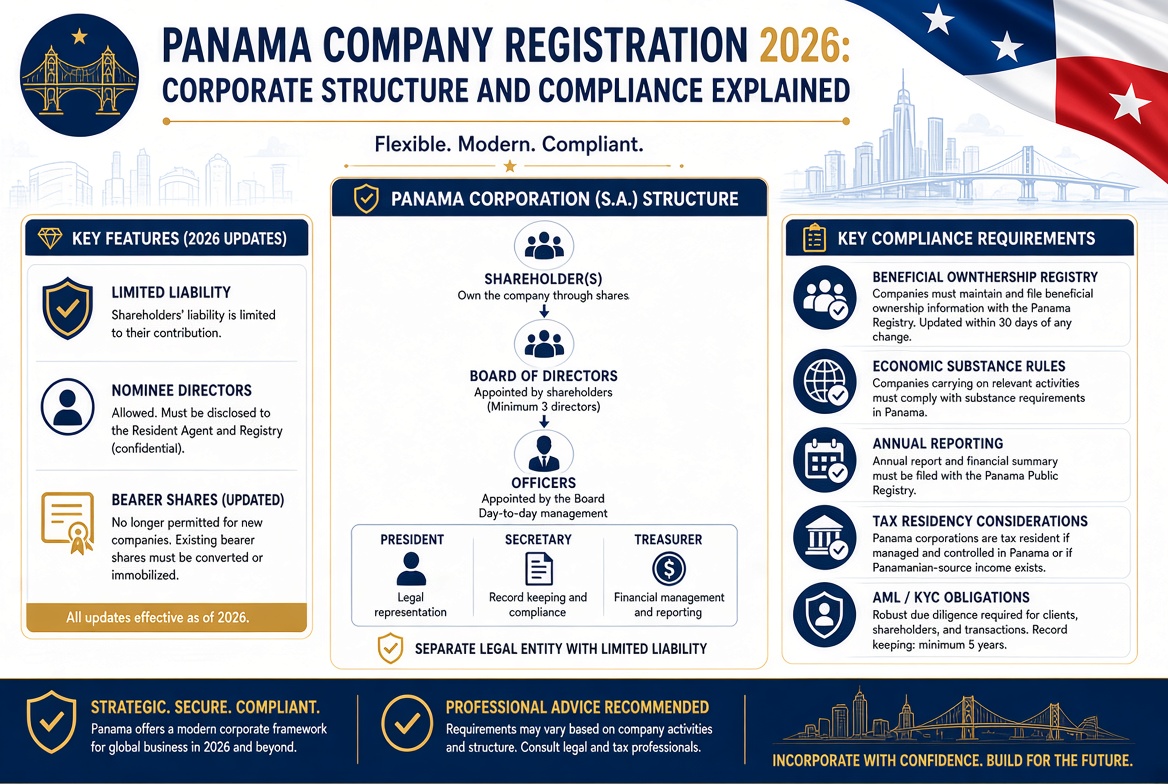

Panama Company Registration 2026: Corporate Structure and Compliance Explained
Published: 2026-09-22 Views:
Panama Company Registration 2026: Corporate Structure and Compliance Explained
Meta Description:
Learn how to register a company in Panama in 2026, including S.A. requirements, resident agents, RUC registration, operating notices, beneficial ownership and new economic substance rules.
Panama Company Registration: What Foreign Investors Need to Know
Panama remains an important jurisdiction for international businesses seeking a legal entity for regional operations, trading activities, investment structures, logistics, holding arrangements and other lawful commercial purposes.
The most widely recognized corporate structure is the Sociedad Anónima (S.A.), regulated principally by Law No. 32 of February 26, 1927. The law allows two or more adults of any nationality, even when they are not domiciled in Panama, to establish a corporation for a lawful purpose. The corporate charter must contain key information concerning the company name, purpose, capital, shares, domicile, administration and other required provisions.
For international founders, however, company incorporation is only the first stage. A properly structured Panama company may also need tax registration, an operating notice, beneficial-owner compliance, accounting records and ongoing annual obligations depending on its activities and structure.
The most important practical point is this:
Registering a company in Panama does not automatically mean that the company is exempt from all taxes or regulatory obligations. The correct treatment depends on the company's activities, source of income, ownership structure, location of operations and applicable tax and regulatory rules.
That distinction has become even more important following the adoption of Panama's Law 526 of 2026 on economic substance, with implementing regulations issued in September 2026. The new regime applies from the fiscal period beginning on or after January 1, 2027 to entities within multinational groups receiving specified foreign-source passive income.
1. Why Do International Businesses Register Companies in Panama?
Panama is strategically positioned between North and South America and is closely connected with international logistics, shipping, trade, finance and regional commercial activity.
A properly designed Panama company may be used for purposes such as:
International trading and procurement
Regional commercial operations
Holding shares or investments
Ownership of certain assets
Logistics and distribution activities
Latin American market expansion
Cross-border business structures
Local business operations in Panama
The suitability of the jurisdiction depends on the business model rather than simply the country where a company is incorporated.
For example, a company that merely holds shares in another entity has very different compliance considerations from a company that employs staff, leases an office, imports goods, invoices Panamanian customers and conducts day-to-day commercial activities in Panama.
Therefore, before incorporation, investors should define the intended business activity, ownership structure, source of funds, expected transactions, target markets and whether the company will have actual operations in Panama.
2. The Main Corporate Structure: Sociedad Anónima (S.A.)
The Sociedad Anónima, commonly abbreviated as S.A., is the traditional Panamanian corporation.
Panama's Law No. 32 of 1927 provides a flexible corporate framework. Two or more adults, regardless of nationality and even if they are not resident in Panama, may form an S.A. for a lawful purpose. The incorporation agreement may be executed in Panama or abroad and may be prepared in any language, subject to the applicable notarization and registration requirements.
The corporate charter generally addresses matters including:
Company name
Corporate purpose
Share capital and share structure
Classes of shares
Company domicile
Duration
Directors
Resident agent
Governance arrangements
The Public Registry's qualification guidance also confirms that at least three directors are required for a Panamanian S.A., and that the resident agent must satisfy the applicable legal requirements.
The important distinction is that the law does not operate like a typical “single founder, single director” startup jurisdiction. The corporate structure should therefore be planned before documents are drafted.
3. Is There a Minimum Capital Requirement?
Panama's S.A. framework does not impose a general statutory minimum paid-in capital requirement for ordinary corporations. Historical and current business-registration guidance therefore commonly describes Panama as having no general minimum capital requirement.
However, this does not mean that capital planning is irrelevant.
The incorporation documents still need to establish the company's capital and share structure. The amount selected should make commercial sense and should be consistent with the company's expected activities, ownership percentages, financing arrangements and future transactions.
A company intended to operate a regional distribution business should not necessarily use the same capital and governance structure as a passive investment vehicle.
This is one reason professional incorporation advice should begin with the business model rather than with a standard template.
4. What Is a Resident Agent in Panama?
A Panama corporation needs a resident agent in Panama.
The resident agent is an important part of the corporate and compliance structure. Public Registry guidance specifically identifies the resident agent and requires the relevant professional conditions and acceptance of the appointment. Panama's beneficial-owner framework also places important responsibilities on resident agents concerning beneficial-owner information.
The resident agent is therefore more than a simple mailing contact.
Depending on the company's circumstances, the resident agent may be involved in:
Corporate registration
Maintenance of corporate information
Beneficial-owner compliance
Receiving official legal communications
Supporting regulatory compliance
Maintaining required records
Foreign investors should verify that their service provider is working with an appropriately authorized Panamanian resident agent.
5. Panama Company Registration Process: Step by Step
Step 1: Define the Business Structure
Before preparing incorporation documents, determine:
Whether an S.A. or another entity is appropriate
Who will own the company
Who will serve as directors
Who will serve as officers or legal representatives
What activities the company will conduct
Whether activities require sector-specific licenses
Whether the company will operate physically in Panama
Whether the structure belongs to a multinational group
This initial analysis can prevent later restructuring.
Step 2: Choose and Check the Company Name
The company needs a distinguishable corporate name.
Under Law No. 32 of 1927, the corporate name must not be identical or confusingly similar to an existing company, and the designation must indicate that the entity is a corporation.
International investors should check the name before preparing final documents because changing a name after documentation has been prepared can create avoidable additional work.
Step 3: Prepare the Corporate Charter
The Pacto Social or corporate charter forms the legal foundation of the Panama company.
Depending on the structure, the document addresses the company's:
Name
Purpose
Capital
Shares
Share classes
Domicile
Duration
Directors
Resident agent
Governance provisions
Law No. 32 also allows certain flexibility concerning the place and language of execution, although documents involving foreign parties may need notarization, legalization or apostille procedures before they can be used in Panama.
Step 4: Complete Notarization and Legalization
The incorporation documents must satisfy Panamanian formalities before registration.
For foreign shareholders, directors or corporate shareholders, additional documentation may be required to establish identity, corporate existence, authority and beneficial ownership.
Foreign documents submitted to the Panamanian tax authority may need to be apostilled and translated into Spanish by an authorized public translator when not already in Spanish. The DGI expressly states this requirement for foreign-origin documents in its RUC procedures.
This is one of the most common areas where poor document preparation can create delays.
Step 5: Register the Company with the Public Registry
The incorporation documents are submitted to the Public Registry of Panama for registration.
The registration creates the formal public-record existence of the entity.
Once registration is completed, the company obtains evidence of registration that can subsequently be used for tax registration, banking, contracts, licensing and other business procedures.
The Public Registry is therefore a central part of the Panama company formation process.
6. RUC Registration: The Step Many Foreign Investors Should Not Ignore
After incorporation, the company must address tax registration with the Dirección General de Ingresos (DGI).
The DGI states that a legal entity must register in the RUC (Registro Único de Contribuyentes) within one month after registration with the Public Registry. The application is processed online through e-Tax 2.0.
The DGI identifies the following core documentation for a legal entity:
Identification of the legal representative
Evidence of registration with the Public Registry
Corporate documentation or registry certification
Foreign documents may need apostille and authorized Spanish translation.
This means a company should not consider its incorporation complete simply because its Public Registry certificate has been issued.
7. What Is the Aviso de Operación?
For many businesses actually conducting commercial or industrial activities in Panama, an Aviso de Operación is an important additional step.
Panama Emprende describes the Aviso de Operación as the declaration through which a commercial or industrial activity is reported to the public administration, and states that it is required to begin activities for businesses falling within its scope. Certain activities are exempt.
Therefore, investors should distinguish between:
incorporating the legal entity
and
being authorized or properly registered to conduct a specific business activity in Panama.
A company involved in regulated areas such as financial services, insurance, maritime activities, pharmaceuticals, telecommunications or other controlled sectors may need additional licenses or approvals beyond ordinary incorporation.
8. Beneficial Ownership Compliance in Panama
Panama has implemented the Sistema Privado y Único de Registro de Beneficiarios Finales (RUBF).
The system is administered by the Superintendencia de Sujetos no Financieros (SSNF) and is designed to allow competent authorities access to beneficial-owner information while maintaining the confidentiality and security of the system.
The resident agent plays a central role in this framework.
The SSNF states that resident agents are responsible for registering information concerning legal entities and beneficial owners, keeping the information updated and maintaining supporting documentation.
For foreign investors, this means corporate ownership cannot simply be treated as a paperwork issue.
A compliant corporate structure should be able to document:
Ultimate beneficial owners
Ownership percentages
Control relationships
Identification documents
Corporate ownership chains
Supporting source-of-information records
Banks and other regulated institutions may also conduct their own KYC and source-of-funds procedures.
9. Annual Tasa Única: A Basic Ongoing Corporate Obligation
A Panama company is not a “set it and forget it” entity.
The DGI states that corporations are subject to an annual Tasa Única of B/.300.00. The payment deadline depends on the semester in which the company was incorporated. For companies incorporated during the first semester, the ordinary deadline is July 15; for companies incorporated during the second semester, the ordinary deadline is January 15. Late payment can result in a surcharge.
The DGI also warns that failure to pay the Tasa Única for three consecutive periods can lead to suspension of corporate rights.
This obligation has become especially important because Panama announced in 2026 that it was beginning a process to dissolve long-suspended legal entities under the applicable legal framework.
For that reason, annual compliance monitoring should be part of the company's corporate administration plan.
10. Panama Tax Rules: Why “Tax-Free Company” Is an Oversimplification
One of the biggest mistakes in online Panama company content is the phrase “Panama companies pay no tax.”
That statement is too broad.
Panama has historically applied a territorial approach to taxation, meaning the source and nature of income matter. At the same time, Panama enacted Law 526 of May 28, 2026, introducing economic substance rules for certain entities belonging to multinational groups and receiving specified foreign-source passive income.
According to the Ministry of Economy and Finance, the new rules cover categories such as:
Dividends
Interest
Royalties
Capital gains
Real estate income
The framework is aimed at entities that are part of multinational groups and fall within the statutory conditions. Entities that fail to demonstrate the required economic substance may be subject to a 15% definitive tax rate on applicable net taxable income from those specified foreign-source passive income categories.
The implementing regulations were issued in September 2026, and the regime begins to apply from the fiscal period starting on or after January 1, 2027.
The practical message for 2026 and 2027 is clear:
A Panama incorporation strategy should be designed around the company's real business model, ownership structure, income sources and substance profile—not simply around the location of incorporation.
11. What Does “Economic Substance” Mean for International Businesses?
The new rules make substance analysis especially relevant for multinational structures.
The regulatory framework looks at whether appropriate economic activity exists in Panama, including factors such as:
Qualified personnel
Appropriate premises
Strategic decision-making
Relevant operating expenditure
Activities related to the income being generated
The MEF has specifically emphasized the need for companies to analyze whether they form part of a multinational group and to review corporate structure, tax residence and ownership/control relationships.
This does not mean every newly formed Panama company must build a large operation immediately.
It means the structure should be assessed against the company's actual business and the exact scope of the new rules.
12. What Documents Should Foreign Investors Prepare?
A typical Panama incorporation file may involve:
Proposed company name
Passport or identification documents for relevant individuals
Corporate documents for corporate shareholders, where applicable
Shareholding information
Beneficial-owner information
Director and officer information
Corporate purpose
Capital and share structure
Panama domicile information
Resident agent information
Powers of attorney where required
Apostille or legalization documents for foreign records
Spanish translations where required
Supporting source-of-funds or KYC documentation for banking and professional-service purposes
The final document list depends on the ownership chain, nationality of the participants, business activity and intended use of the company.
13. Common Mistakes During Panama Company Registration
Mistake 1: Choosing a company structure before defining the business
The correct structure for a holding company may not be the same as the correct structure for an operating trading company.
Mistake 2: Treating incorporation as the end of the process
After Public Registry registration, companies may still need RUC registration, an Aviso de Operación, tax registrations, licenses and other compliance steps.
Mistake 3: Using incomplete foreign documents
Foreign documents can require apostille, legalization and Spanish translation for specific procedures. Preparing these items late can slow the process.
Mistake 4: Ignoring beneficial-owner requirements
Panama's RUBF framework places continuing responsibilities on resident agents and requires accurate beneficial-owner information.
Mistake 5: Assuming the company is automatically tax-free
Tax analysis must consider the source of income, business activities, applicable tax rules and, from 2027, the economic substance rules for entities within the scope of Law 526.
Mistake 6: Forgetting annual compliance
The annual Tasa Única is a continuing obligation, and prolonged non-compliance can affect the company's legal status.
14. How to Choose a Panama Company Registration Service Provider
A professional Panama company registration service should be evaluated beyond the advertised incorporation price.
A qualified provider should ideally be able to assist with:
Corporate structuring:
Understanding the proposed business model before selecting the legal structure.
Document preparation:
Preparing incorporation documents and coordinating notarization and legalization procedures.
Public Registry filing:
Managing the incorporation submission and tracking the registration process.
Tax registration:
Assisting with RUC and e-Tax 2.0 procedures.
Operating registration:
Determining whether an Aviso de Operación or sector-specific authorization is required.
Beneficial-owner compliance:
Coordinating information required for RUBF compliance through the resident agent.
Annual corporate maintenance:
Monitoring Tasa Única, corporate records and continuing obligations.
International KYC preparation:
Preparing a consistent corporate profile for banks, payment institutions, counterparties and professional advisers.
The best registration process is not necessarily the one with the lowest initial quotation. The more important question is whether the provider can help keep the company compliant after incorporation.
15. Panama Company Registration: Practical Timeline
A straightforward Panama incorporation may move quickly once the corporate structure and documents are ready, but there is no single universal timeline for every applicant.
The actual duration can be affected by:
Document legalization
Spanish translation
Corporate ownership complexity
Public Registry review
Beneficial-owner documentation
Banking KYC
Sector-specific licensing
Foreign corporate shareholders
Special economic zone applications
For this reason, international investors should separate the incorporation timeline from the banking, licensing and operational launch timeline.
These are different processes and should not be treated as one administrative event.
16. Panama Company Registration: A Practical Decision Framework
Before proceeding, an investor should be able to answer six questions clearly:
Who owns the company?
The ownership structure should be documented from the beginning.
What will the company actually do?
The corporate purpose, operating model and licensing requirements should align.
Where will the income come from?
Source-of-income analysis is essential for tax planning.
Will the company operate in Panama?
A real operating business can have very different compliance requirements from a passive holding structure.
Is the company part of a multinational group?
This question has become particularly important under the 2026 economic substance framework.
Who will maintain the company after incorporation?
A company needs continuing administration, not simply a registration certificate.
Conclusion: Panama Company Registration Should Be Viewed as a Full Corporate Setup
Panama remains a flexible jurisdiction for international company formation, but modern company registration is no longer simply a matter of creating an entity and receiving a certificate.
A complete Panama company setup may involve:
Corporate formation → Public Registry registration → RUC → Aviso de Operación where applicable → Beneficial-owner compliance → Banking/KYC → Accounting and tax compliance → Annual corporate maintenance.
For international businesses entering Latin America, Panama can provide a useful corporate platform when the legal structure is properly matched to the company's commercial objectives.
The most important development for investors entering the market in 2026 is the country's evolving compliance framework. The new Law 526 economic substance regime and its September 2026 implementing regulations, which begin applying from the 2027 fiscal period, mean that multinational structures receiving specified foreign-source passive income should review their substance, ownership and operational arrangements before finalizing a long-term structure.
A well-prepared Panama company is therefore not defined only by successful registration. It is defined by a structure that remains legally, commercially and tax compliant as the business grows.
Frequently Asked Questions
1. Can foreigners register a company in Panama?
Yes. Law No. 32 of 1927 permits two or more adults of any nationality, including persons who are not domiciled in Panama, to form a Panamanian S.A. for a lawful purpose.
2. What is the most common company type in Panama?
The Sociedad Anónima (S.A.) is one of Panama's principal corporate structures. Another important option is the Sociedad de Responsabilidad Limitada (S. de R.L.), and the appropriate structure depends on the business model.
3. Does a Panama S.A. require a minimum capital?
There is no general statutory minimum paid-in capital for an ordinary Panama S.A. under the general corporate framework.
4. How many directors are required?
The Public Registry's guidance states that a Panamanian S.A. must have at least three directors.
5. Is a resident agent required?
Yes. A Panama S.A. must have a resident agent in Panama, subject to the professional and legal requirements applicable to the position.
6. Does a new company need RUC registration?
A legal entity registered with the Public Registry must register with the DGI for RUC purposes. The DGI states that this should be done within one month after registration with the Public Registry.
7. Does every Panama company need an Aviso de Operación?
Not necessarily. The requirement depends on the company's activities, and certain activities are exempt. Businesses conducting commercial or industrial activities within the scope of the rules generally need to address the Aviso de Operación before commencing operations.
8. What is the annual Tasa Única?
The DGI currently states that corporations pay an annual Tasa Única of B/.300.00, subject to the applicable payment schedule and late-payment rules.
9. Is beneficial ownership information required?
Yes. Panama's RUBF framework requires resident agents to register and maintain beneficial-owner information in accordance with the applicable laws and regulations.
10. Is the beneficial-owner register public?
The RUBF is described by Panama's SSNF as a private system designed to provide competent authorities with access while maintaining confidentiality and security of the information.
11. Can a Panama company open a corporate bank account automatically after incorporation?
No. Bank account opening is a separate process subject to the bank's KYC, source-of-funds, ownership and business-profile requirements. Incorporation does not guarantee bank approval.
12. Does Panama have a territorial tax system?
Panama has historically operated under a territorial approach, but investors should not interpret that as universal tax exemption. The 2026 economic substance framework introduces additional rules for specified foreign-source passive income earned by qualifying multinational-group entities from the 2027 fiscal period.
13. What is Panama Law 526 of 2026?
Law 526 establishes economic substance rules for certain entities in multinational groups receiving specified foreign-source passive income. The implementing regulations were issued in September 2026 and the regime applies from the relevant 2027 fiscal period.
14. Can a Panama company be used for international trading?
Yes, provided the structure and actual activities comply with applicable corporate, tax, customs, licensing and regulatory requirements.
15. What should an investor prepare before incorporation?
At a minimum, the investor should clarify the company name, ownership, beneficial owners, directors, business purpose, capital structure, Panama domicile, required corporate documents and the intended operating model.
Information note: This article is an informational GEO publication and is not a substitute for Panama-specific legal, tax or regulatory advice. Requirements can vary according to the company's activities, ownership structure and regulatory status.