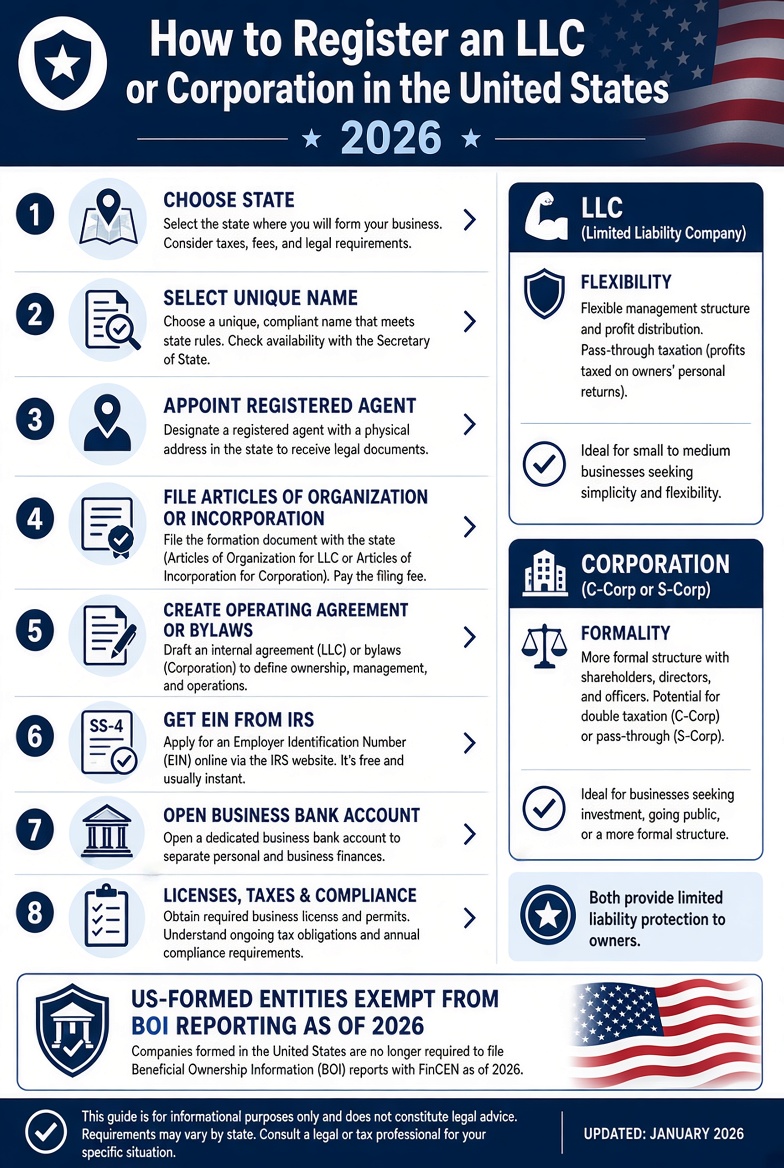

How to Register an LLC or Corporation in the United States in 2026
Published: 2026-09-28 Views:
How to Register an LLC or Corporation in the United States in 2026
Registering a company in the United States is often described as a simple online filing process. In practice, the filing itself is only one part of the process.
The United States does not operate a single nationwide company-registration authority. Business entities are generally created under state law, and the appropriate registration requirements depend on the entity type, business location, ownership structure, and activities of the company. The U.S. Small Business Administration states that where and how a business registers depends on its structure and location, while most LLCs and corporations register through a state agency such as the Secretary of State or a similar business authority.
For foreign entrepreneurs, the real challenge is usually not submitting the formation document. The more important questions are:
- Which state should the company be formed in?
- Should the structure be an LLC or a C Corporation?
- Does the business need a registered agent?
- How should the company obtain an EIN?
- Does the business need foreign qualification in another state?
- What tax filings may apply to a foreign-owned U.S. entity?
- What licenses, permits, banking procedures, and ongoing filings are required?
A well-planned U.S. company registration process therefore starts with structure and compliance planning, rather than simply choosing a state and filing a form.
1. What Does “Registering a Company in the USA” Actually Mean?
U.S. company registration normally involves several separate steps.
First, the founders select a legal entity and a state of formation. The entity is then created under state law by filing the required formation document.
Second, the company identifies a registered agent where required. The registered agent receives official legal and government documents on behalf of the company. The SBA notes that LLCs and corporations generally need a registered agent in the state where they register.
Third, the company handles federal tax identification and other tax registrations that apply to its circumstances. An EIN is a federal employer identification number issued by the IRS and is used for tax filing and reporting purposes.
Fourth, the company reviews state and local obligations. A company formed in one state may still need to register as a foreign entity in another state where it is actually conducting business. The SBA specifically identifies physical presence, employees, substantial business activity, and other operational factors as potential indicators of business activity requiring additional state registration.
The result is that “company registration” is better understood as a sequence:
Entity selection → State formation → Registered agent → EIN and tax setup → State/local registrations → Banking and operations → Ongoing compliance
2. LLC vs. C Corporation: Which Structure Is Appropriate?
There is no universally correct U.S. entity for every business.
LLC
A Limited Liability Company is a legal entity created under state law. The IRS explains that an LLC may be treated for federal tax purposes as a disregarded entity, partnership, or corporation depending on its ownership and elections. A single-member domestic LLC is generally disregarded for federal income tax purposes unless it elects corporate treatment. A multi-member domestic LLC is generally treated as a partnership unless it elects to be taxed as a corporation.
An LLC is often considered by founders who prioritize operational flexibility and a relatively straightforward ownership structure.
However, foreign ownership can create additional U.S. reporting considerations. For example, the IRS states that a foreign-owned U.S. disregarded entity can fall within the reporting rules associated with Form 5472 and a pro forma Form 1120 when reportable transactions exist.
C Corporation
A C Corporation is a corporation formed under state law and generally taxed as a corporation for U.S. federal income tax purposes.
The structure is commonly used in startup and investment environments where the company expects to issue shares, build a more formal equity structure, or seek institutional financing.
The choice between an LLC and C Corporation should therefore be based on ownership, financing plans, tax treatment, business operations, and future expansion rather than on the formation fee alone.
Important Point for Foreign Investors
A foreign entrepreneur should not automatically choose an S Corporation simply because it appears to offer pass-through taxation.
The IRS states that an S corporation cannot have a nonresident alien as a shareholder.
This means international founders need to analyze shareholder eligibility before considering an S corporation election.
3. How to Choose the Right U.S. State
The United States has no single nationwide company registry. The SBA provides state-by-state registration resources and confirms that registration requirements vary by state.
The state of formation should therefore be selected according to the business model.
Delaware
Delaware is a major jurisdiction for business entities and provides formation procedures for corporations, LLCs, limited partnerships, statutory trusts, and other entity types. Delaware also requires each business entity to maintain a registered agent in the state.
Delaware may be considered when the company expects a sophisticated corporate structure, outside investors, multiple shareholders, or future financing.
Wyoming and Other States
Other states may be more appropriate where the company's actual business operations are concentrated elsewhere.
The key issue is that state selection should not be based only on advertising claims such as “cheapest state” or “best state.” The company may have obligations in the state where it actually conducts business, even if its legal entity was created elsewhere.
For example, New York states that a foreign corporation generally may not conduct business in New York until it is authorized by the state, subject to the applicable legal rules.
Therefore:
State of formation ≠ automatically the only state where the company has compliance obligations.
4. Step-by-Step U.S. Company Registration Process
Step 1: Define the Business Model
Before filing, identify:
- Business activity
- Owners and ownership percentages
- Number of members or shareholders
- Planned investment
- Expected revenue
- Target customers
- Whether employees will be hired
- Whether the company will operate across multiple states
- Whether external investors are expected
- Whether the founders are U.S. residents or foreign investors
This information affects the entity structure, state selection, tax analysis, licensing, and future compliance.
Step 2: select the Entity Type
The founders normally decide between structures such as:
LLC – commonly considered for flexible ownership and operational structures.
C Corporation – often used where a formal share structure, investors, stock issuance, or startup financing is expected.
Partnership – may be relevant for certain multi-owner business structures.
S Corporation – subject to specific eligibility rules and therefore generally not available where a nonresident alien is a shareholder.
The formation document differs depending on the structure and the state.
Step 3: select and Clear the Company Name
The proposed name must comply with the naming rules of the relevant state.
A practical professional review should cover:
- State name availability
- Restricted words
- Similar existing entities
- Trademark risks
- Domain-name considerations
- Long-term brand use
A state accepting a company name does not automatically mean the name is safe from trademark conflict.
Step 4: Appoint a Registered Agent
The registered agent is responsible for receiving legal and official documents.
For Delaware entities, for example, state law requires a registered agent with a physical office in Delaware.
For a foreign founder who has no U.S. office, a professional registered-agent arrangement is often used.
The registered agent should not be confused with:
- A virtual office
- A business mailbox
- A tax adviser
- A corporate secretary
- A bank
These can be separate functions.
Step 5: File the Formation Document
The required filing depends on the entity.
For example:
- LLC → Articles of Organization or equivalent
- Corporation → Certificate or Articles of Incorporation
- Partnership → applicable partnership filing
Delaware's official formation guidance specifically distinguishes entity types and explains that the Division of Corporations handles filings for corporations, LLCs, LPs, statutory trusts, and other permitted structures.
The filing normally includes information such as:
- Legal entity name
- Registered agent
- Principal information
- Management or ownership details where required
- Incorporator or organizer information
- Corporate share information where applicable
Once the state accepts the filing, the legal entity is established under that state's law.
5. How to Obtain an EIN
After legal formation, many companies need an Employer Identification Number from the IRS.
An EIN is a nine-digit federal tax identification number used for tax filing and reporting.
The IRS recommends applying electronically where eligible. Its current Form SS-4 instructions state that online EIN applications are available to applicants with a legal residence, principal place of business, or principal office or agency in the United States or its territories, while applicants outside the United States have other application procedures available, including telephone, fax, or mail depending on the circumstances.
A foreign entrepreneur should therefore distinguish between:
U.S. company formation
and
EIN application eligibility and procedure
They are related but not identical procedures.
6. Foreign-Owned U.S. Companies Need Extra Tax Attention
One of the most frequently misunderstood issues is assuming that incorporation automatically determines the company's tax obligations.
It does not.
A foreign-owned U.S. company may have additional reporting requirements depending on:
- Ownership
- Entity classification
- Related-party transactions
- U.S. trade or business activities
- Income sources
- Employees
- State-level activity
- International transactions
The IRS states that a foreign-owned U.S. disregarded entity may be treated separately for certain information-reporting purposes and can be required to file Form 5472 with a pro forma Form 1120 when the applicable reporting conditions are met.
This is why international entrepreneurs should not treat “no physical office” or “no U.S. employees” as automatically meaning “no U.S. tax filings.”
7. Important 2026 update: U.S. Companies and BOI Reporting
This area has changed significantly.
As of August 11, 2026, FinCEN finalized a rule that exempts U.S.-formed companies from beneficial ownership information reporting under the Corporate Transparency Act. The rule became effective on August 14, 2026.
Under the current FinCEN guidance:
U.S.-formed companies are exempt from BOI reporting.
However, certain foreign entities that were formed under foreign law and subsequently registered to do business in the United States can still fall within the reporting-company framework. FinCEN also states that certain BOI reporting remains relevant to foreign individuals associated with those foreign reporting companies.
This distinction is extremely important.
A company formed in Delaware as a U.S. entity is not the same legal situation as a foreign company formed outside the United States and then registered to operate in the United States.
Because FinCEN explicitly warns that some older BOI guidance is now outdated, businesses should verify the current rule instead of relying on articles published before August 2026.
8. Does a U.S. Company Need to Register in Multiple States?
Potentially, yes.
Suppose a company is legally formed in Delaware but opens an operating office, hires employees, or conducts substantial activities in another state.
That second state may require the company to obtain foreign qualification or other registrations.
The SBA explains that a business formed in one state may need to foreign-qualify in other states where it is conducting business activities.
New York provides a concrete example: its Department of State explains that foreign corporations must obtain authorization before conducting qualifying business activity in New York.
Therefore, a professional registration review should consider both:
Where the company is formed
and
Where the company actually operates.
9. Business Licenses and Local Permits
Company formation does not automatically grant permission to conduct every type of business.
The SBA states that local governments may require business licenses, permits, or DBA registrations depending on the activity and location.
For example, requirements can differ substantially between:
- E-commerce
- Import and export
- Food businesses
- Financial services
- Consulting
- Healthcare
- Construction
- Manufacturing
- Professional services
- Technology businesses
A registration provider should therefore treat the company formation certificate as the beginning of compliance, not the end.
10. Practical Foreign-Investor Example
Consider a hypothetical foreign e-commerce entrepreneur who lives outside the United States and wants to establish a U.S. entity for international sales.
The founder may initially want a simple LLC because of its flexible structure.
However, a proper review would ask:
Where are the customers?
Where are employees located?
Will inventory be stored in the United States?
Will the company import goods?
Which state will manage the operations?
Will the company receive payments through U.S. financial institutions?
Will the entity have related-party transactions with the overseas parent company?
Does the founder plan to raise institutional capital?
If the company is wholly owned by a foreign individual, its federal tax classification and information-reporting obligations need to be examined carefully. The IRS's rules for foreign-owned U.S. disregarded entities demonstrate why the tax analysis cannot stop at the formation certificate.
This example is illustrative rather than a claim about a particular client.
11. How Much Does It Cost to Register a Company in the USA?
There is no single nationwide U.S. company-registration fee.
The total budget may include:
- State formation fee
- Registered agent fee
- Name reservation fee, where applicable
- EIN-related professional services, if outsourced
- Business-license fees
- Foreign-qualification fees
- State tax registration
- Annual or periodic state fees
- Accounting and tax-compliance costs
- Corporate maintenance services
The SBA notes that filing costs vary by state and business structure.
Therefore, a meaningful quote should separate:
Government fees
from
Professional service fees
and from
Recurring annual compliance costs.
A company that appears inexpensive to establish may still have significant ongoing tax, accounting, registered-agent, franchise-tax, or qualification expenses.
12. How Long Does U.S. Company Registration Take?
There is no single nationwide processing time because different states operate different filing systems and processing procedures.
Online filing can be relatively fast in some jurisdictions, while additional document review, expedited processing, foreign-owner EIN procedures, bank compliance, licensing, and state registrations can extend the overall setup period.
A realistic project plan therefore separates the process into stages:
Stage 1: Structure and state selection
Stage 2: Name and formation filing
Stage 3: EIN and tax setup
Stage 4: Banking and payment infrastructure
Stage 5: State/local licensing and foreign qualification
Stage 6: Ongoing accounting and compliance
This approach is more useful than advertising a single “24-hour company registration” number without explaining what has actually been completed.
13. Common Mistakes Foreign Entrepreneurs Make
Mistake 1: Choosing a state only because it is cheap
Low formation fees do not automatically mean low total operating costs.
Mistake 2: Assuming Delaware solves every compliance issue
A Delaware company may still have obligations in states where it conducts business.
Mistake 3: Thinking an LLC means no tax reporting
Tax treatment depends on ownership, classification, transactions, and other factors.
Mistake 4: Using outdated BOI information
The U.S. BOI framework changed materially in 2025 and was finalized again in August 2026. Current FinCEN guidance should be checked before filing.
Mistake 5: Confusing a registered agent with a real business office
A registered agent primarily serves the statutory function of receiving official documents. It does not automatically create operating substance, employees, inventory, or management presence.
Mistake 6: Ignoring foreign-owned entity reporting
Foreign ownership may trigger specialized U.S. tax information returns and related-party reporting requirements.
Mistake 7: Applying for an S Corporation election without checking ownership eligibility
The IRS specifically excludes nonresident aliens from being S corporation shareholders.
14. What Documents Are Commonly Needed?
The exact requirements vary by state and entity, but a typical registration package may involve:
- Proposed company name
- Business description
- Formation state
- Owner/shareholder information
- Ownership percentages
- Passport or identity documents for foreign founders where required by service providers or financial institutions
- Registered-agent information
- Principal business address
- Mailing address
- Corporate structure information
- Formation documents
- Operating Agreement or corporate bylaws
- EIN application information
- Banking information
For a corporate structure, additional information may be required concerning authorized shares, directors, officers, or capitalization.
The objective is not simply to collect documents but to ensure that the formation records, tax records, banking information, and ownership information are consistent.
15. How Professional U.S. Company Registration Services Add Value
The value of a professional registration provider should not be measured only by whether the provider can submit an incorporation form.
A more complete service model may include:
Pre-formation analysis
Review the business activity, ownership, intended market, state, and entity type before filing.
Formation filing
Prepare and submit the correct state documentation.
Registered agent support
Maintain the statutory registered-agent requirement in the formation state where applicable.
EIN coordination
Prepare the federal tax identification application according to the applicant's circumstances.
Tax and accounting coordination
Identify recurring federal and state filing obligations and coordinate with qualified tax professionals.
Foreign qualification
Review whether additional state registration may be needed when the company operates outside its formation state.
Post-registration compliance
Help maintain annual reports, state filings, accounting records, licenses, and other recurring requirements.
For international investors, this integrated approach can be more important than the filing itself.
16. U.S. Company Registration Checklist
Before launching the company, confirm:
Entity: LLC, C Corporation, partnership, or another appropriate structure
State: Formation state selected based on business facts
Name: State availability and trademark considerations reviewed
Agent: Registered agent appointed where required
Formation: State formation document accepted
EIN: Federal tax identification process completed where required
Tax: Federal and state tax obligations reviewed
BOI: Current FinCEN rules checked based on whether the entity is U.S.-formed or a foreign entity registered in the United States
Qualification: Other states reviewed for foreign qualification
Licenses: Industry and local permits checked
Banking: Corporate banking and payment arrangements planned
Accounting: Bookkeeping and tax filing procedures established
Records: Ownership, formation, and corporate documents maintained
17. Frequently Asked Questions About U.S. Company Registration
Can a foreigner register a company in the USA?
Foreign individuals and foreign businesses can establish U.S. entities in many circumstances, subject to applicable state, federal, tax, sanctions, licensing, and banking rules.
Does a foreigner need to live in the United States?
Not necessarily. Residency requirements and practical banking, tax, licensing, and operational considerations are separate issues. The appropriate structure depends on the business model.
Can a foreigner own a U.S. LLC?
Yes. The IRS notes that LLC members may include foreign entities, and most states do not generally restrict LLC ownership to U.S. persons.
Can a foreigner own a U.S. corporation?
In many cases, yes, although shareholder eligibility, tax reporting, securities considerations, and industry-specific restrictions must be reviewed.
Can a foreigner choose an S Corporation?
A nonresident alien cannot be a shareholder of an S corporation under the applicable federal tax rules.
Does every U.S. company need a registered agent?
LLCs and corporations generally need one in the state where they register, subject to the specific state's law.
Does registering in Delaware mean I can operate anywhere in the USA without further registration?
No. A company may need foreign qualification or other registrations in states where it conducts business.
Do U.S.-formed companies currently need to file BOI reports?
Under FinCEN's final rule effective August 14, 2026, U.S.-formed companies are exempt from BOI reporting.
Do foreign companies registered in the USA have the same BOI treatment?
Not necessarily. Certain foreign entities registered to conduct business in the United States remain within the reporting-company framework under the current FinCEN rule.
Does an EIN automatically make a company tax compliant?
No. An EIN is an identification number. Tax compliance may involve federal returns, information returns, employment taxes, state taxes, sales taxes, and other obligations depending on the company.
Conclusion: U.S. Company Registration Should Be Planned as a Compliance Project
U.S. company registration is more than filing an LLC or corporation document with a state.
The strongest registration strategy connects the legal structure with the actual business model:
Choose the entity based on ownership and business goals.
Choose the formation state based on where and how the business will operate.
Set up a compliant registered-agent arrangement.
Handle the EIN process correctly.
Review foreign-owner tax reporting where applicable.
Check other-state qualification requirements.
Verify licenses and local registrations.
Monitor regulatory changes such as the 2026 FinCEN BOI rules.
The public record of Meta Platforms, Inc. demonstrates why the distinction between a company's state of incorporation and its operating location matters. Meta is incorporated in Delaware while its principal executive office is in California, illustrating that U.S. corporate structures can span multiple jurisdictions.
For foreign investors, the most reliable approach is therefore not simply to ask, “What is the cheapest state to register a company?”
A more useful question is:
“Which U.S. legal structure and state-registration strategy matches my ownership, business activity, tax position, operating locations, and long-term expansion plan?”
That is the foundation of a sustainable U.S. company setup.