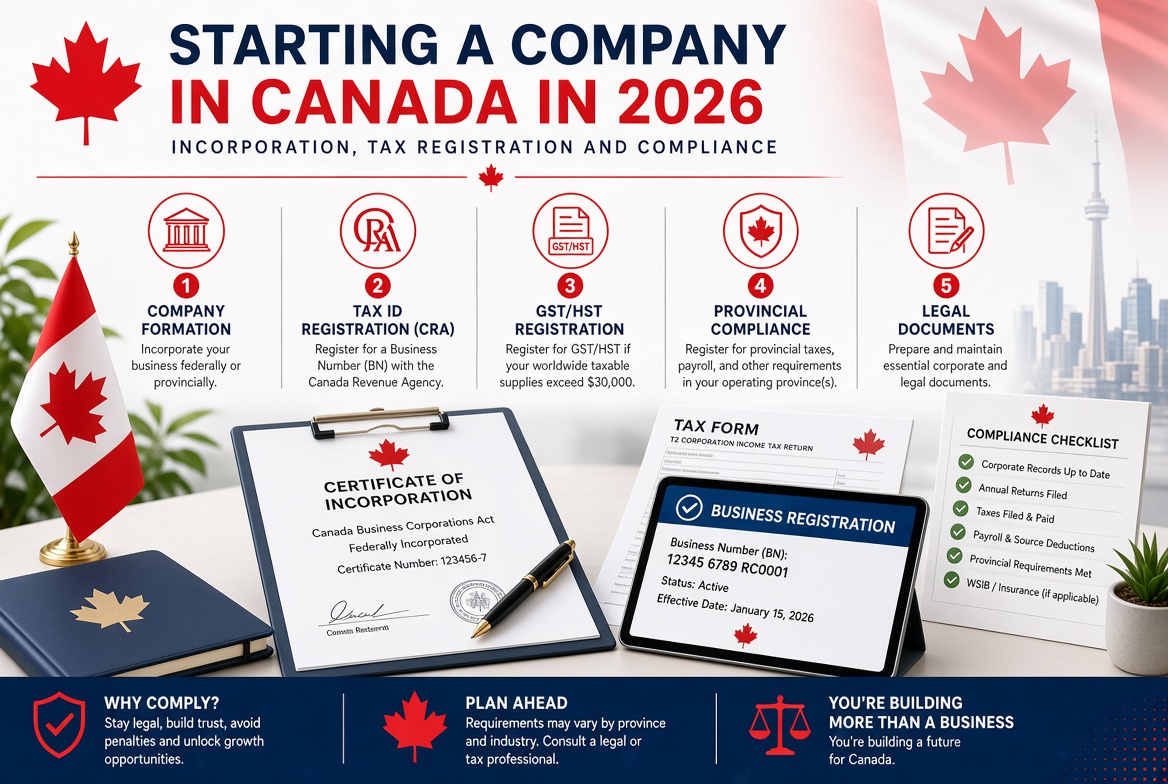

Starting a Company in Canada in 2026: Incorporation, Tax Registration and Compliance
Published: 2026-09-29 Views:
Introduction: What Does Company Registration in Canada Actually Mean?
Canada has a mature corporate registration system designed for both domestic entrepreneurs and international businesses. However, “registering a company in Canada” is not a single filing with one nationwide business registry.
A business can generally be incorporated federally under the Canada Business Corporations Act (CBCA) or provincially/territorially under the applicable corporate legislation. After incorporation, the company may also need to complete tax registrations, provincial registrations, municipal licensing, and other industry-specific registrations. The Government of Canada specifically notes that corporations may need to register in every province or territory where they conduct business.
For international founders, the important question is therefore not simply:
“How do I register a Canadian company?”
The better question is:
“Which Canadian incorporation structure, province, ownership arrangement, tax setup, and compliance model matches my business activities?”
That distinction can materially affect the cost, administration, director requirements, banking preparation, tax obligations, and expansion strategy.
1. Main Corporate Registration Options in Canada
The Canadian system can broadly be divided into two routes.
Federal Incorporation
Federal incorporation is administered by Corporations Canada, part of Innovation, Science and Economic Development Canada.
A federal corporation receives a legal corporate identity under the CBCA. A federally approved corporate word name gives the corporation the right to use that name across Canada, subject to applicable rules and registration requirements in the provinces and territories where it operates.
Federal incorporation can be particularly relevant for businesses that intend to operate across multiple Canadian jurisdictions or want a federal corporate structure from the beginning.
The current federal online incorporation fee is CAD 200, with a standard online service time of one business day. Corporations Canada also offers an express service for an additional CAD 100, with a four-business-hour service standard for eligible applications.
Provincial or Territorial Incorporation
A corporation can instead be formed under the legislation of a particular province or territory.
This can make sense when the business has a relatively concentrated operating footprint and its legal, administrative, and expansion plans are better aligned with a particular province.
For example, British Columbia currently lists a CAD 350 basic incorporation fee for a B.C. limited company, plus a CAD 30 name approval fee when applicable.
The precise incorporation procedure and ongoing requirements vary by jurisdiction, so foreign investors should not assume that the rules for an Ontario corporation, British Columbia corporation, and federal corporation are interchangeable.
2. Federal vs. Provincial Incorporation: Key Differences
A frequent mistake is to treat federal incorporation as a replacement for provincial registration.
It is not.
Corporations Canada explains that a federal corporation generally must also register in the provinces or territories where it conducts business. The definition of “doing business” can vary by jurisdiction and may include factors such as having an address, phone number, or offering products or services in the province or territory.
A practical comparison looks like this:
| Factor | Federal Incorporation | Provincial/Territorial Incorporation |
|---|---|---|
| Main authority | Corporations Canada | Provincial or territorial registry |
| Governing law | Canada Business Corporations Act | Local corporate statute |
| Corporate name | Federal approval | Provincial/territorial rules |
| Expansion | Designed for a Canada-wide corporate identity | May require extra-provincial registrations when expanding |
| Director rules | CBCA requirements apply | Depend on the jurisdiction |
| Government incorporation fee | CAD 200 online | Varies by jurisdiction |
| Additional registrations | May be required where business operates | Depends on business footprint |
This means the incorporation decision should be made before filing, not after.
3. Who Can Register a Company in Canada?
Canada permits companies to be owned by individuals or corporate shareholders, including structures involving international investors.
However, eligibility requirements depend on the jurisdiction, industry, ownership structure, and the nature of the proposed business.
For federal incorporation, the board of directors is especially important.
Under the current CBCA framework, at least 25% of directors must generally be resident Canadians. When a corporation has fewer than four directors, at least one must be a resident Canadian. Certain regulated sectors can have stricter Canadian participation requirements.
This is one of the first issues that international founders should examine.
A foreign investor might have:
- A foreign parent company
- One or more non-Canadian shareholders
- A Canadian operating subsidiary
- A Canadian-resident director where required
- A Canadian registered office
- Local accounting and tax support
The corporate structure should be designed as a complete system rather than treating incorporation as an isolated form-filing exercise.
4. Choosing a Canadian Company Name
Company naming is one of the earliest steps in Canadian incorporation.
For a federal corporation, there are two principal choices:
Word Name
A word name is the company’s legal name, such as:
Northstar Digital Solutions Inc.
The proposed name must meet federal naming rules. It must be distinctive, must not create confusion with existing corporate names, business names or trademarks, and must not contain prohibited or misleading elements.
For online federal incorporation, the name-search process is integrated into the incorporation process for eligible applications, so applicants do not necessarily need to obtain a separate NUANS report before filing a word-name incorporation online.
Numbered Name
A numbered company could look like:
12345678 Canada Inc.
This is generally the simplest corporate naming route because Corporations Canada assigns the number. A corporation using a numbered legal name may operate under another business or trade name, subject to applicable provincial or territorial registration rules.
Important Distinction: Corporate Name vs. Trademark vs. Domain
These are not the same thing.
A corporate name is the legal name of the company.
A trade name is the operating name.
A trademark identifies a brand or protected sign.
A domain name is the internet address.
The Government of Canada specifically distinguishes these four concepts. Owning a domain name does not automatically give the owner rights to use it as a corporate name or trademark.
For businesses planning international expansion, it is therefore sensible to assess all four before committing to a brand.
5. Core Documents Required for Canadian Incorporation
The exact documentation depends on the jurisdiction and structure, but the incorporation process commonly involves several fundamental items.
For a federal corporation, Corporations Canada identifies five major steps:
- Choose a corporate name.
- Create the Articles of Incorporation.
- Establish the registered office and first board of directors.
- File information about individuals with significant control.
- Submit the application and pay the applicable fee.
Articles of Incorporation
The Articles establish the basic constitutional structure of the corporation.
Depending on the structure, they may address:
- Corporate name
- Share classes
- Share rights
- Restrictions on share transfers
- Number of directors
- Restrictions on business activities
- Other corporate provisions
For small private businesses, Corporations Canada also offers a basic incorporation model with predetermined articles and a simplified share structure.
Registered Office
Every incorporated business needs a registered office.
This address is important because it is where corporate records are maintained and where official documents may be served.
A registered office is not necessarily the same thing as:
- A commercial storefront
- A warehouse
- A mailing-only address
- A virtual office used for marketing purposes
The address should be selected based on the legal and operational requirements of the company.
6. Individuals with Significant Control: A Major Compliance Requirement
Canada has increased corporate transparency requirements in recent years.
For corporations incorporated under the CBCA, information about Individuals with Significant Control (ISC) must be filed with Corporations Canada. This requirement has applied to CBCA corporations since January 22, 2024.
An ISC may be a person who:
- Owns, controls or directs 25% or more of shares;
- Has control in fact without necessarily owning shares; or
- Meets a combination of relevant control criteria.
ISC information must be updated in accordance with the filing requirements, including on incorporation and following relevant changes. Federally incorporated businesses must also maintain an internal ISC register.
This makes ownership planning increasingly important for:
- Family-owned companies
- Foreign-invested corporations
- Holding companies
- Joint ventures
- Group structures
- Private equity structures
- Companies with nominee or trust arrangements
The corporate structure should therefore clearly identify who ultimately owns or controls the business.
7. Canada Business Number and CRA Registration
Incorporation is not the same as tax registration.
Once a company is established, it may need to interact with the Canada Revenue Agency (CRA) and obtain the appropriate business number and program accounts.
A Canadian Business Number, or BN, is the standard identifier used to interact with the CRA and various government programs.
Depending on the company’s activities, the relevant CRA accounts may include:
- Corporation income tax account
- GST/HST account
- Payroll deductions account
- Information return account
- Other specialized program accounts
The CRA states that certain incorporation routes automatically result in a BN and corporation income tax account, while companies incorporated in other jurisdictions may need to register separately with the CRA.
There is also an important current digital-registration change: since July 14, 2026, CRA’s Business Registration Online requires sign-in through a CRA account for applicable online registrations.
8. GST/HST Registration: When Does a Canadian Company Need It?
GST/HST is one of the most important post-incorporation tax issues.
For most businesses, the small-supplier threshold is generally CAD 30,000 based on taxable supplies, subject to the detailed rules and exceptions. When a business exceeds the threshold in a single calendar quarter or over the applicable four-consecutive-quarter calculation, GST/HST registration can become mandatory.
Companies should not look only at “sales in Canada.”
The GST/HST registration rules can involve worldwide taxable revenues, associated persons, and specific rules for non-resident businesses and digital-economy activities.
Once registered, a business generally has responsibilities relating to:
- Charging GST/HST
- Collecting the tax
- Filing returns
- Remitting amounts owing
- Maintaining appropriate records
- Potentially claiming eligible input tax credits
This is why tax planning should begin at incorporation rather than after the first major invoice.
9. Corporate Income Tax Filing in Canada
A common misunderstanding is that a newly incorporated company does not need to file tax returns until it becomes profitable.
That is generally incorrect.
Canadian resident corporations generally must file a T2 Corporation Income Tax Return every tax year, even if no tax is payable. The rule also applies to inactive corporations, subject to specific exceptions.
The standard deadline is generally within six months after the end of the corporation’s tax year.
Therefore, a Canadian company’s compliance calendar should be established immediately after incorporation.
The company should track at least:
- Fiscal year-end
- T2 filing deadline
- Corporate tax payment deadlines
- GST/HST filing periods
- Payroll obligations
- Annual corporate filings
- Director and shareholder changes
- ISC updates
- Provincial registrations
- Business licence renewals
10. Is a Canadian Company Bank Account Automatically Included?
No.
Company incorporation, CRA registration, and corporate bank account opening are separate processes.
A corporation may receive its incorporation documents and then approach a bank or financial institution for account opening.
The financial institution can carry out its own:
- Corporate KYC review
- Beneficial ownership review
- Director verification
- Source-of-funds review
- Business activity assessment
- Expected transaction review
- Anti-money-laundering checks
For foreign-owned businesses, banking preparation deserves particular attention because the bank may want to understand the relationship between the Canadian company and the overseas shareholder or parent company.
Documents commonly relevant to the process can include:
- Certificate of Incorporation
- Articles
- Corporate profile
- Director information
- Ownership information
- Identification documents
- Business plan or activity description
- Major contracts or invoices
- Parent-company documents where applicable
The practical lesson is simple:
Incorporation creates the legal entity; it does not guarantee banking approval.
11. Provincial, Municipal, and Industry Licences
Another common misconception is:
“Once the company is incorporated, the business can start operating immediately.”
That is not always true.
The federal government notes that businesses may need extra-provincial registration and permits or licences depending on their activities.
A company may potentially require:
- Extra-provincial registration
- Municipal business licences
- Sales-tax registrations
- Import/export registrations
- Employer registrations
- Professional licences
- Industry-specific approvals
- Health or safety permits
- Environmental permits
- Financial-services registrations
A technology consulting company may have a relatively straightforward setup.
A food importer, medical-device distributor, financial-services business, transportation company, or regulated professional practice may face a substantially different compliance environment.
Therefore:
Company registration should always be evaluated together with the company’s actual business activity.
12. Typical Canada Company Registration Process
A professional registration project can be organized into the following sequence.
Step 1: Define the Business Model
Determine:
- What the company will sell
- Where customers are located
- Where management is located
- Where employees will work
- Expected revenue
- Whether there will be inventory
- Whether the company will import or export
- Whether the business is regulated
Step 2: Choose the Incorporation Jurisdiction
Compare:
- Federal incorporation
- Provincial incorporation
- Director requirements
- Name considerations
- Filing costs
- Future expansion
- Tax and administrative implications
Step 3: select the Company Name
Check corporate-name availability and separately review potential trademark and domain conflicts.
Step 4: Prepare Corporate Documents
Prepare the Articles, director details, registered-office information, ownership structure, share structure, and required control information.
Step 5: Submit the Incorporation Application
For federal incorporation, Corporations Canada currently lists an online fee of CAD 200 and a one-business-day standard processing time, with express service available for eligible applications.
Step 6: Obtain Tax Registrations
Determine whether the company requires:
- BN
- Corporation income tax account
- GST/HST
- Payroll
- Other CRA program accounts
Step 7: Complete Provincial and Local Registrations
Register the federal corporation in jurisdictions where required and obtain business licences relevant to the operating location.
Step 8: Prepare for Banking and Operations
Set up:
- Corporate bank account
- Accounting system
- Invoicing
- Bookkeeping
- Payroll if applicable
- Contracting procedures
- Record retention
Step 9: Establish the Compliance Calendar
Set recurring reminders for corporate, tax, payroll, GST/HST, annual-return, and ownership-control requirements.
13. How Much Does It Cost to Register a Company in Canada?
There is no single “Canada company registration price.”
Government filing fees depend on the incorporation route.
For example:
- Federal incorporation: CAD 200 online; express service adds CAD 100 where available.
- British Columbia limited company: CAD 350 basic incorporation fee, with a CAD 30 name approval fee where applicable.
But the government filing fee is only one component of the real setup budget.
A foreign-owned business may also incur costs for:
- Corporate legal documents
- Registered-office services
- Accounting setup
- Tax registration assistance
- Provincial registrations
- Business licences
- Corporate minute books
- Banking preparation
- Bookkeeping
- Annual corporate compliance
- Tax return preparation
- Industry-specific compliance
Therefore, when evaluating a Canadian company-registration service provider, the better question is not simply:
“What is the cheapest incorporation price?”
Instead, ask:
“What exactly is included in the registration and post-incorporation service?”
14.Successful Registration Cases of Shenzhen Ruibo Canada Company (2026 Completed Projects)
The following two cases represent the most common registration scenarios for international clients, with full details of challenges, solutions and verified outcomes.
Case 1: Cross-Border E-Commerce Business – Federal Incorporation for US-Canada Market Integration
BackgroundShenzhen Horizon E-Commerce Co., Ltd., a mid-sized home goods seller with existing operations on Amazon US, planned to launch Amazon Canada FBA and Walmart Canada marketplace stores. The team initially tried to operate using their Chinese entity and a third-party intermediary, but faced payment withholding, limited category access and inability to register for import accounts. They required a standalone Canadian federal corporation to own store accounts, hold inventory and process payments locally.
Challenges Faced
- First self-filing attempt was rejected due to lack of a Canadian registered office address and local registered agent.
- Two proposed corporate names were refused during the NUANS name search process due to confusing similarity with existing trademarks.
- The team was unfamiliar with GST/HST registration requirements and import account setup, risking customs clearance delays after launch.
Solution & Execution
- The client selected federal incorporation to enable seamless cross-provincial FBA operations across Canada.
- A licensed local service provider was engaged to provide a registered office address in Ontario and act as statutory registered agent, satisfying federal requirements.
- A pre-NUANS availability screening was conducted to shortlist 3 compliant names, with Horizon Trade Canada Inc. selected and successfully reserved.
- Filing was completed remotely via the Corporations Canada online portal, with all documents apostilled and submitted digitally.
- Business Number (BN), GST/HST account and CBSA import account were registered concurrently with incorporation.
OutcomeFull registration was completed in 12 business days, including the certificate of incorporation, BN confirmation and tax registration documentation. The client successfully onboarded to Amazon Canada FBA within 3 weeks, opened a Canadian dollar corporate bank account remotely, and achieved 35% higher order fulfillment speed compared to cross-border shipping from US warehouses. All annual compliance and tax filing requirements are now managed proactively to maintain good standing.
Case 2: Tech Startup – British Columbia Provincial Incorporation for Startup Visa Program
BackgroundIntelliServe AI, a Beijing-based enterprise AI customer service SaaS startup, planned to expand its North American customer base and apply for Canada’s Startup Visa Program for its core founding team. British Columbia was selected for its concentration of tech talent, designated startup incubators and generous SR&ED R&D tax credits. The team required a BC provincial corporation that met immigration program equity requirements and could qualify for local innovation incentives.
Challenges Faced
- The Startup Visa program requires specific shareholding structures and endorsement from a designated Canadian incubator, which the team was unfamiliar with structuring.
- All founders were based in China and required fully remote incorporation without travel to Canada.
- The company needed to register for provincial PST and federal GST, and set up systems to track eligible R&D expenses for future SR&ED claims.
Solution & Execution
- BC provincial incorporation was chosen as it has no mandatory Canadian resident director requirement, allowing the all-Chinese founding team to maintain full board control.
- Articles of incorporation were drafted to align with IRCC Startup Visa guidelines, with approved share classes and ownership structure.
- The client was connected with a Vancouver-based designated tech incubator, which completed due diligence and issued the formal Letter of Support required for the visa application.
- Incorporation was filed electronically with the BC Corporate Registry, with BN, GST and PST registrations completed in parallel.
- Post-incorporation support included introduction to a Canadian tech-focused bank for remote account opening and SR&ED eligibility consulting.
OutcomeBC provincial incorporation (IntelliServe AI Canada Corp.) was finalized in 18 business days. The incubator Letter of Support was issued shortly after, and the founding team submitted their Startup Visa applications. Within 6 months of incorporation, the company signed 7 North American enterprise clients and successfully claimed its first SR&ED tax refund for product development costs.
15. Case Scenario for Foreign Investors
Consider a foreign technology company planning to establish a Canadian subsidiary for North American sales.
The parent company may need to consider:
Corporate structure:
Canadian operating subsidiary owned by the overseas parent.
Jurisdiction:
Federal or provincial incorporation based on the planned operating footprint and governance requirements.
Directors:
Confirm applicable director residency rules before filing.
Registered office:
Maintain a compliant Canadian registered office.
Ownership transparency:
Identify the individuals who ultimately control the corporate structure.
Tax:
Determine corporation income tax, GST/HST, payroll, and cross-border tax obligations.
Banking:
Prepare parent-company and beneficial-ownership documents for KYC.
Operations:
Review immigration/work authorization, employment, licensing, import/export, and contractual requirements where relevant.
This illustrates why professional Canadian company registration is not simply about filling out an incorporation form.
It is about making the corporate, tax, ownership, and operational pieces work together.
16. Common Mistakes When Registering a Company in Canada
Mistake 1: Choosing the jurisdiction based only on filing price
A low initial incorporation cost does not necessarily mean lower total operating cost.
Mistake 2: Confusing corporate registration with business licensing
Incorporation creates the corporation. It does not automatically provide every permit required for the company’s activities.
Mistake 3: Ignoring director requirements
Federal director residency requirements can be highly relevant for international founders.
Mistake 4: Treating the registered office as a casual mailing address
The registered office has a legal function and must be capable of receiving official documents.
Mistake 5: Delaying tax registration
GST/HST and corporate income-tax responsibilities should be evaluated from the beginning rather than after the business starts generating significant revenue.
Mistake 6: Ignoring ownership transparency
Federal corporations have ISC filing and recordkeeping obligations.
Mistake 7: Assuming incorporation guarantees a bank account
Banking institutions conduct independent KYC and risk reviews.
Mistake 8: Using a corporate name without trademark clearance
A company name, trademark and domain name are separate rights and registration systems.
17. What International Entrepreneurs Should Prepare Before Filing
A foreign founder can make the Canadian registration process much smoother by preparing the following information before the application begins:
Corporate Information
- Proposed company name
- Business activities
- Registered-office address
- Fiscal-year planning
- Share structure
Founder Information
- Full legal names
- Residential or service addresses
- Identification documents
- Director information
- Share ownership percentages
Group Structure
- Parent company details
- Ultimate beneficial ownership
- Existing overseas entities
- Proposed intercompany relationships
Business Planning
- Expected Canadian activities
- Customer locations
- Expected revenues
- Employees
- Suppliers
- Import/export activities
- Banking requirements
The clearer these items are before incorporation, the less likely it is that the company will need expensive structural corrections later.
18. Why Professional Canada Company Registration Services Can Be Valuable
For straightforward domestic businesses, self-filing may be possible.
For foreign-owned or more complex companies, however, a professional registration provider can help coordinate several related tasks.
A professional service package may include:
- Incorporation application
- Company-name assessment
- Articles preparation
- Registered-office arrangements
- Corporate records
- Director/shareholder documentation
- CRA registration
- GST/HST registration support
- Provincial registration
- Accounting setup
- Annual compliance reminders
- Cross-border tax coordination
- Corporate changes and maintenance
The most useful providers are not merely filing agents. They should be able to identify potential structural issues before the company is incorporated.
19. Canada Company Registration Checklist
Before filing:
☐ Decide between federal and provincial incorporation
☐ Confirm business activities
☐ Check company-name availability
☐ Review trademark and domain considerations
☐ Confirm director requirements
☐ Prepare registered-office information
☐ Decide the share structure
☐ Identify shareholders and ultimate controllers
☐ Prepare ISC information
☐ Determine CRA registration requirements
☐ Review GST/HST requirements
☐ Check provincial and municipal licences
☐ Prepare banking documentation
After incorporation:
☐ Obtain and organize incorporation documents
☐ Complete tax registrations
☐ Register extra-provincially where required
☐ Open the corporate bank account
☐ Set up bookkeeping and accounting
☐ Establish payroll compliance if applicable
☐ Maintain corporate records
☐ Track annual filing deadlines
☐ update director and ownership information when required
20. Frequently Asked Questions About Canada Company Registration
1. Can a foreigner register a company in Canada?
Foreign investors can establish Canadian corporations, but eligibility, director rules, sector restrictions, tax considerations and local registration requirements should be checked for the selected jurisdiction and business activity.
2. What is the cheapest way to register a Canadian company?
The government filing fee depends on the jurisdiction. Federal online incorporation is currently CAD 200. Provincial fees vary.
3. Can I incorporate a company online in Canada?
Yes. Federal incorporation is available through the Corporations Canada Online Filing Centre, and many provinces also provide online incorporation systems.
4. How long does federal incorporation take?
Corporations Canada currently lists a one-business-day online service standard for federal incorporation, with express service of four business hours for eligible applications.
5. Do I need a Canadian-resident director?
For a federal corporation, generally yes: at least 25% of directors must be resident Canadians, and if there are fewer than four directors, at least one must be a resident Canadian, subject to applicable exceptions.
6. Do I need a Canadian business address?
An incorporated corporation must maintain a registered office meeting the applicable legal requirements. Federal incorporation requires a registered office address.
7. Does incorporation automatically give me a GST/HST number?
Not necessarily. GST/HST registration is a separate tax issue and depends on the company’s circumstances and taxable supplies.
8. What happens if my company has no revenue?
A Canadian resident corporation generally still has to file its T2 corporate income tax return even when no tax is payable.
9. Is a Canadian company the same as a Canadian trademark?
No. Corporate names and trademarks are governed by different systems.
10. Do I need provincial registration after federal incorporation?
Potentially yes. A federal corporation generally needs to register in provinces or territories where it conducts business, subject to the specific rules of those jurisdictions.
11. Is opening a corporate bank account automatic after incorporation?
No. Banks and other financial institutions conduct their own onboarding and KYC procedures.
12. Does owning a Canadian company give the owner Canadian immigration status?
No. Corporate ownership and immigration/work authorization are separate legal matters.
Conclusion: Canada Company Registration Should Be Planned as a Complete Business Setup
Canada offers a structured corporate environment for entrepreneurs, international investors, startups, trading companies, technology businesses, holding structures, and companies expanding into North America.
But effective Canadian company registration involves more than obtaining a Certificate of Incorporation.
A well-designed setup should answer five questions:
Where should the company be incorporated?
Who will own and control it?
Who will serve as directors?
What tax registrations are required?
Where and how will the company actually conduct business?
For federal corporations, the current process includes corporate-name selection, Articles of Incorporation, a registered office, director information, ISC disclosure and filing fees.
After incorporation, CRA registration, GST/HST analysis, provincial registrations, licensing, banking and ongoing corporate compliance become equally important.
For this reason, international founders should evaluate Canada company registration as a complete corporate-entry project rather than a one-step government filing.