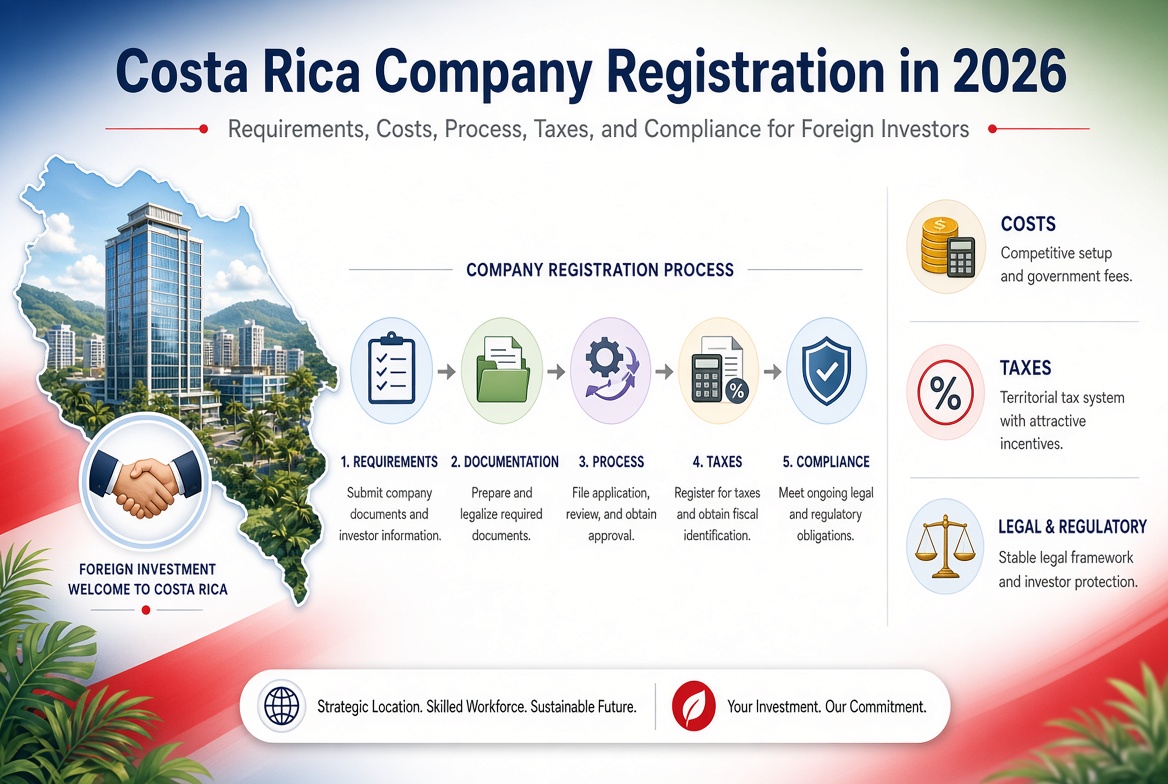

Costa Rica Company Registration in 2026: Requirements, Costs, Process, Taxes, and Compliance for Foreign Investors
Published: 2026-10-09 Views:
Costa Rica Company Registration in 2026: Requirements, Costs, Process, Taxes, and Compliance for Foreign Investors
1. Introduction: Why Consider Company Registration in Costa Rica?
Costa Rica has attracted international entrepreneurs, technology businesses, manufacturers, service providers, and regional trading companies seeking to establish a commercial presence in Central America.
Its established legal framework, access to regional markets, educated workforce, and participation in international trade agreements can make it an attractive location for companies with a clear commercial strategy.
However, registering a company in Costa Rica involves more than preparing incorporation documents. Foreign investors must select an appropriate legal structure, complete the applicable registration process, establish a suitable registered address, understand tax registration requirements, and comply with beneficial ownership reporting and other ongoing obligations.
Corporate law and administrative procedures have also evolved. In particular, recent amendments concerning corporate identification and official electronic notifications mean that investors should verify the current requirements before submitting incorporation documents.
The key principle is that company incorporation creates a legal entity, but it does not automatically authorize every business activity, guarantee a corporate bank account, or eliminate tax and reporting obligations.
This guide explains the principal requirements, procedures, costs, and practical considerations involved in Costa Rica company registration in 2026.
2. Which Legal Structure Should You Choose in Costa Rica?
Two common legal forms for commercial businesses are the Sociedad Anónima (S.A.) and the Sociedad de Responsabilidad Limitada (S.R.L.).
Both provide a corporate framework distinct from their owners. The appropriate choice depends on the ownership arrangement, management model, future investment plans, and nature of the proposed business.
2.1 Sociedad Anónima (S.A.)
A Sociedad Anónima is generally comparable to a share corporation.
Its ownership is represented by shares, and its management framework typically includes a board of directors and designated corporate representatives.
An S.A. can be suitable for businesses that expect to have multiple investors, establish a formal governance structure, or accommodate future changes in share ownership.
Typical applications include:
International trading and distribution companies.
Manufacturing and commercial operating subsidiaries.
Businesses with multiple shareholders.
Companies seeking a formal share-based investment structure.
Certain holding and investment arrangements, subject to the applicable legal and tax rules.
The incorporation documents should clearly establish the share capital, contributions, management arrangements, representation powers, and other required corporate provisions.
2.2 Sociedad de Responsabilidad Limitada (S.R.L.)
A Sociedad de Responsabilidad Limitada is generally comparable to a limited liability company.
Ownership is represented by capital quotas rather than ordinary corporate shares, and management is commonly entrusted to one or more managers.
An S.R.L. may suit closely held businesses, family-owned enterprises, consulting firms, and foreign investors who prefer a more compact management structure.
Its transfer and governance provisions differ from those of an S.A. Therefore, investors should review the proposed ownership arrangements before deciding which form is appropriate.
2.3 S.A. vs. S.R.L.: Key Differences
| Consideration | Sociedad Anónima (S.A.) | Sociedad de Responsabilidad Limitada (S.R.L.) |
|---|---|---|
| Ownership interest | Shares | Capital quotas |
| Typical governance | Board of directors and designated representatives | One or more managers |
| Common use | Businesses requiring a formal share-based structure | Closely held and owner-managed businesses |
| Ownership changes | Governed by applicable share-transfer rules and corporate documents | Governed by quota-transfer rules and statutory requirements |
| Main planning priority | Shareholder rights, board governance, and representation | Member rights, management powers, and transfer restrictions |
Neither form is universally superior. The correct structure should be determined after reviewing the ownership model, financing plans, commercial activities, and local legal requirements.
Important legal update: Costa Rica's Law No. 10,729 of 2025 amended provisions of the Commercial Code concerning the identification of ordinary S.A. and S.R.L. entities. Constitutional challenges to parts of that reform appeared before the Constitutional Chamber in 2026. The status and implementation of the relevant provisions should therefore be checked with a Costa Rican notary or corporate lawyer when preparing a new application.
A corporate identification number should not be confused with a commercial brand or trademark. Businesses wishing to protect a public-facing brand should separately assess the applicable commercial-name and trademark registration procedures.
3. Can Foreign Investors Establish a Company in Costa Rica?
Foreign investors can generally participate in Costa Rican companies, and a local subsidiary may be appropriate for a foreign group seeking a separate legal entity in the country.
The precise ownership and operating conditions depend on the industry and any applicable special legislation.
Before proceeding, investors should distinguish among three possible arrangements.
Option A: Incorporate a New Costa Rican Company
The investor creates a new local legal entity that operates under Costa Rican law.
This option can provide a dedicated legal structure for local sales, employment, supplier contracts, inventory, and business operations.
Option B: Register a Branch of a Foreign Company
An existing foreign company may consider establishing a branch where the statutory requirements are satisfied.
The process typically involves documentation demonstrating the foreign company's legal existence and authority, together with the appointment of an appropriately empowered local representative and registration of the branch arrangements.
A branch is not the same as incorporating a new Costa Rican subsidiary. The legal, governance, and liability implications should be reviewed before selecting this model.
Option C: Use a Local Distribution or Service Partner
A foreign company that does not initially require a separate Costa Rican corporate entity may consider engaging a local distributor or independent commercial partner.
This arrangement may reduce the initial administrative burden, but the contracts must reflect the actual business relationship. It should not be used to disguise a local operation that legally requires registration, licensing, tax registration, or employment compliance.
Foreign investors should also avoid assuming that company ownership automatically grants immigration or work authorization. Residency and employment permissions are separate matters that require their own analysis.
4. What Documents Are Required for Costa Rica Company Registration?
The required documents depend on the entity type, shareholder profile, capital contributions, and filing procedure.
For a typical incorporation, the preparation checklist may include the following.
4.1 Identification Documents
Individual founders and proposed corporate representatives should prepare the identification information requested by the notary.
For foreign individuals, this normally includes a valid passport and the personal information necessary for the incorporation instrument.
The notary should confirm whether certified copies, notarization, apostilles, or additional identity verification are necessary for documents signed or issued abroad.
4.2 Shareholder Information
The founding shareholders or members must provide the information required to identify them and document their participation in the company.
Where a shareholder is itself a foreign legal entity, additional corporate documents may be required to establish its existence, representation powers, and authority to invest.
Foreign-language documents may require translation into Spanish, and foreign public documents may require apostille or other legalization procedures, depending on the issuing jurisdiction and the document involved.
4.3 Corporate Structure and Capital Information
The founders should determine:
The intended legal structure.
The shareholders or members and their respective interests.
The proposed capital and contribution arrangements.
The corporate purpose and planned commercial activities.
The management structure and representation powers.
The registered office in Costa Rica.
The official electronic address for legal notifications.
The proposed accounting and tax-compliance arrangements.
Capital contributions made in cash are not necessarily processed in the same way as contributions involving registrable assets. The notary should determine which registration channel applies.
4.4 Registered Office and Official Notification Email
Costa Rican commercial companies must pay particular attention to their registered address and official notification arrangements.
The applicable Commercial Code provisions require a domestic corporate address and an electronic address for receiving official notifications.
For ordinary new incorporations, the official electronic notification address must be included in the incorporation documents under the relevant implementation rules.
This requirement should be treated as a substantive compliance item, not as an optional administrative detail. The company should maintain an email account that is accessible, monitored, and appropriately controlled.
Existing companies should also verify compliance with the applicable electronic-notification requirements. The National Registry publicly announced an extension to September 4, 2026, for existing companies to register the relevant email address. Because that date has passed, any company that has not completed the required filing should immediately check for subsequent regulatory changes and obtain advice on corrective action.
The official notice and the current Commercial Code provisions should be reviewed before filing.
5. Step-by-Step Process for Registering a Company in Costa Rica
Although the details vary by transaction, a properly managed incorporation generally follows a series of stages.
Step 1: Define the Business Model and Legal Structure
Begin by determining what the company will actually do.
A trading business, software consultancy, manufacturing operation, property-holding entity, and regulated financial service may have different legal, tax, licensing, and capital considerations.
Prepare a concise description of the business model, target customers, expected transaction flows, ownership structure, and intended operating location.
This initial analysis helps the notary and advisers identify any industry-specific restrictions or additional approvals.
Step 2: Confirm the Corporate Identification and Naming Requirements
Costa Rica's 2025 commercial-law amendments changed the identification framework applicable to ordinary S.A. and S.R.L. entities.
Because parts of the reform have been challenged, applicants should not rely on outdated incorporation templates or assume that conventional corporate-name procedures remain unchanged in every respect.
Ask the Costa Rican notary to confirm the current National Registry practice for the selected legal form.
Where a business plans to trade under a distinctive brand, separately assess commercial-name and trademark protection. Incorporation and intellectual-property protection serve different purposes.
Step 3: Prepare and Execute the Incorporation Instrument
A Costa Rican notary public prepares the required incorporation instrument and confirms the information that must be included.
The instrument typically addresses the corporate purpose, capital, ownership interests, management, representation powers, registered office, and other statutory provisions.
Foreign founders who cannot sign locally should discuss the availability of an appropriate power of attorney and the applicable authentication requirements.
Step 4: Submit the Application to the National Registry
Eligible ordinary incorporations of S.A. and S.R.L. companies funded with cash or securities are subject to the applicable electronic filing procedure through the government's designated company-registration platform.
The official National Registry guidance identifies this electronic route for the relevant applications. Different procedures can apply to entities governed by special legislation and to certain incorporations involving contributions of registrable assets.
The notary should determine the correct filing method rather than assume that every transaction can be completed through the same electronic form.
The Registry reviews the application under the applicable legal and procedural requirements. If a filing receives an objection or correction request, the document may need to be amended and resubmitted.
Step 5: Complete Registration and Obtain the Corporate Identification
Once the company is successfully registered, it obtains its Costa Rican corporate identification number.
The founders should retain the incorporation documents, current registry information, details of the legal representatives, and relevant corporate records.
The registered entity can then proceed with the administrative work required for its intended operations.
Registration itself does not replace industry permits, tax registration, employment-related registrations, or financial institution due diligence.
Step 6: Complete Tax Registration
The company must determine the appropriate registration and reporting obligations with Costa Rica's tax authority.
The applicable activities, tax regime, invoicing requirements, filing deadlines, and tax classifications should be evaluated before the business begins operating.
Businesses should not assume that the corporate registration process automatically completes every tax-related step.
For official background, the Ministry of Finance provides guidance on registration in the Registro Único Tributario and the related tax-administration requirements.
Step 7: Complete Beneficial Ownership Reporting
Costa Rica operates a Registro de Transparencia y Beneficiarios Finales (RTBF), or Transparency and Beneficial Ownership Registry.
Companies should identify the natural persons who ultimately own or control them and determine how the applicable declaration must be submitted through the authorized system.
The information should be consistent with the ownership structure and supporting corporate records.
Founders should establish a process for reviewing reporting deadlines and updating information when ownership or control changes. The precise filing period and any applicable exemptions should be confirmed through current official guidance.
Step 8: Obtain Business Permits and Operational Registrations
Depending on the company's business activities, further registrations or authorizations may be required.
These may include municipal business licenses, land-use approvals, health permits, professional registrations, import or export procedures, and industry-specific authorizations.
Companies hiring employees should also assess employer-registration and social security obligations, including the requirements of the Costa Rican Social Security Fund (CCSS).
A company should not assume that incorporation alone is sufficient to begin every regulated activity.
Step 9: Open a Corporate Bank Account
Bank account opening should be treated as a separate due-diligence process.
Financial institutions may request incorporation documents, identification documents, beneficial ownership details, evidence of the source of funds, business contracts, transaction forecasts, and an explanation of the intended account activity.
The exact requirements depend on the bank and the customer profile.
A registered company does not have an automatic right to a bank account, and registration does not guarantee bank approval.
6. How Much Does Company Registration in Costa Rica Cost in 2026?
The total cost consists of statutory registration charges and transaction-specific professional and operating expenses.
Investors should distinguish official government fees from the total commercial cost of incorporation.
6.1 Official National Registry Fees
The National Registry's published 2026 fee schedule includes the following charges.
| Fee category | Published amount for 2026 |
|---|---|
| Registration of ordinary commercial companies in the applicable classes | ₡46,220 |
| Legalization of mercantile company books | ₡13,400 |
| Assignment of a corporate identification number, where applicable as a separate charge | ₡2,000 |
These figures are published Registry fee items, not an all-inclusive incorporation quotation. The applicable lines and treatment must be confirmed for the specific filing.
6.2 Other Incorporation Expenses
The final cost may also include:
Notary fees and preparation of the incorporation instrument.
Applicable taxes, stamps, and publication-related charges.
Certified translations of foreign documents.
Apostille or legalization expenses.
Power-of-attorney preparation and authentication.
Registered-office services, where needed.
Accounting, tax-registration, and ongoing compliance services.
Industry-specific permits and professional registrations.
Foreign shareholders may incur additional document-preparation expenses if their identification and corporate documents originate outside Costa Rica.
For this reason, published government fees should not be presented as the guaranteed total cost of setting up a company.
6.3 How to Compare Incorporation Service Providers
When reviewing proposals, ask for an itemized quotation that distinguishes statutory charges from professional services.
A useful quotation should explain what is included in the incorporation package, who prepares the public instrument, whether the filing is handled by a Costa Rican notary, which documents the client must supply, and whether post-registration tax and beneficial ownership support is included.
Also confirm whether annual corporate taxes, accounting services, registered-office arrangements, and business permits are excluded from the initial price.
The lowest initial fee is not necessarily the lowest total cost if important compliance steps are omitted.
7. Corporate Taxes and Ongoing Compliance in Costa Rica
The tax treatment of a Costa Rican company depends on its activities, income, applicable tax regime, and compliance status.
Foreign investors should consider the expected tax obligations before incorporation rather than attempting to reconstruct the structure after transactions have begun.
7.1 Corporate Income Tax
Costa Rican corporate income-tax rules distinguish between the general corporate rate and qualifying smaller companies that may be subject to graduated rates.
For the 2026 tax period, legal entities whose annual gross income exceeds the applicable threshold of ₡119,174,000 are generally subject to a 30% corporate income-tax rate on net taxable income.
Eligible entities at or below the relevant gross-income threshold may qualify for progressive rates of 5%, 10%, 15%, and 20% on taxable net income under the applicable rules.
The reduced schedule is not available solely because a company is newly established. Eligibility, thresholds, deductions, and any special treatment for qualifying micro and small enterprises must be reviewed against the current rules.
Actual tax calculations require an analysis of taxable income and allowable expenses.
7.2 Value Added Tax (VAT)
Costa Rica's general VAT rate is 13%, subject to applicable reduced rates, exemptions, and special treatments.
Whether a particular transaction is subject to VAT, which rate applies, and whether any credit or refund is available depend on the nature of the supply and the governing rules.
Businesses should implement appropriate invoicing and record-keeping procedures and confirm the correct tax treatment for their products and services.
Export-related transactions should be assessed under the specific rules applicable to the relevant goods or services rather than assuming that every transaction connected to an international customer receives identical treatment.
7.3 Annual Legal Entity Tax
Costa Rica imposes an annual legal entity tax, known as the Impuesto a las Personas Jurídicas, subject to the applicable statutory conditions and exemptions.
The Ministry of Finance published the following amounts for the 2026 period, using a base salary of ₡462,200.
| Company category | 2026 annual tax |
|---|---|
| Inactive legal entities | ₡69,330 |
| Active entities with gross income below 120 base salaries, under the applicable categories | ₡115,550 |
| Active entities with gross income from 120 to below 280 base salaries | ₡138,660 |
| Active entities with gross income equal to or greater than 280 base salaries | ₡231,100 |
The correct classification depends on the company's tax status and the relevant income declarations. The applicable exemptions and specific statutory requirements must also be checked.
Failure to pay can result in interest, penalties, restrictions involving Registry procedures, and potentially dissolution after the statutory conditions are met.
An inactive company should therefore not be assumed to have no annual obligations.
7.4 Accounting and Tax Returns
Companies must determine which accounting records, tax returns, invoicing procedures, and supporting documents their activities require.
The specific obligations can vary according to the tax regime and whether the company has employees, taxable transactions, withholding obligations, or other reportable activities.
A consistent bookkeeping process helps the company support deductions, reconcile revenues and expenses, prepare returns, and respond to requests for information.
7.5 Beneficial Ownership and Corporate Records
Beneficial ownership reporting should be incorporated into the company's annual compliance calendar.
Management should monitor changes in ownership, control, authorized representation, and other information that may trigger an updated declaration or corporate filing.
Corporate documents should remain consistent with the company's actual operations. Shareholder agreements, corporate resolutions, contracts, accounting records, and bank information should not contradict one another.
7.6 Employment and Social Security
If the company hires employees, it should determine its registration and payment obligations with the relevant authorities, including CCSS requirements and applicable occupational insurance arrangements.
The timing of employer registration and contributions depends on the applicable rules and employment circumstances.
The company should also comply with relevant employment contracts, payroll, withholding, and workplace requirements.
8. Common Mistakes Foreign Investors Should Avoid
Mistake 1: Choosing an Entity Without Reviewing Governance
Selecting an S.A. or S.R.L. solely because one is advertised as cheaper may create difficulties with future share transfers, decision-making, management powers, or investment.
Better approach: Review the intended ownership model and governance requirements before incorporation.
Mistake 2: Treating Registration as a Complete Business License
A corporate registration does not automatically authorize every activity.
Better approach: Identify the municipal, sector-specific, employment, tax, and import or export requirements that apply to the actual business model.
Mistake 3: Ignoring Official Electronic Notifications
A notification sent through the legally designated channel may trigger deadlines even if nobody in the company notices it promptly.
Better approach: Maintain an accessible official email address, assign responsibility for monitoring it, and confirm that the registry information is current.
Mistake 4: Underestimating Annual Costs
Some founders budget only for incorporation and overlook annual entity taxes, accounting, tax returns, beneficial ownership declarations, and other continuing obligations.
Better approach: Prepare a 12-month compliance budget before registration.
Mistake 5: Assuming a Bank Account Will Be Approved
Incorporation and banking are separate processes.
Better approach: Prepare a coherent business plan, ownership records, source-of-funds evidence, and expected transaction information before approaching financial institutions.
Mistake 6: Relying on Outdated Legal Templates
Costa Rica's commercial-law and electronic-notification rules have changed, making old templates potentially unsuitable for a new filing.
Better approach: Have a qualified local notary confirm the current legislation, registration platform, corporate identification requirements, and filing method.
9. How to Choose a Costa Rica Company Registration Service Provider
Foreign investors often work with a Costa Rican notary public, corporate lawyer, accountant, or corporate services provider to coordinate incorporation and post-registration compliance.
When comparing providers, consider the following factors.
Local legal capability: Confirm that the person responsible for the incorporation is qualified to handle the required Costa Rican legal and Registry procedures.
Transparent pricing: Request a breakdown of government fees, notary charges, document preparation, translations, and other services.
Foreign-document experience: International shareholders may need support with authentication, powers of attorney, and corporate documents originating abroad.
Tax and accounting coordination: The incorporation team should explain which tax registrations and ongoing declarations are included and which must be arranged separately.
Ownership transparency: The provider should be able to explain the applicable beneficial ownership reporting requirements and how changes must be handled.
Post-registration support: Ask who will monitor filing deadlines, official correspondence, annual tax payments, and other continuing obligations.
A reliable service provider should explain both the incorporation process and the responsibilities that continue after registration.
10. Frequently Asked Questions About Costa Rica Company Registration
Can a foreigner register a company in Costa Rica?
Foreign investors can generally establish or participate in Costa Rican companies, subject to applicable sector-specific laws and restrictions. The founders must complete the relevant incorporation and registration requirements. Company ownership does not automatically grant immigration or work authorization.
Which is better in Costa Rica: an S.A. or an S.R.L.?
An S.A. typically uses a share-based ownership structure and board governance, while an S.R.L. generally uses capital quotas and manager-based administration. The more suitable form depends on the planned ownership, management, investment, and transfer arrangements.
How much does it cost to register a company in Costa Rica in 2026?
The National Registry publishes a fee of ₡46,220 for the relevant ordinary commercial-company registration category, alongside other listed charges for certain registration services and mercantile books. The total cost may be higher after notary fees, applicable taxes and stamps, translations, apostilles, and professional services are included.
Does company registration automatically provide a bank account?
No. A bank performs its own customer identification, ownership, source-of-funds, and business-activity checks. A company may be legally registered without having an approved bank account.
Does an inactive company have annual tax obligations?
Yes. An inactive legal entity may still be liable for the annual legal entity tax and other applicable obligations. The company should confirm its current classification, payment requirements, and any available exemptions.
What is the standard VAT rate in Costa Rica?
The general VAT rate is 13%, with reduced rates and other special treatments applicable to qualifying transactions. Businesses should confirm the correct treatment of their particular goods and services.
Must a Costa Rican company file beneficial ownership information?
Companies subject to the RTBF rules must determine their applicable reporting obligations and use the authorized reporting system. Investors should confirm the current filing period, deadlines, and any exemptions rather than relying on an outdated calendar.
Is a registered address required?
The applicable Commercial Code provisions require a Costa Rican corporate address. Commercial companies must also address the official electronic-notification requirement under the applicable legislation.
How long does incorporation take?
The overall timeline depends on document preparation, authentication of foreign documents, notarial review, Registry processing, and any corrections or additional approvals. Tax registration, bank onboarding, and licensing may extend the time required before the business is operational. A specific completion date should not be guaranteed without reviewing the case.
Can a Costa Rican company operate without additional permits?
Not necessarily. Depending on its activities and location, a registered company may need municipal licenses, health permits, professional registrations, import or export procedures, or other industry-specific approvals.
11. Conclusion: Build Compliance into Your Costa Rica Incorporation Plan
Costa Rica company registration can provide an appropriate legal structure for foreign entrepreneurs and international businesses seeking a commercial presence in the country.
A successful setup requires more than completing an incorporation form. Investors should select the right entity, prepare accurate founding documents, use the correct registration procedure, complete tax registration, address beneficial ownership reporting, and determine which operating permits apply.
They should also plan for annual entity taxes, accounting, electronic notifications, and any bank or employment-related requirements.
Because the applicable rules and administrative procedures can change, founders should obtain current advice from qualified Costa Rican professionals before filing. A well-planned incorporation process can reduce avoidable delays, improve compliance, and create a stronger foundation for long-term business operations.
Disclaimer: This article is for general informational purposes and is not legal, tax, immigration, or investment advice. The applicable requirements depend on the specific company, ownership structure, industry, and facts of the transaction. Verify current rules and official fees before taking action.